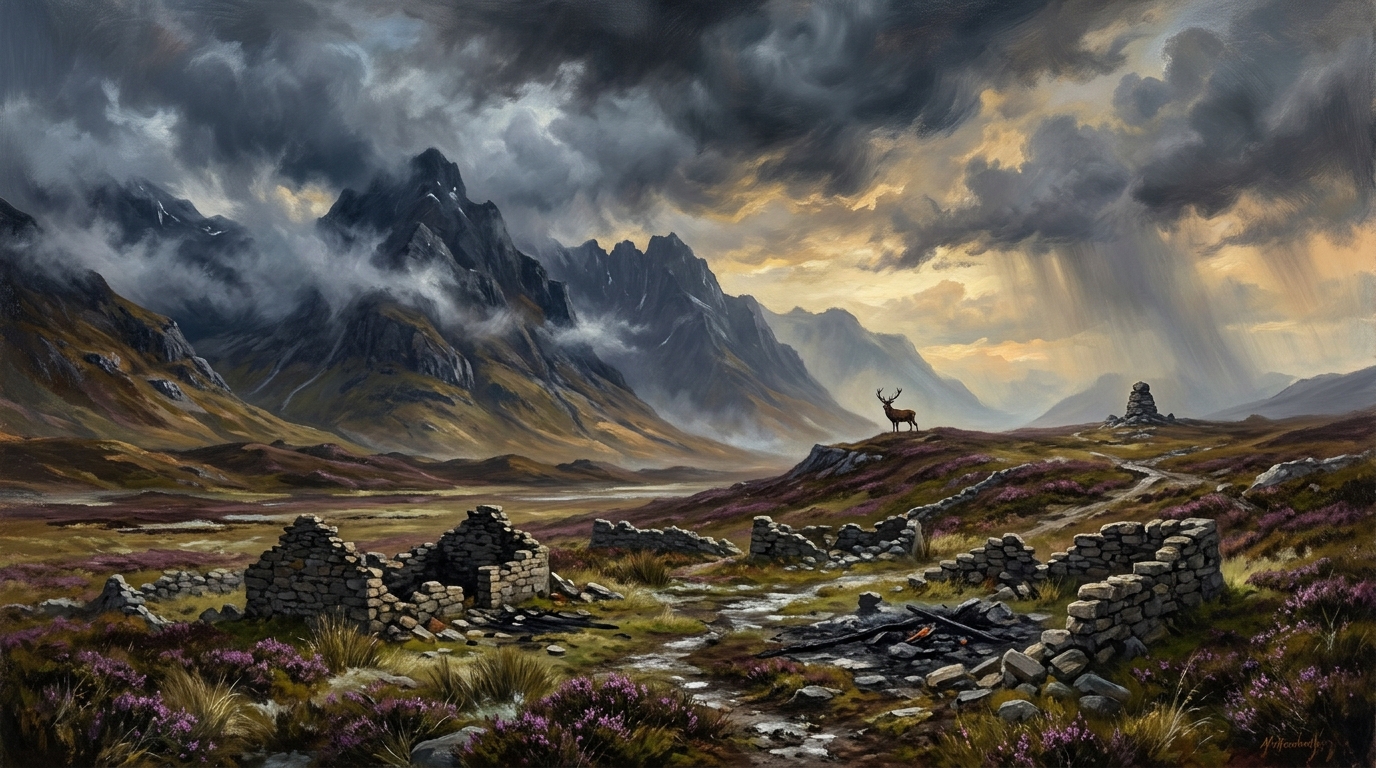
Few subjects generate stronger emotions in Scotland than the treatment of the Highland people during the centuries following the Revolution of 1688, the Union of 1707, the Jacobite Wars and the Highland Clearances. The reason is simple. These events are not controversies buried in forgotten archives. Their consequences can still be seen in Scotland's landscape, population distribution, language decline and continuing debates about land ownership. The story is not merely one of battles won and lost. It is a story of government power, military repression, forced migration, cultural disruption and economic transformation.
One of the most notorious events in Scottish history was the Massacre of Glencoe in February 1692. Members of the MacDonald clan were killed by government troops after providing them with hospitality for nearly two weeks. Contemporary estimates place the number murdered at about thirty eight, while additional people died from exposure after escaping into severe winter conditions. The event was later investigated by the Scottish Parliament, which described it as "murder under trust", a phrase that still carries enormous emotional weight in Scotland. Responsibility has long been associated with Sir John Dalrymple, Master of Stair acting under the authority of King William III, while the operation itself involved officers including Captain Robert Campbell of Glenlyon, Major Robert Duncanson and Captain Drummond. britannica.com ↗ glen-coe.com ↗ en.wikipedia.org ↗
What made Glencoe unique was not the scale of killing alone. Scotland's history contains larger battles and bloodier conflicts. Glencoe became infamous because of the violation of trust. Soldiers accepted food, shelter and protection from the very people they would later attack. Even historians who disagree on wider political interpretations generally acknowledge that the betrayal element is central to understanding why Glencoe occupies such a powerful place in Scottish memory. glen-coe.com ↗ lovetovisitscotland.com ↗
More than half a century later came the event that many regard as the decisive turning point in Highland history. On 16 April 1746 the Jacobite army led by Charles Edward Stuart met government forces commanded by William Augustus, Duke of Cumberland on Culloden Moor near Inverness. The Jacobites suffered a devastating defeat. Historical estimates place their losses at between 1,500 and 2,000 killed and wounded, while hundreds more were captured. The battle lasted less than an hour, yet its consequences transformed Highland Scotland. en.wikipedia.org ↗
The aftermath of Culloden remains one of the most controversial chapters in Scottish history. Accounts from the period describe wounded Jacobites being executed after the battle, prisoners facing harsh treatment and entire districts subjected to military control. Government forces moved through the Highlands searching for rebels and supporters. Estates were forfeited, prisoners transported and local populations brought under tighter state authority. These actions earned Duke of Cumberland the nickname "The Butcher", a title that has followed him ever since. robertson.org ↗ smartstep.blog ↗ sundaypost.com ↗
The government's objective extended beyond military victory. The defeat of the Jacobite army was followed by a programme of political and social restructuring. The British Parliament introduced legislation intended to weaken the clan system and increase direct state control. The Act of Proscription 1746 reinforced disarmament measures and restricted Highland dress. The associated Dress Act made traditional Highland attire illegal in many circumstances. At the same time, the Heritable Jurisdictions (Scotland) Act abolished many hereditary judicial powers previously exercised by clan chiefs and transferred them to institutions operating under Crown authority. These Acts were official government measures enacted in the wake of the Jacobite defeat. en.wikipedia.org ↗ en.wikipedia.org ↗ en.wikipedia.org ↗ legislation.gov.uk ↗
Supporters of these reforms argued that they brought greater legal uniformity, government stability and integration into the wider British state. Critics argued that they deliberately dismantled traditional Highland institutions and accelerated the decline of Gaelic culture. Regardless of interpretation, the significance of the legislation is not disputed. The relationship between Highland communities and government authority changed fundamentally after Culloden. en.wikipedia.org ↗ info.scot ↗
The destruction of the old clan order created conditions that would contribute to an even larger social upheaval. During the late eighteenth and nineteenth centuries the Highlands experienced the removals now known collectively as the Highland Clearances. These were not a single event but a series of policies across different regions and over many decades. Landowners increasingly concluded that sheep farming and other commercial activities generated greater profits than traditional tenant communities. The result was mass population displacement across large parts of northern Scotland. highlifehighland.com ↗ undiscoveredscotland.co.uk ↗
Families were removed from long-established holdings. Many were relocated to coastal settlements. Others moved to industrial centres. Great numbers emigrated overseas. Communities that had existed for centuries disappeared. Houses were often demolished or burned to prevent reoccupation. Historical accounts describe confusion, grief and hardship as people were forced to abandon homes, land and local connections built over generations. highlifehighland.com ↗ undiscoveredscotland.co.uk ↗
Among the most famous clearance regions was Sutherland. Historical sources indicate that approximately 15,000 people were removed from Sutherland estates during the principal clearance period. The policies became associated with figures including Patrick Sellar, William Young, Elizabeth Gordon, Countess of Sutherland, and George Leveson-Gower. Through their actions and decisions, vast areas of northern Scotland were transformed. undiscoveredscotland.co.uk ↗ en.wikipedia.org ↗
No individual became more controversial than Patrick Sellar. He was charged with offences including culpable homicide and wilful fire-raising arising from clearance operations in Strathnaver. Although acquitted, he became permanently associated with one of the most disputed episodes in Scottish history. To critics he embodied the human cost of clearance policies. To defenders he represented agricultural and economic modernisation. More than two centuries later, debate surrounding his role remains active. en.wikipedia.org ↗ highlifehighland.com ↗
The impact of the Clearances extended far beyond Sutherland. Similar pressures affected communities in Ross shire, Inverness shire, Caithness, Skye, Mull, Morvern, Lochaber and other Highland districts. Local populations contracted. Entire communities vanished from areas that had once been densely occupied by Highland standards. The consequences can still be seen in modern Scotland, where large tracts of land contain remarkably small resident populations despite evidence of much greater historical settlement. highlifehighland.com ↗ theorkneynews.scot ↗
The consequences were immense. Highland emigrants established communities throughout Canada, the United States, Australia and New Zealand. Today millions of people around the world trace ancestry to those migrations. The creation of a global Scottish diaspora stands among the most significant outcomes of the clearance era. Yet from the perspective of the Highlands themselves, that diaspora emerged from population loss on a scale rarely experienced elsewhere in Britain. theorkneynews.scot ↗ highlifehighland.com ↗
The weakening of Gaelic-speaking communities formed another lasting consequence. Population dispersal, economic pressures and social change contributed to language decline across many traditional Gaelic-speaking areas. Although efforts have been made to preserve and revive Gaelic the erosion of population in historic Gaelic heartlands remains a central factor in understanding the language's modern position.
Official concern regarding Highland conditions eventually led to major investigations. One of the most important was the Napier Commission of 1883-84, formally established to investigate the condition of crofters and cottars in the Highlands and Islands. The commission gathered extensive evidence regarding land use, tenancy conditions and the legacy of previous policies. Its testimony remains one of the most important official records available to historians studying Highland grievances and rural life in nineteenth-century Scotland.
Questions of responsibility remain fiercely contested. Some of the most controversial figures associated with these events were themselves Scottish. Sir John Dalrymple played a major role in the Glencoe affair. Patrick Sellar became synonymous with clearance operations. Powerful Scottish aristocrats approved or implemented many of the policies that altered Highland society. This reality complicates simplistic explanations based solely on nationality. The story involves governments, aristocrats, military authorities, economic interests and state institutions operating within the broader framework of Britain.
Nevertheless, for many descendants of those affected, the consequences matter more than the constitutional detail. People were killed at Glencoe. The Jacobite cause was crushed at Culloden. Parliamentary legislation weakened the clan system. Tens of thousands experienced displacement during the Clearances. Communities disappeared. Languages declined. Vast numbers left Scotland altogether. Those facts remain at the centre of modern historical debate. britannica.com ↗ en.wikipedia.org ↗ en.wikipedia.org ↗ undiscoveredscotland.co.uk ↗
In 2026 the legacy remains visible. Memorials stand at Glencoe, Culloden and Strathnaver. Debates continue regarding land reform, rural depopulation and concentrated land ownership. Historians continue to dispute motivations, responsibility and interpretation, but the existence of profound change is beyond serious argument. The Highlands that emerged from the nineteenth century were radically different from those that entered the eighteenth.
Whether viewed as state-building, repression, economic modernisation or national tragedy, these events left an enduring mark upon Scotland. Their story is preserved not only in archives, legislation and inquiries, but in depopulated glens, scattered communities and a global Scottish diaspora whose origins lie in one of the most transformative periods of history.
- Massacre of Glencoe, Encyclopaedia Britannica and parliamentary inquiry findings. britannica.com ↗ glen-coe.com ↗ en.wikipedia.org ↗
- Battle of Culloden, casualty estimates, commanders and battle details. en.wikipedia.org ↗
- Act of Proscription 1746 & The Dress Act 1746. Act of Proscription ↗ Dress Act ↗
- Heritable Jurisdictions (Scotland) Act 1746, official legislation. legislation.gov.uk ↗ en.wikipedia.org ↗
- Highland Clearances archive resources and educational records. highlifehighland.com ↗
- Patrick Sellar and Sutherland estate records. en.wikipedia.org ↗ undiscoveredscotland.co.uk ↗
- National Records of Scotland archival material on Jacobite prisoners, estate forfeitures and Highland administration. HM General Register House, Edinburgh
- Napier Commission Report (1884), evidence regarding crofting and Highland land conditions. Parliamentary Papers / C. 3980