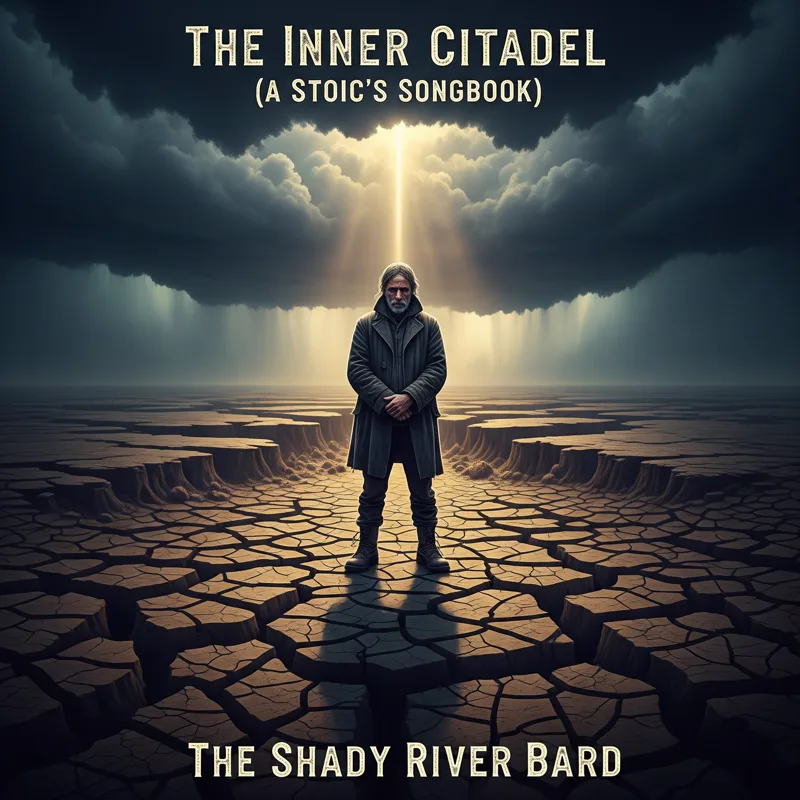
A Stoic's Songbook — Musical Meditations on Fortitude, Acceptance, and Universal Connection
In a world that increasingly feels chaotic, fractured, and beyond our control, where do we find the strength to stand? This album suggests the answer lies not in changing the external world, but in fortifying the self. Drawing directly from the ancient philosophy of Stoicism—specifically the writings of Marcus Aurelius, Epictetus, and Seneca—The Shady River Bard translates timeless principles into the vernacular of American folk, Delta blues, and roots storytelling.
This is not an album about hiding from reality. It is about building an "Inner Citadel"—a fortress of the will—that allows us to step back into the fire of modern life with courage, kindness, and unshakeable peace.
"When the external world fractures, the only ground that cannot be confiscated is the ground within. True sovereignty does not begin at the ballot box or the statehouse; it begins in the citadel of the mind."
Across albums such as The Fracture, Sold Cheap, and The Republic of Nobody, The Shady River Bard dissected the macroeconomic and institutional machinery of modern extraction. The Inner Citadel: A Stoic's Songbook represents an essential and deliberate pivot: from diagnostic critique of the outer world to psychological, spiritual, and moral self-defense.
The Ancient Stoic Trinity
Rome, 1st – 2nd Century CE
Marcus Aurelius, Epictetus & Seneca
The album synthesizes three distinct Stoic voices: Epictetus, the former slave who identified the vital dividing line between what is ours and what is not; Seneca, the playwright and statesman who confronted the urgency of mortality; and Marcus Aurelius, the Roman Emperor whose private diary (*Meditations*) wrestled with the burden of duty, betrayal, and maintaining an unshakeable inner retreat.
The Modern Cognitive Science Link
Stoicism is not cold detachment or emotional repression. As modern psychologists have established, Stoic philosophy is the direct intellectual forebear of Cognitive Behavioral Therapy (CBT) and Rational Emotive Behavior Therapy (REBT). Both rest on Epictetus's fundamental insight: "People are not disturbed by things, but by the view they take of them."
The Metaphor of the Citadel
Popularized by philosopher Pierre Hadot, the "Inner Citadel" is the invulnerable fortress of the ruling faculty (the hegemonikon). No drought, market crash, political deceit, or physical affliction can breach this fortress unless the sovereign individual surrenders the keys from within.
"The soul becomes dyed with the color of its thoughts. Build the citadel not to abandon the world, but to walk through its fires without burning."
Section II
The 5 Stoic Pillars & Thematic Matrices
Core philosophical tenets translated into the living soil of American roots music
Amor Fati is not passive resignation or defeated shrugs. It is the active, passionate embrace of reality as it unfolds. When a drought scorches a multi-generational harvest, cursing the sky produces no rain. True peace emerges from seeing that destruction clears the ground for the next emergence.
Musical Manifestation:
Heard in "The Field Must Burn" and "Whatever Comes": the cracked clay, the burning stalk, and the quiet shift from rage to tranquil readiness.
The foundational Stoic teaching categorizes all phenomena into two distinct spheres: what is within our power (our judgments, intentions, desires, and integrity) and what is outside our power (the economy, weather, politics, rumors, and other people's opinions). Mental suffering originates almost entirely from confusing the two.
Musical Manifestation:
Heard in "Just My Own Two Hands" and "The Unseen Storm": the carpenter ignoring the noise of capitals to plane the pine board smooth, and the lone soul holding an unshakeable inner compass against gossip.
"The mind adapts and converts to its own purposes the obstacle to our acting. The impediment to action advances action. What stands in the way becomes the way." A blazing fire consumes whatever is thrown upon it, turning obstacles into light and heat.
Musical Manifestation:
Heard in "The Mason's Wall" and "Rust and Bone": heavy overdriven Telecasters, slide guitar grit, and hard-bitten American blues honoring the physical resistance that creates iron will.
Memento Mori is never morbid or fatalistic in Stoic thought; it is the ultimate sharpener of purpose. Remembering that life is finite liberates the soul from trivial squabbles, status anxiety, and procrastination. It reveals that the only moment we ever truly possess is the present breath.
Musical Manifestation:
Heard in "The Final Acre", "The Unwritten Page", and "Dust to Stars": delicate fingerpicking, mournful cello, and intimate ballads looking upon life's boundary stones with quiet gratitude.
Sympatheia proves that Stoicism is fundamentally communal. We are not isolated atoms; we are limbs of a single cosmic body. To harm another is to harm oneself; to show compassion is to honor the fabric of reality. This principle builds the essential bridge to the Bard's broader themes of healing societal divides.
Musical Manifestation:
Heard in "The River Runs Through All" and "Common Ground (The Unlikely Handshake)": soaring fiddles, warm harmonies, and an anthemic celebration of the shared human condition.
Building character and revealing hidden strengths through struggle.
Memento Mori
Remember Death; reflection on mortality.
An aging farmer contemplating life's end; awareness of life's brevity.
Living more fully and virtuously with intention and purpose.
Dichotomy of Control
Focus on what is controllable (thoughts, actions); release the rest.
A worker overwhelmed by economic shifts; a person facing unjust criticism.
Finding inner peace by distinguishing between internal and external.
Sympatheia
Universal Connection; all things are interwoven and interdependent.
Bridging generational or political divides; shared human experience.
Fostering unity, empathy, and collective resilience.
Section III
4-Act Narrative Architecture & Song Roadmap
The 13-track progressive journey of psychological and spiritual self-defense
Act I: Tracks 01–04The Grounding
Amor Fati & Control
Finding internal ballast. Through stories of farmers facing drought and craftsmen ignoring the noise of kings, we learn the peace that comes from accepting what we cannot change and mastering what we can.
Act II: Tracks 05–07The Forge
The Obstacle is the Way
Facing the fire. The music shifts to a grittier, blues-rock sound to demonstrate how adversity, physical wear, and economic struggle are not impediments to life, but the very forge of character.
Act III: Tracks 08–10The Reckoning
Memento Mori
Confronting mortality. Far from morbid fatalism, these intimate acoustic ballads use the certainty of death to dissolve trivial anxieties and illuminate the sacred necessity of living virtuously right now.
Act IV: Tracks 11–13The Unbroken Thread
Sympatheia & Synthesis
Universal interconnectedness. Expanding from the individual soul to the collective human family, celebrating the common ground and shared affinity that binds all people and nature together.
The acoustic return: fingerpicking, Delta slide, and porch-side storytelling
Acoustic Foundations
Marks a profound return to the Bard's acoustic roots: intricate Martin D-28 fingerpicking, weeping harmonica swells, upright bass, and gentle brush-stick drums designed for listening and quiet reflection.
The Forge Shift
In Act II, the sound combusts into raw Delta slide guitar, overdriven Telecasters, and stomping percussion, reflecting the physical grind of work, illness, and perseverance.
Anthemic Reconnection
Act IV blossoms into expansive Americana, incorporating sweet fiddle lines, warm three-part harmonies, and soaring choruses that translate personal discipline into collective unity.
Artistic & Historical Touchstones
Musically echoes the weathered authenticity of Doc Watson, the contemplative desolation of Townes Van Zandt, and the patient, front-porch sincerity of Mississippi John Hurt. The guitar chords and open tunings ground high philosophical doctrine in the working hands of American craftsmen.
Section V
Detailed Track Explorations
Complete lyrics, guitar chords, performance notes, and video liner notes
Act I: The Grounding
Amor Fati
Track 01 of 13
Tempo: Slow, Deliberate
01. The Field Must Burn
Style: Contemplative Folk, Delta Blues influence • Mood: Melancholy, Resigned, Reflective, Somber but ultimately peaceful
"The Field Must Burn" serves as the album's opening meditation on the Stoic principle of Amor Fati. It tells the story of a farmer witnessing his life's work decimated by a relentless drought. The narrative follows his emotional journey from initial despair and anger at an uncaring sky to a state of profound, if somber, acceptance. He realizes that some forces are beyond his control, and the only path forward is to embrace the harsh reality, understanding that destruction is a necessary prelude to rebirth. The song sets a contemplative and melancholic tone for the album, grounding an ancient philosophy in the tangible soil of human struggle.
A sparse and contemplative folk song with a heavy delta blues influence. The mood is melancholy, reflective, and deeply resigned. A raw, weary, and weathered lead male baritone vocal tells a story of loss and acceptance. The primary instrument is a simple, clean, fingerpicked acoustic guitar, accompanied by distant, mournful harmonica swells.
Official Video Liner Notes
Sometimes, the hardest thing to do is simply accept what we cannot change. This song introduces the ancient concept of Amor Fati (Love of Fate) through the eyes of a farmer facing a devastating drought. He moves from anger at the sky to a grim, profound peace, realizing that nature’s cycle is beyond his control. It is a meditation on letting go of the outcome to find peace in the present.
@TheShadyRiverBard
Sometimes strength isn't fighting back, but accepting what you can't change. This one is about that grim peace. #AmorFati #TheInnerCitadel #NewMusic
Plaintext
From the dust and the ash, a new start waits. Our new song, "The Field Must Burn," is out now. #FolkMusic #Stoicism #ShadyRiverBard
Plaintext
"You can't pray the rain on down / To save this thirsty, tired town." A line from our new track about letting go of the things beyond our control. #NewSingle #Lyrics
[Intro]
Am G C F
Am G Am
[Verse 1]
Am G
The cracked clay is a broken plate
C F
Beneath a sun of burnished brass
Am G
The corn stalks, just brittle bone
E Am
Like promises that couldn't last
Am G
My father's sweat is in this ground
C F
His father's hope in every seed
Am G
Now all their work just blows around
E Am
A bitter dust, a broken creed
[Chorus]
C G
You can shake your fist and curse the sky
Am F
You can fall down on your knees and cry
C G
But you can't pray the rain on down
E Am
To save this thirsty, tired town
C G
So let the fire climb up high
Am F
And watch the worthless harvest die
C G
I finally see with sun-scorched eyes
E Am
The field must burn to rise
[Instrumental]
Am G C F
Am G Am
[Verse 2]
Am G
I walked the rows at break of day
C F
Remembered how the green would climb
Am G
I bargained with what I can't sway
E Am
And tried to turn the tide of time
Am G
But leaning on this fence post now
C F
There's no more anger left to spend
Am G
A quiet settles on my brow
E Am
This is the start, and not the end
[Chorus]
C G
You can shake your fist and curse the sky
Am F
You can fall down on your knees and cry
C G
But you can't pray the rain on down
E Am
To save this thirsty, tired town
C G
So let the fire climb up high
Am F
And watch the worthless harvest die
C G
I finally see with sun-scorched eyes
E Am
The field must burn to rise
[Bridge]
F C
There's a life that sleeps beneath the ash
G C
There's a strength the roots still hold
F C
This pain is just a lightning flash
G E
A story that is getting old
[Chorus]
C G
No more shakin' fists and cursing skies
Am F
No more falling down with pleading cries
C G
'Cause you can't pray the rain on down
E Am
To save this thirsty, tired town
C G
So let the fire climb up high
Am F
And watch the worthless harvest die
C G
I finally see with clearin' eyes
E Am
The field must burn to rise
[Outro]
Am G C F
Yeah, the field must burn
Am G Am
.....Mmm, let it burn
[Style: Contemplative Folk, Delta Blues influence]
[Mood: Melancholy, Resigned, Reflective, Somber but ultimately peaceful]
[Tempo: Slow, Deliberate]
[Instrumentation: Sparse Acoustic Guitar, Light Harmonica swells]
[Vocalist: Male, Raw, Weary, Weathered, Baritone]
[Production: Raw, Analog, Organic]
[Intro]
[acoustic guitar with slow, deliberate fingerpicking]
[sparse, distant harmonica wail]
[Verse]
The cracked clay is a broken plate
Beneath a sun of burnished brass
The corn stalks, just brittle bone
Like promises that couldn't last
My father's sweat is in this ground
His father's hope in every seed
Now all their work just blows around
A bitter dust, a broken creed
[Chorus]
[vocals become slightly stronger, more resolute]
You can shake your fist and curse the sky
You can fall down on your knees and cry
But you can't pray the rain on down
To save this thirsty, tired town
So let the fire climb up high
And watch the worthless harvest die
I finally see with sun-scorched eyes
The field must burn to rise
[Instrumental]
[acoustic guitar solo, simple and melodic]
[harmonica takes a mournful lead]
[Verse]
I walked the rows at break of day
Remembered how the green would climb
I bargained with what I can't sway
And tried to turn the tide of time
But leaning on this fence post now
There's no more anger left to spend
A quiet settles on my brow
This is the start, and not the end
[Chorus]
[vocals are firm, full of grim acceptance]
You can shake your fist and curse the sky
You can fall down on your knees and cry
But you can't pray the rain on down
To save this thirsty, tired town
So let the fire climb up high
And watch the worthless harvest die
I finally see with sun-scorched eyes
The field must burn to rise
[Bridge]
[music lifts slightly, a touch less melancholy]
There's a life that sleeps beneath the ash
There's a strength the roots still hold
This pain is just a lightning flash
A story that is getting old
[Chorus]
[vocals are powerful, a statement of principle]
No more shakin' fists and cursing skies
No more falling down with pleading cries
'Cause you can't pray the rain on down
To save this thirsty, tired town
So let the fire climb up high
And watch the worthless harvest die
I finally see with clearin' eyes
The field must burn to rise
[Outro]
[acoustic guitar fingerpicking slows down]
[final harmonica note fades into silence]
Yeah, the field must burn
.....Mmm, let it burn
[End]
Act I: The Grounding
Amor Fati
Track 02 of 13
Tempo: Mid-tempo, steady walking pace
02. Whatever Comes
Style: Gritty Delta Blues, Acoustic Blues Rock, Americana • Mood: Resolute, Defiant, Grounded, Unflinching, Stoic
"Whatever Comes" expands on the album's theme of Amor Fati, shifting from the quiet resignation of the first track to an anthem of courageous acceptance. The song presents a series of vignettes—losing a job, receiving a bad diagnosis, facing personal loss—that represent life's unpredictable and often harsh turns. Instead of succumbing to despair, the narrator adopts a resolute stance, choosing to face each challenge as part of a larger, unavoidable pattern. Set to a gritty, mid-tempo Delta Blues rhythm, the song embodies a more active and defiant form of Stoic resilience, finding strength not in changing fate, but in the unwavering will to meet it head-on.
Gritty Delta Blues with a driving Americana feel. A steady, mid. The mood is resolute, defiant, and unflinching. A powerful, weathered lead male baritone sings with grounded conviction.
Official Video Liner Notes
Life rarely asks for our permission before it changes course. This track shifts the focus to active resilience. Whether it is a pink slip, a diagnosis, or a sudden loss, the narrative explores the power of standing your ground. It isn't about liking the hardship; it's about the refusal to flinch in front of it. A declaration that we can handle the weight of our own lives.
@TheShadyRiverBard
Life throws its punches. The trick is to stand your ground and not flinch. Our new song "Whatever Comes" is about that fight. #Resilience #BluesMusic #TheInnerCitadel
Plaintext
"'Cause every scar and every grace / Is just the pattern taking place." A line from our new track about finding strength in acceptance. #WhateverComes #NewMusic #ShadyRiverBard
Plaintext
For anyone facing the unexpected today. This one's for you. #AmorFati #Stoic #NewFolk
[Intro]
(Gritty acoustic slide guitar riff in Am)
Am G Am
Am G Am
[Verse 1]
Am C
Pink slip paper in my hand
G Am
The foreman wouldn't meet my eye
Am C
Said the bottom line is wearin' thin
G Am
No room for men like you and I
F C
For forty years of calloused skin
G Am
A handshake and a "best of luck"
F C
A chapter ends, a new begins
G E7
Whether you're ready or you're stuck
[Chorus]
F C
So let the river rise and fall
G Am
I'll stand my ground and meet it all
F C
'Cause every scar and every grace
G Am
Is just the pattern taking place
F C
I'll look it right square in the face
G Am
Whatever comes
[Instrumental]
Am G Am
Am G Am
[Verse 2]
Am C
The white-coat doctor, sober-faced
G Am
Spread shadows out across the screen
Am C
A map of what cannot be erased
G Am
The landscape of the unforeseen
F C
He talked of odds and battle plans
G Am
But all I heard was rushing wind
F C
Some things are out of any hands
G E7
No matter how you might pretend
[Chorus]
F C
So let the river rise and fall
G Am
I'll stand my ground and meet it all
F C
'Cause every scar and every grace
G Am
Is just the pattern taking place
F C
I'll look it right square in the face
G Am
Whatever comes
[Guitar Solo]
(Raw, emotional slide guitar solo over the verse chords: Am, C, G, Am / F, C, G, E7)
[Verse 3]
Am C
The front door lock don't sound the same
G Am
The kitchen chair sits cold and bare
Am C
I find myself whisperin' your name
G Am
To silence hanging in the air
F C
The world don't stop to feel your pain
G Am
The sun still burns, the earth still turns
F C
You learn to walk inside the rain
G E7
Another lesson the heart learns
[Chorus]
F C
So let the river rise and fall
G Am
I'll stand my ground and meet it all
F C
'Cause every scar and every grace
G Am
Is just the pattern taking place
F C
I'll look it right square in the face
G Am
Whatever comes
[Outro]
(Gritty acoustic slide guitar riff repeats)
Am G Am
Yeah, whatever comes...
Am G Am
Bring it on... whatever comes.
(Single, resonant Am chord to end)
[Style: Gritty Delta Blues, Acoustic Blues Rock, Americana]
[Mood: Resolute, Defiant, Grounded, Unflinching, Stoic]
[Tempo: Mid-tempo, steady walking pace]
[Instrumentation: Gritty acoustic slide guitar, driving acoustic rhythm guitar, sparse bass, simple kick-snare drum beat]
[Vocalist: Male, Raw, Powerful chest voice, Weathered Baritone]
[Production: Analog, Warm, Gritty]
[Intro]
[gritty, determined acoustic slide guitar riff]
[Verse]
Pink slip paper in my hand
The foreman wouldn't meet my eye
Said the bottom line is wearin' thin
No room for men like you and I
For forty years of calloused skin
A handshake and a "best of luck"
A chapter ends, a new begins
Whether you're ready or you're stuck
[Chorus]
[vocals become a powerful, resolute declaration]
So let the river rise and fall
I'll stand my ground and meet it all
'Cause every scar and every grace
Is just the pattern taking place
I'll look it right square in the face
Whatever comes
[Instrumental]
[gritty acoustic slide guitar riff]
[Verse]
The white-coat doctor, sober-faced
Spread shadows out across the screen
A map of what cannot be erased
The landscape of the unforeseen
He talked of odds and battle plans
But all I heard was rushing wind
Some things are out of any hands
No matter how you might pretend
[Chorus]
[vocals are powerful, a resolute declaration]
So let the river rise and fall
I'll stand my ground and meet it all
'Cause every scar and every grace
Is just the pattern taking place
I'll look it right square in the face
Whatever comes
[Guitar Solo]
[Raw, emotional, slightly overdriven acoustic slide guitar solo, more melodic than flashy, sounds like a human voice]
[Verse]
The front door lock don't sound the same
The kitchen chair sits cold and bare
I find myself whisperin' your name
To silence hanging in the air
The world don't stop to feel your pain
The sun still burns, the earth still turns
You learn to walk inside the rain
Another lesson the heart learns
[Chorus]
[vocals at their most powerful and defiant]
So let the river rise and fall
I'll stand my ground and meet it all
'Cause every scar and every grace
Is just the pattern taking place
I'll look it right square in the face
Whatever comes
[Outro]
[gritty acoustic slide guitar riff repeats and fades slightly]
Yeah, whatever comes...
[Vocal Ad-lib: Bring it on... whatever comes.]
[single, resonant chord ends the song abruptly]
[End]
Act I: The Grounding
Dichotomy of Control
Track 03 of 13
Tempo: Mid-tempo, steady, reliable rhythm
03. Just My Own Two Hands
Style: Grounded Country Blues, Americana Folk • Mood: Resolute, Calm, Centered, Purposeful
"Just My Own Two Hands" is the practical heart of the album's first act, a direct musical embodiment of the Stoic Dichotomy of Control. The song tells the story of a craftsman or blue-collar worker feeling overwhelmed by the relentless chaos of the modern world—political shouting, economic instability, and endless bad news. He finds his salvation not by trying to solve the world's problems, but by deliberately narrowing his focus to what is within his immediate power: his work, his integrity, and the tangible results of his own effort. Set to a steady, reliable country-blues rhythm, the track is a calming anthem for finding peace and purpose amidst turmoil by anchoring oneself to the tangible and controllable.
Grounded Country Blues with an Americana folk feel. A steady, reliable mid, rhythmic acoustic guitar. The mood is calm, centered, and purposeful. A clear and resolute lead male baritone sings with simple, honest conviction.
Official Video Liner Notes
In a world deafened by political shouting and global anxieties, where can we find peace? This song answers with the Dichotomy of Control. The narrator, a craftsman, deliberately turns away from the chaos of the screen to focus on the wood and tools on his bench. It is a tribute to the sanity found in doing good work within your own small sphere of influence.
@TheShadyRiverBard
In a world full of noise, what can you actually control? Maybe it's closer than you think. Our new song is about finding that center. #DichotomyOfControl #TheInnerCitadel
Plaintext
For everyone who finds their peace in their work. A song about the power of your own two hands. #Craftsman #CountryBlues #ShadyRiverBard
Plaintext
"'The only truth I understand / Is held right here within my soul.'" A line from our new song, "Just My Own Two Hands." #NewMusic #Lyrics #Stoicism
[Intro]
G C G D
G C G D G
[Verse 1]
G C
The screen is on, the shouting starts
G D
About some bill I'll never read
G C
The talking heads all play their parts
G D G
To plant a different kind of seed
C G
Of worry 'bout some foreign shore
D G
Of fear about the coming years
C G
And I don't know what I'm angry for
D
But I can feel the rising fears
[Chorus]
C G
But I can't steer this mighty ship
D G
Or heal the world with words I've said
C G
I can't un-poison every sip
D
Or fix the path that lies ahead
C G
The only truth I understand
D Em
Is held right here within my soul
C G
I'll do the good work that I can
D G
With just my own two hands' control
[Instrumental]
G C G D
G C G D G
[Verse 2]
G C
The headlines tell of rising tides
G D
The market dips, the market soars
G C
A fragile peace somewhere abides
G D G
While others fight in futile wars
C G
And I could let it drain my soul
D G
A ghost in my own house to be
C G
But I've got a different goal
D
To focus on what's in front of me
[Chorus]
C G
'Cause I can't steer this mighty ship
D G
Or heal the world with words I've said
C G
I can't un-poison every sip
D
Or fix the path that lies ahead
C G
The only truth I understand
D Em
Is held right here within my soul
C G
I'll do the good work that I can
D G
With just my own two hands' control
[Bridge]
C G
The smell of coffee, metal, wood
D G
The simple, honest, clean-drawn line
C G
This little patch of understood
D
Is sacred, and it's truly mine
[Guitar Solo]
(A clean, melodic acoustic guitar solo over the chorus chords, not flashy but purposeful and clear)
[Chorus]
C G
No, I can't steer this mighty ship
D G
Or heal the world with words I've said
C G
I can't un-poison every sip
D
Or fix the path that lies ahead
C G
The only truth I understand
D Em
Is held right here within my soul
C G
I'll do the good work that I can
D G
With just my own two hands' control
[Outro]
C G D G
Yeah, just my own two hands
C G D G
......It's all I understand
(Steady acoustic strumming fades out)
[Style: Grounded Country Blues, Americana Folk]
[Mood: Resolute, Calm, Centered, Purposeful]
[Tempo: Mid-tempo, steady, reliable rhythm]
[Instrumentation: Clean Acoustic Guitar, simple bass line, gentle brush-stick drums]
[Vocalist: Male, Clear, Calm, Centered, Baritone]
[Production: Clean, Warm, Uncluttered]
[Intro]
[steady, rhythmic acoustic strumming, like a reliable heartbeat]
[Verse]
The screen is on, the shouting starts
About some bill I'll never read
The talking heads all play their parts
To plant a different kind of seed
Of worry 'bout some foreign shore
Of fear about the coming years
And I don't know what I'm angry for
But I can feel the rising fears
[Chorus]
[vocals become a confident, simple statement of fact]
But I can't steer this mighty ship
Or heal the world with words I've said
I can't un-poison every sip
Or fix the path that lies ahead
The only truth I understand
Is held right here within my soul
I'll do the good work that I can
With just my own two hands' control
[Instrumental]
[steady acoustic strumming, a simple melodic guitar line enters]
[Verse]
The headlines tell of rising tides
The market dips, the market soars
A fragile peace somewhere abides
While others fight in futile wars
And I could let it drain my soul
A ghost in my own house to be
But I've got a different goal
To focus on what's in front of me
[Chorus]
[vocals are clear, calm, and resolute]
'Cause I can't steer this mighty ship
Or heal the world with words I've said
I can't un-poison every sip
Or fix the path that lies ahead
The only truth I understand
Is held right here within my soul
I'll do the good work that I can
With just my own two hands' control
[Bridge]
[music becomes slightly more intimate and quiet]
The smell of coffee, metal, wood
The simple, honest, clean-drawn line
This little patch of understood
Is sacred, and it's truly mine
[Guitar Solo]
[A clean, melodic acoustic guitar solo, not flashy, every note feels intentional and purposeful]
[Chorus]
[vocals are strong and centered, a final affirmation]
No, I can't steer this mighty ship
Or heal the world with words I've said
I can't un-poison every sip
Or fix the path that lies ahead
The only truth I understand
Is held right here within my soul
I'll do the good work that I can
With just my own two hands' control
[Outro]
[steady acoustic strumming continues]
Yeah, just my own two hands
......It's all I understand
[steady strumming fades to silence]
[End]
Act I: The Grounding
Dichotomy of Control
Track 04 of 13
Tempo: Very Slow, Sparse
"The Unseen Storm" concludes the first act of the album with a powerful and defiant take on the Dichotomy of Control. The song grapples with the emotional weight of unjust criticism and public opinion. Instead of finding a vulnerable, quiet peace, the narrator takes a resolute and unflinching stance. He recognizes the gossip and judgment as an external force he cannot control and makes a powerful declaration of his own integrity and character. Musically, the song creates a compelling contrast, setting a raw, powerful, and weathered vocal against a sparse, contemplative folk arrangement, embodying the concept of unshakeable inner strength amidst outer chaos.
Reputation is a thing we cannot control, yet we let it rule us. This song serves as a shield against the "unseen storm" of gossip and public opinion. The narrator recognizes that what others say is merely wind; his character is the only flame he needs to tend. A song for anyone who has ever felt the sting of a false word and chosen integrity over argument.
@TheShadyRiverBard
[Intro]
(Delicate, slow fingerpicking)
Am G C F
Am G Am
[Verse 1]
Am G
The whispers fall like freezing rain
C F
A bitter wind of "have-you-heard"
Am G
You feel the turning of the vane
E Am
On every careless, cutting word
Am G
They build a you that isn't you
C F
With stones of envy and of doubt
Am G
And there ain't a thing that you can do
E Am
To keep the rising water out
[Chorus]
F C
But that's an unseen storm out there
G C
A war that's happening outside my soul
F C
Their words are only empty air
G Am
A thing I never can control
F C
My own true north is all I need
G C
The quiet voice that knows my name
F C
Let them plant their bitter seed
G Am
I'll tend my own small flame
[Instrumental]
Am G C F
Am G Am
[Verse 2]
Am G
You want to scream, you want to fight
C F
Correct the course of every lie
Am G
And stand all day and through the night
E Am
With proof to show them how they're wrong and why
Am G
But you'd be arguing with the tide
C F
Or shouting sermons at the wind
Am G
There is no safer place to hide
E Am
Than in the comfort of your own skin
[Chorus]
F C
'Cause that's an unseen storm out there
G C
A war that's happening outside my soul
F C
Their words are only empty air
G Am
A thing I never can control
F C
My own true north is all I need
G C
The quiet voice that knows my name
F C
Let them plant their bitter seed
G Am
I'll tend my own small flame
[Bridge]
C G
The thunder rolls, the winds may blow
Dm Am
But in this quiet room I find
C G
The only truth I have to know
E
Is I'm the master of my mind
[Chorus]
F C
So let the unseen storm rage on
G C
That war is happening outside my soul
F C
Their words are gone as quick as dawn
G Am
A thing I never will control
F C
My own true north is all I need
G C
The quiet voice that knows my name
F C
Let them plant their bitter seed
G Am
I'll tend my own small flame
[Outro]
(Delicate, slow fingerpicking resumes and fades)
Am G C F
Am G Am
...My own small flame.
[Style: Intimate Contemplative Folk, Singer-Songwriter, Acoustic Ballad]
[Mood: Resolute, Defiant, Grounded, Unflinching, Stoic]
[Tempo: Very Slow, Sparse]
[Instrumentation: Delicate fingerpicked acoustic guitar]
[Vocalist: Male, Raw, Powerful chest voice, Weathered Baritone]
[Production: Minimalist, Raw, Intimate]
[Intro]
[sparse, delicate fingerpicked acoustic guitar, lots of space between notes]
[Verse]
[vocals are firm and grounded, a clear statement]
The whispers fall like freezing rain
A bitter wind of "have-you-heard"
You feel the turning of the vane
On every careless, cutting word
They build a you that isn't you
With stones of envy and of doubt
And there ain't a thing that you can do
To keep the rising water out
[Chorus]
[vocals become a powerful, resolute declaration]
But that's an unseen storm out there
A war that's happening outside my soul
Their words are only empty air
A thing I never can control
My own true north is all I need
The quiet voice that knows my name
Let them plant their bitter seed
I'll tend my own small flame
[Instrumental]
[delicate, melodic fingerpicking]
[Verse]
[vocals are firm and grounded, a clear statement]
You want to scream, you want to fight
Correct the course of every lie
And stand all day and through the night
With proof to show them how they're wrong and why
But you'd be arguing with the tide
Or shouting sermons at the wind
There is no safer place to hide
Than in the comfort of your own skin
[Chorus]
[vocals become a powerful, resolute declaration]
'Cause that's an unseen storm out there
A war that's happening outside my soul
Their words are only empty air
A thing I never can control
My own true north is all I need
The quiet voice that knows my name
Let them plant their bitter seed
I'll tend my own small flame
[Bridge]
[vocals are a clear statement of principle, strong and unwavering]
The thunder rolls, the winds may blow
But in this quiet room I find
The only truth I have to know
Is I'm the master of my mind
[Chorus]
[vocals are at their most powerful and defiant]
So let the unseen storm rage on
That war is happening outside my soul
Their words are gone as quick as dawn
A thing I never will control
My own true north is all I need
The quiet voice that knows my name
Let them plant their bitter seed
I'll tend my own small flame
[Outro]
[delicate, slow fingerpicking resumes and fades]
...My own small flame.
[End]
Act II: The Forge
The Obstacle is the Way
Track 05 of 13
Tempo: Mid-tempo, Driving Rhythm
05. The Mason's Wall
Style: Gritty Blues Rock, Southern Rock, Americana Rock • Mood: Determined, Gritty, Powerful, Unrelenting, Anthemic
Kicking off the album's second act, "The Mason's Wall" translates the Stoic principle "The Obstacle is the Way" into a powerful blues-rock anthem. The song uses the metaphor of a mason confronting an insurmountable wall to explore how life's greatest barriers are not merely impediments, but the very tools by which character is forged. The narrator moves from initial despair to embracing the struggle, realizing that the act of lifting each stone builds the strength needed to continue. The track's driving rhythm and gritty electric guitar mark a deliberate sonic shift for the album, embodying the heat, pressure, and transformative power of the forge.
Musical Blueprint & Instrumentation
Heavy overdriven electric guitar riff, pounding drums, driving bassline • Male, Powerful, Raw, Soulful, Bluesy Shout, Baritone
Gritty, mid. The foundation is a heavy, driving drum beat and a powerful, overdriven electric guitar riff. The mood is determined, unrelenting, and gritty. A raw, powerful, and soulful male baritone sings with the force of a man engaged in hard labor.
Official Video Liner Notes
We often see obstacles as interruptions to our life. This song argues that the obstacle is the life. Exploring the principle "The Obstacle is the Way," the lyrics follow a mason who realizes the heavy stones blocking his path are actually the material he needs to build his character. It is a gritty anthem for transforming struggle into strength.
@TheShadyRiverBard
The obstacle in the path *is* the path. A new song about finding strength in the struggle. #TheObstacleIsTheWay #BluesRock #TheInnerCitadel
Plaintext
We are all masons. We are all building something with the stones life throws in our way. #TheMasonsWall #NewMusic #ShadyRiverBard
Plaintext
'Every rock I have to lift / Puts fire burning in my chest.' Kicking off Act II of our new album with some grit. #RockMusic #Stoicism
[Intro]
(Heavy, gritty electric guitar riff in Em)
Em G A Em
Em G A Em
[Verse 1]
Em
They put a wall up in my way
G
A thousand stones of "no you can't"
A
The sun beat down on it all day
Em
A shadow where I'd meant to plant
Em
Yeah, first I cursed and then I cried
G
And looked for cracks to squeeze on through
A
I beat it 'til my knuckles cried
Em
And didn't know what else to do
[Chorus]
G D
But this ain't the thing that blocks the path
A Em
This is the quarry and the stone
G D
It ain't the focus of God's wrath
A Em
It's building me from skin and bone
G D
I am the mason of the wall
A Em
And with each stone I stand up tall
G D
My spirit's forged in sweat and fall
A
Yeah, I'm the mason of the wall
[Instrumental]
Em G A Em
[Verse 2]
Em
The easy path is overgrown
G
It disappeared behind the haze
A
I'm left here with these blocks of stone
Em
To occupy my working days
Em
So I picked up my calloused hands
G
Mixed mortar with my sweat and grit
A
The world can keep its promised lands
Em
'Cause I'm still building, bit by bit
[Chorus]
G D
'Cause this ain't the thing that blocks the path
A Em
This is the quarry and the stone
G D
It ain't the focus of God's wrath
A Em
It's building me from skin and bone
G D
I am the mason of the wall
A Em
And with each stone I stand up tall
G D
My spirit's forged in sweat and fall
A
Yeah, I'm the mason of the wall
[Guitar Solo]
(Gritty, soulful, blues-rock electric guitar solo over Em - G - A - Em progression. It should feel like a struggle and a release.)
[Bridge]
C
The strain that breaks your back in two
G
Is the same that makes the muscle grow
D
The hardest thing they make you do
Em
Is the only way you'll ever know
[Chorus]
G D
No, this ain't the thing that blocks the path
A Em
This is the quarry and the stone
G D
It ain't the focus of God's wrath
A Em
It's building me from skin and bone
G D
I am the mason of the wall
A Em
And with each stone I stand up tall
G D
My spirit's forged in sweat and fall
A
Yeah, I'm the mason of the wall
[Outro]
(Main riff gets heavier, more rhythmic)
Em G A Em
The stone! The fire! The skin! The bone!
Em G A Em
The stone! The fire! The skin! The bone!
(Ends on a hard, final Em power chord)
[Style: Gritty Blues Rock, Southern Rock, Americana Rock]
[Mood: Determined, Gritty, Powerful, Unrelenting, Anthemic]
[Tempo: Mid-tempo, Driving Rhythm]
[Instrumentation: Heavy overdriven electric guitar riff, pounding drums, driving bassline]
[Vocalist: Male, Powerful, Raw, Soulful, Bluesy Shout, Baritone]
[Production: Gritty, Saturated, Live feel]
[Intro]
[heavy, crunchy, overdriven electric guitar riff with a stomp-clap feel]
[driving, heavy drum beat kicks in]
[Verse]
[vocals are a powerful, raw, bluesy shout]
They put a wall up in my way
A thousand stones of "no you can't"
The sun beat down on it all day
A shadow where I'd meant to plant
Yeah, first I cursed and then I cried
And looked for cracks to squeeze on through
I beat it 'til my knuckles cried
And didn't know what else to do
[Chorus]
[vocals soar, anthemic and powerful]
[heavy power chords on the guitar]
But this ain't the thing that blocks the path
This is the quarry and the stone
It ain't the focus of God's wrath
It's building me from skin and bone
I am the mason of the wall
And with each stone I stand up tall
My spirit's forged in sweat and fall
Yeah, I'm the mason of the wall
[Instrumental]
[main electric guitar riff]
[Verse]
[vocals are raw and determined]
The easy path is overgrown
It disappeared behind the haze
I'm left here with these blocks of stone
To occupy my working days
So I picked up my calloused hands
Mixed mortar with my sweat and grit
The world can keep its promised lands
'Cause I'm still building, bit by bit
[Chorus]
[vocals soar, anthemic and powerful]
[heavy power chords on the guitar]
'Cause this ain't the thing that blocks the path
This is the quarry and the stone
It ain't the focus of God's wrath
It's building me from skin and bone
I am the mason of the wall
And with each stone I stand up tall
My spirit's forged in sweat and fall
Yeah, I'm the mason of the wall
[Guitar Solo]
[Gritty, soulful, and powerful electric guitar solo with bluesy bends, sounds like a struggle and a triumphant release]
[Bridge]
[music breaks down slightly, just a heavy bass and drum groove with guitar swells]
The strain that breaks your back in two
Is the same that makes the muscle grow
The hardest thing they make you do
Is the only way you'll ever know
[Chorus]
[crashes back in, full power]
No, this ain't the thing that blocks the path
This is the quarry and the stone
It ain't the focus of God's wrath
It's building me from skin and bone
I am the mason of the wall
And with each stone I stand up tall
My spirit's forged in sweat and fall
Yeah, I'm the mason of the wall
[Outro]
[Main riff gets heavier, more rhythmic, chant-like vocals]
The stone! The fire! The skin! The bone!
The stone! The fire! The skin! The bone!
[song ends abruptly on a final, loud power chord]
[End]
Act II: The Forge
The Obstacle is the Way
Track 06 of 13
Tempo: Mid-tempo, Driving
06. Rust and Bone
Style: Gritty Americana Rock, Folk Rock, Heartland Rock • Mood: Defiant, Resilient, Communal, Hopeful, Anthemic
"Rust and Bone" continues Act II's exploration of "The Obstacle is the Way," expanding the focus from an individual to an entire community. Revisiting the deindustrialized landscape of the Bard's earlier work, the song portrays a town grappling with the "rust" of economic collapse. Instead of a lament, however, it's an anthem of collective resilience. The town's people transform their shared hardship into the "bone" of a new, stronger identity. The track is defined by its gritty Americana sound, a driving rhythm, a defiant fiddle, and a powerful call-and-response vocal structure that evokes the sound of a community standing and singing as one.
Musical Blueprint & Instrumentation
Driving acoustic guitar, electric guitar, prominent fiddle, bass, pounding drums • Male, Raw, Gritty, Lead
Gritty, driving Americana rock with a heartland feel. The song is built on a powerful call, soulful lead male vocal and a small choir of gritty male backup singers. A fiery, defiant fiddle is a prominent lead instrument over a foundation of driving acoustic and electric guitars.
Official Video Liner Notes
What happens to a community when the factory closes? This track applies Stoic resilience to a collective scale. It paints a portrait of a town that refuses to die, transforming the "rust" of economic collapse into the "bone" of a new, harder identity. A narrative of defiant hope and the unbreakable spirit of the American worker.
@TheShadyRiverBard
What happens after the factory closes? The rust settles in, but the backbone remains. A song for every town that refused to die. #RustAndBone #Americana #TheInnerCitadel
Plaintext
For those who remember "The Hammer and the Rust," this is the next chapter. The story of what comes after. #TheObstacleIsTheWay #ShadyRiverBard #NewMusic
Plaintext
"They can't take the heart of it all / We're made of rust and bone!" A song about community, resilience, and rebuilding. #FolkRock #Lyrics
[Intro]
(Driving acoustic guitar and a gritty, determined fiddle melody)
Dm C G Dm
Dm C G Dm
[Verse 1]
Dm
The whistle screams a silent sound
C
Across the empty parking lots
(Nothin' left now)
G
The ghosts of progress walk this ground
Dm
Where promises and people rot
Dm
They sold the gears and locked the gate
C
Left billboards peeling in the sun
(Left us to our fate)
G
Said, "Boys, you've come a little late,
Dm
The golden age is over, done."
[Chorus]
(All Together)
F C
But the rust may creep, the steel may fall
G Dm
The bankers write us off their sheets
F C
But listen close, you'll hear the call
G A
In every heart that still here beats
F C
They can't take the heart of it all
G Dm
The backbone that we've always known
F C
We answer when our futures call
G Dm
We're made of rust and bone!
[Instrumental]
(Fiddle takes a short, fiery lead)
Dm C G Dm
[Verse 2]
Dm
The old men sit on folding chairs
C
And watch the young kids paint the walls
(Takin' what is theirs)
G
They're breathing life in with new airs
Dm
And answering their own new calls
Dm
A brewery in the old machine shop
C
A garden where the slag heap lay
(They ain't gonna stop)
G
This town's heart never skipped or stopped
Dm
It just learned to beat a different way
[Chorus]
(All Together, more powerful)
F C
'Cause the rust may creep, the steel may fall
G Dm
The bankers write us off their sheets
F C
But listen close, you'll hear the call
G A
In every heart that still here beats
F C
They can't take the heart of it all
G Dm
The backbone that we've always known
F C
We answer when our futures call
G Dm
We're made of rust and bone!
[Bridge]
Bb
Yeah, the rust, it leaves a bitter stain
F
A memory of acid rain
C
But what they couldn't wash away
G
Is the spine we build here every day
[Fiddle Solo]
(A fiery, defiant, and soulful fiddle solo over the chorus chords. It's a hoedown in the ruins.)
[Chorus]
(All Together, almost a shout)
F C
THE RUST MAY CREEP, THE STEEL MAY FALL
G Dm
THE BANKERS WRITE US OFF THEIR SHEETS
F C
BUT LISTEN CLOSE, YOU'LL HEAR THE CALL
G A
IN EVERY HEART THAT STILL HERE BEATS
F C
THEY CAN'T TAKE THE HEART OF IT ALL
G Dm
THE BACKBONE THAT WE'VE ALWAYS KNOWN
F C
WE ANSWER WHEN OUR FUTURES CALL
G Dm
WE'RE MADE OF RUST AND BONE!
[Outro]
(Music breaks down to acoustic guitar and stomp-claps)
We're made of rust... (RUST AND BONE!)
Yeah, we're made of rust... (RUST AND BONE!)
What we are is... (RUST AND BONE!)
(Fiddle hits a final, sharp note)
[Style: Gritty Americana Rock, Folk Rock, Heartland Rock]
[Mood: Defiant, Resilient, Communal, Hopeful, Anthemic]
[Tempo: Mid-tempo, Driving]
[Instrumentation: Driving acoustic guitar, electric guitar, prominent fiddle, bass, pounding drums]
[Vocalist: Male, Raw, Gritty, Lead]
[Backup Vocals: Small group of male voices, powerful call-and-response]
[Intro]
[Driving acoustic guitar and a gritty, determined fiddle melody]
[Verse]
[Vocalist: Male, Raw, Gritty, Lead] The whistle screams a silent sound
Across the empty parking lots
[Backup Vocals: Small group of male voices, call-and-response] (Nothin' left now)
[Vocalist: Male, Raw, Gritty, Lead] The ghosts of progress walk this ground
Where promises and people rot
[Vocalist: Male, Raw, Gritty, Lead] They sold the gears and locked the gate
Left billboards peeling in the sun
[Backup Vocals: Small group of male voices, call-and-response] (Left us to our fate)
[Vocalist: Male, Raw, Gritty, Lead] Said, "Boys, you've come a little late,
The golden age is over, done."
[Chorus]
[All vocals together, powerful and anthemic]
But the rust may creep, the steel may fall
The bankers write us off their sheets
But listen close, you'll hear the call
In every heart that still here beats
They can't take the heart of it all
The backbone that we've always known
We answer when our futures call
We're made of rust and bone!
[Instrumental]
[Fiddle takes a short, fiery lead melody]
[Verse]
[Vocalist: Male, Raw, Gritty, Lead] The old men sit on folding chairs
And watch the young kids paint the walls
[Backup Vocals: Small group of male voices, call-and-response] (Takin' what is theirs)
[Vocalist: Male, Raw, Gritty, Lead] They're breathing life in with new airs
And answering their own new calls
[Vocalist: Male, Raw, Gritty, Lead] A brewery in the old machine shop
A garden where the slag heap lay
[Backup Vocals: Small group of male voices, call-and-response] (They ain't gonna stop)
[Vocalist: Male, Raw, Gritty, Lead] This town's heart never skipped or stopped
It just learned to beat a different way
[Chorus]
[All vocals together, more powerful and communal]
'Cause the rust may creep, the steel may fall
The bankers write us off their sheets
But listen close, you'll hear the call
In every heart that still here beats
They can't take the heart of it all
The backbone that we've always known
We answer when our futures call
We're made of rust and bone!
[Bridge]
[music becomes more spacious, vocals are clear and determined]
Yeah, the rust, it leaves a bitter stain
A memory of acid rain
But what they couldn't wash away
Is the spine we build here every day
[Fiddle Solo]
[A fiery, defiant, and soulful fiddle solo, like a hoedown in the ruins, with driving rhythm section]
[Chorus]
[All vocals together, almost shouting with passion and defiance]
THE RUST MAY CREEP, THE STEEL MAY FALL
THE BANKERS WRITE US OFF THEIR SHEETS
BUT LISTEN CLOSE, YOU'LL HEAR THE CALL
IN EVERY HEART THAT STILL HERE BEATS
THEY CAN'T TAKE THE HEART OF IT ALL
THE BACKBONE THAT WE'VE ALWAYS KNOWN
WE ANSWER WHEN OUR FUTURES CALL
WE'RE MADE OF RUST AND BONE!
[Outro]
[Music breaks down to acoustic guitar and stomp-claps]
[Vocalist: Male, Raw, Gritty, Lead] We're made of rust... [Backup Vocals: Small group of male voices, call-and-response] (RUST AND BONE!)
[Vocalist: Male, Raw, Gritty, Lead] Yeah, we're made of rust... [Backup Vocals: Small group of male voices, call-and-response] (RUST AND BONE!)
[Vocalist: Male, Raw, Gritty, Lead] What we are is... [Backup Vocals: Small group of male voices, call-and-response] (RUST AND BONE!)
[Fiddle hits a final, sharp note]
[End]
Act II: The Forge
The Obstacle is the Way
Track 07 of 13
Tempo: Mid-tempo, steady and flowing
07. Crooked Path, True North
Style: Hopeful Folk Rock, Americana, Heartland Rock • Mood: Reflective, Wise, Hopeful, Grateful, Optimistic
"Crooked Path, True North" serves as the reflective conclusion to the album's second act, "The Forge." This hopeful folk-rock track offers a final perspective on the principle "The Obstacle is the Way," told from the viewpoint of someone looking back on a difficult life journey. The narrator recounts the detours, dead ends, and failures not as mistakes, but as the necessary, crooked path that ultimately revealed his "true north"—his authentic self and purpose. The song's intricate acoustic picking and soaring, melodic feel provide a sense of clarity and gratitude, celebrating the hard-won wisdom that can only be gained through adversity.
Musical Blueprint & Instrumentation
Intricate acoustic guitar picking, clean electric guitar, steady bass and drums, subtle organ pads • Male, Warm, Clear, Wise, Calm, Baritone
Hopeful, melodic Folk Rock with a strong Americana feel. The song is built on an intricate, driving fingerpicked acoustic guitar pattern. The mood is reflective and wise, building to a feeling of hope and gratitude. A warm, clear, and knowing lead male vocal tells the story of a life's journey.
Official Video Liner Notes
We often regret our detours, but what if they were the only way to find the destination? This reflective song looks back on a life of mistakes—failed farms, lost loves—not with shame, but with gratitude. It suggests that getting "good and lost" was the necessary prerequisite for finding one's "True North."
@TheShadyRiverBard
Sometimes the wrong turns are the only way to find the right direction. A song about the journey. #FolkRock #TheInnerCitadel #NewMusic
Plaintext
Don't curse the crooked path. It's leading you to your true north. #TheObstacleIsTheWay #Americana #ShadyRiverBard
Plaintext
"'Every dead end, every fall / Was just a compass, after all.'" A line from our new song, "Crooked Path, True North." #Lyrics #Hope
[Intro]
(Intricate, steady acoustic guitar picking in D)
D G A D
D G A D
[Verse 1]
D G
I thought I had a perfect map
A D
A straight line drawn from A to B
D G
A fool who'd never seen the trap
A D
That waits for plans made foolishly
Bm G
Got tangled in the briar patch
D A
Of youthful pride and wanting more
Em G
Pulled a latch on a dead-end hatch
A D
And wondered what I was living for
[Chorus]
G D
But every stumble, every fall
A D
And every time I thought I'd lost the way
G D
Was just a compass, after all
A D
Pointing me right here to this day
G D
The bitter taste, the heavy cost
A Bm
The lessons written in the frost
G D
It took the getting good and lost
A D
To find my true north path
[Instrumental]
D G A D
[Verse 2]
D G
That failed farm down by the creek
A D
Where all I raised was doubt and debt
D G
It taught me how to hear the meek
A D
A lesson I have not failed yet
Bm G
That love that burned me to the ground
D A
And left a scar across my soul
Em G
It's where the seeds of grace were found
A D
When I learned to let go of control
[Chorus]
G D
'Cause every stumble, every fall
A D
And every time I thought I'd lost the way
G D
Was just a compass, after all
A D
Pointing me right here to this day
G D
The bitter taste, the heavy cost
A Bm
The lessons written in the frost
G D
It took the getting good and lost
A D
To find my true north path
[Bridge]
Em G
You can't learn mountains on a plain
D A
You can't know the sun without the rain
Em G
Every scar just proves the cost
A
You're never found until you're lost
[Guitar Solo]
(A clean, melodic, and hopeful electric guitar solo that soars over the chorus progression. It feels like a moment of clarity and release.)
[Chorus]
G D
Yeah, every stumble, every fall
A D
And every time I thought I'd lost the way
G D
Was just a compass, after all
A D
Pointing me right here to this day
G D
The bitter taste, the heavy cost
A Bm
The lessons written in the frost
G D
It took the getting good and lost
A D
To find my true north path
[Outro]
(Acoustic picking from intro returns, slows down)
G D A D
......My crooked path, my true north
G D A D
......My crooked path, my true north...
(Fades out on a final, resonant D chord)
[Style: Hopeful Folk Rock, Americana, Heartland Rock]
[Mood: Reflective, Wise, Hopeful, Grateful, Optimistic]
[Tempo: Mid-tempo, steady and flowing]
[Instrumentation: Intricate acoustic guitar picking, clean electric guitar, steady bass and drums, subtle organ pads]
[Vocalist: Male, Warm, Clear, Wise, Calm, Baritone]
[Production: Clean, Warm, Layered]
[Intro]
[intricate, steady acoustic guitar picking pattern, sounds like a journey]
[Verse]
[Vocalist: Male, Warm, Clear, and Wise, telling a story]
I thought I had a perfect map
A straight line drawn from A to B
A fool who'd never seen the trap
That waits for plans made foolishly
Got tangled in the briar patch
Of youthful pride and wanting more
Pulled a latch on a dead-end hatch
And wondered what I was living for
[Chorus]
[music opens up, becomes more hopeful and expansive]
[vocals are full of conviction and gratitude]
But every stumble, every fall
And every time I thought I'd lost the way
Was just a compass, after all
Pointing me right here to this day
The bitter taste, the heavy cost
The lessons written in the frost
It took the getting good and lost
To find my true north path
[Instrumental]
[acoustic guitar picking continues, with a light electric guitar melody over top]
[Verse]
[Vocalist: Male, Warm, Clear, and Wise, telling a story]
That failed farm down by the creek
Where all I raised was doubt and debt
It taught me how to hear the meek
A lesson I have not failed yet
That love that burned me to the ground
And left a scar across my soul
It's where the seeds of grace were found
When I learned to let go of control
[Chorus]
[music is open, hopeful, and expansive]
[vocals are full of conviction and gratitude]
'Cause every stumble, every fall
And every time I thought I'd lost the way
Was just a compass, after all
Pointing me right here to this day
The bitter taste, the heavy cost
The lessons written in the frost
It took the getting good and lost
To find my true north path
[Bridge]
[music becomes more intimate, vocals are a quiet statement of truth]
You can't learn mountains on a plain
You can't know the sun without the rain
Every scar just proves the cost
You're never found until you're lost
[Guitar Solo]
[A clean, soaring, and melodic electric guitar solo, full of hope and clarity, not bluesy or gritty, more like a revelation]
[Chorus]
[final chorus is powerful, anthemic, and full of gratitude]
Yeah, every stumble, every fall
And every time I thought I'd lost the way
Was just a compass, after all
Pointing me right here to this day
The bitter taste, the heavy cost
The lessons written in the frost
It took the getting good and lost
To find my true north path
[Outro]
[music breaks down to just the acoustic picking from the intro, slows to a finish]
......My crooked path, my true north
......My crooked path, my true north...
[End]
Act III: The Reckoning
Memento Mori
Track 08 of 13
Tempo: Very Slow, Gentle
08. The Final Acre
Style: Quiet Acoustic Ballad, Contemplative Folk, Singer-Songwriter • Mood: Peaceful, Reflective, Wise, Accepting, Melancholy but not sad
"The Final Acre" opens the album's third act, "The Reckoning," with a quiet and poignant meditation on Memento Mori. The song is an intimate acoustic ballad from the perspective of an aging farmer, a character who echoes the figures from "Quiet Harvest" and the album's opening track. He looks out over his land, contemplating the finite nature of his own life not with fear, but with a peaceful sense of completion and purpose. The "final acre" serves as a metaphor for the last chapter of life, a piece of ground to be tended with care and wisdom. The track's sparse arrangement and gentle, weathered vocal create a deeply personal atmosphere of acceptance, finding beauty and urgency in life's final season.
A quiet, intimate, and deeply reflective acoustic folk ballad. The mood is peaceful and accepting, like a fond farewell. An old, gentle, and wise male vocal, weathered but clear, sings with quiet honesty. The sole accompaniment is a simple, slow, and beautifully fingerpicked acoustic guitar.
Official Video Liner Notes
Memento Mori—remember you must die. This isn't a morbid thought, but a clarifying one. This ballad takes us to the "final acre" of a farmer's life. He looks at his end not with fear, but with the satisfaction of a day's work nearing completion. A song about living with urgency and purpose because our time is finite.
@TheShadyRiverBard
To remember death is to remember to live. The first song from Act III of our new album, "The Inner Citadel." #MementoMori #FolkMusic #TheFinalAcre
Plaintext
Tending the final acre. A song about living with purpose, right to the very end. #Acoustic #TheInnerCitadel #ShadyRiverBard
Plaintext
"'Don't count the summers that you've got / Just feel the sun while it is hot.'" A line from our new song, "The Final Acre." #Lyrics #Stoicism
[Intro]
(Slow, gentle fingerpicking in G)
G C G D
G C G
[Verse 1]
G C
The sun sits lower on the hill
G D
The autumn air is sharp and thin
G C
The working day is nearly still
G D G
A time for gathering things in
Em C
These hands are maps of sun and frost
G D
They know the language of the soil
Em C
For every seed I saved or lost
G D G
In a lifetime's good and honest toil
[Chorus]
C G
And I can see it now, clear and plain
D G
The final acre in the rain
C G
It ain't a thing that brings me pain
D
It's just the last row left to sow
C G
With all the wisdom that I know
D Em
Before I let the body go
C G
And turn my face to the winter snow
D G
On the final acre
[Instrumental]
G C G D
G C G
[Verse 2]
G C
This farm ain't just a patch of dirt
G D
Or deeds and titles to my name
G C
It's every joy and every hurt
G D G
The ember that outlives the flame
Em C
My father's voice is in the wind
G D
My mother's strength is in the stone
Em C
A legacy that has no end
G D G
In the quiet work I've always known
[Chorus]
C G
And I can see it now, clear and plain
D G
The final acre in the rain
C G
It ain't a thing that brings me pain
D
It's just the last row left to sow
C G
With all the wisdom that I know
D Em
Before I let the body go
C G
And turn my face to the winter snow
D G
On the final acre
[Bridge]
Em C
Don't count the summers that you've got
G D
Just feel the sun while it is hot
Em C
Don't curse the coming of the night
G D
Just be grateful for the fading light
[Instrumental Solo]
(A slow, simple, and melodic acoustic guitar passage, full of peace and resolution)
[Chorus]
C G
Yeah, I can see it now, clear and plain
D G
The final acre in the rain
C G
It ain't a thing that brings me pain
D
It's just the last row left to sow
C G
With all the wisdom that I know
D Em
Before I let the body go
C G
And turn my face to the winter snow
D G
On the final acre
[Outro]
(Slow, gentle fingerpicking fades out)
G C G D
...The final acre...
G C G
...Left to sow...
[Style: Quiet Acoustic Ballad, Contemplative Folk, Singer-Songwriter]
[Mood: Peaceful, Reflective, Wise, Accepting, Melancholy but not sad]
[Tempo: Very Slow, Gentle]
[Instrumentation: Solo fingerpicked acoustic guitar]
[Vocalist: Male, Old, Gentle, Wise, close-mic'd, weathered baritone]
[Production: Intimate, Minimalist, Warm, Analog]
[Intro]
[Slow, gentle, and spacious fingerpicked acoustic guitar]
[Verse]
[Vocalist: Male, Old, Gentle, Wise, close-mic'd, weathered baritone, sounds like a quiet reflection]
The sun sits lower on the hill
The autumn air is sharp and thin
The working day is nearly still
A time for gathering things in
These hands are maps of sun and frost
They know the language of the soil
For every seed I saved or lost
In a lifetime's good and honest toil
[Chorus]
[Vocals remain gentle, full of peaceful acceptance]
And I can see it now, clear and plain
The final acre in the rain
It ain't a thing that brings me pain
It's just the last row left to sow
With all the wisdom that I know
Before I let the body go
And turn my face to the winter snow
On the final acre
[Instrumental]
[delicate, melodic fingerpicking]
[Verse]
[Vocalist: Male, Old, Gentle, Wise, close-mic'd, weathered baritone, sounds like a quiet reflection]
This farm ain't just a patch of dirt
Or deeds and titles to my name
It's every joy and every hurt
The ember that outlives the flame
My father's voice is in the wind
My mother's strength is in the stone
A legacy that has no end
In the quiet work I've always known
[Chorus]
[Vocals remain gentle, full of peaceful acceptance]
And I can see it now, clear and plain
The final acre in the rain
It ain't a thing that brings me pain
It's just the last row left to sow
With all the wisdom that I know
Before I let the body go
And turn my face to the winter snow
On the final acre
[Bridge]
[Vocals are a direct, quiet piece of advice]
Don't count the summers that you've got
Just feel the sun while it is hot
Don't curse the coming of the night
Just be grateful for the fading light
[Instrumental Solo]
[A slow, simple, and melodic acoustic guitar passage, full of peace and resolution, like a final thought]
[Chorus]
[Vocals are a final, peaceful whisper]
Yeah, I can see it now, clear and plain
The final acre in the rain
It ain't a thing that brings me pain
It's just the last row left to sow
With all the wisdom that I know
Before I let the body go
And turn my face to the winter snow
On the final acre
[Outro]
[Slow, gentle fingerpicking fades to silence]
...The final acre...
...Left to sow...
[End]
Act III: The Reckoning
Memento Mori
Track 09 of 13
Tempo: Mid-tempo, walking pace
09. The Unwritten Page
Style: Mid-tempo Country Blues, Folk, Americana • Mood: Urgent but not anxious, Reflective, Soulful, Hopeful
Following the peaceful acceptance of "The Final Acre," "The Unwritten Page" explores the urgent, practical implications of Memento Mori. This soulful country-blues track uses the metaphor of a life as a book: the past is filled with unchangeable, written pages, while the future remains a blank mystery. This awareness inspires the narrator to focus with clear-eyed purpose on the only thing he can control: the single, "unwritten page" of the present day. Driven by a steady mid-tempo rhythm and a soulful harmonica, the song is a vulnerable yet determined call to live consciously and virtuously in the here and now.
A soulful, mid. The mood is reflective and urgent, but not anxious. A prominent, soulful harmonica weaves through the track, supported by a steady acoustic rhythm guitar. A vulnerable, honest, and weathered male baritone sings with a sense of clear.
Official Video Liner Notes
The past is a book already written; the ink is dry. The future is a book not yet printed. The only thing we possess is the page open in front of us right now. This song uses the metaphor of authorship to explore agency and the present moment. It is a call to write a single, honest line today, regardless of what happened in the chapters before.
@TheShadyRiverBard
The past is written. The future is a mystery. The only thing you can write is today's page. #TheUnwrittenPage #MementoMori #TheInnerCitadel
Plaintext
If you only had one page left to write the story of your life, what would it say? #NewMusic #Folk #ShadyRiverBard
Plaintext
"'Can't change what's done, can't see the end / So I'll just live this day, my friend.'" A line from our new song, "The Unwritten Page." #Lyrics #CountryBlues
[Intro]
(Soulful, slightly melancholy harmonica over acoustic strumming)
Am F C G
Am F C G
[Verse 1]
Am F
The book of me is worn and thumbed
C G
The binding's cracked, the corners bent
Am F
The early chapters feel like from
C G
A life some other person spent
Dm Am
The ink is dry on every deed
F C
The good, the bad, the in-between
Dm Am
I can't go back and change a single read
G
Or edit out a single scene
[Chorus]
F C
But right here is the unwritten page
G Am
The ink is wet, the pen is mine
F C
To write a line upon life's stage
G
A single, true, and honest line
F C
Can't change what's done, can't see the end
G Am
So I'll just live this day, my friend
F G C
On the unwritten page
[Instrumental]
Am F C G
[Verse 2]
Am F
The pages yet to come are blank
C G
And blinding white under the sun
Am F
For every chapter I can thank
C G
There could be ten, there could be none
Dm Am
No table of contents I can find
F C
No epilogue to put me at ease
Dm Am
Just this one moment for my mind
G
To catch the truth upon the breeze
[Chorus]
F C
'Cause right here is the unwritten page
G Am
The ink is wet, the pen is mine
F C
To write a line upon life's stage
G
A single, true, and honest line
F C
Can't change what's done, can't see the end
G Am
So I'll just live this day, my friend
F G C
On the unwritten page
[Bridge]
Dm Am
So will I write of fear or grace?
F C
Of holding grudges, letting go?
Dm Am
This page will be my time and place
F G
To choose which kind of seeds I'll sow
[Harmonica Solo]
(A soulful, expressive harmonica solo. Starts with a touch of the verse's melancholy, but builds into a hopeful, resolute melody over the chorus chords.)
[Chorus]
F C
Yeah, right here is the unwritten page
G Am
The ink is wet, the pen is mine
F C
To write a line upon life's stage
G
A single, true, and honest line
F C
Can't change what's done, can't see the end
G Am
So I'll just live this day, my friend
F G C
On the unwritten page
[Outro]
(Acoustic strumming slows, harmonica plays a final, soft phrase)
Am F C G
......The unwritten page...
Am F C
......Write it now...
[Style: Mid-tempo Country Blues, Folk, Americana]
[Mood: Urgent but not anxious, Reflective, Soulful, Hopeful]
[Tempo: Mid-tempo, walking pace]
[Instrumentation: Soulful harmonica, steady acoustic rhythm guitar, simple bass, light drums]
[Vocalist: Male, Vulnerable, Honest, Weathered, baritone]
[Production: Warm, Analog, Clean]
[Intro]
[mournful but soulful harmonica intro]
[steady acoustic rhythm guitar kicks in]
[Verse]
[vocals are vulnerable and reflective]
The book of me is worn and thumbed
The binding's cracked, the corners bent
The early chapters feel like from
A life some other person spent
The ink is dry on every deed
The good, the bad, the in-between
I can't go back and change a single read
Or edit out a single scene
[Chorus]
[vocals become more determined and clear]
[harmonica swells with a hopeful tone]
But right here is the unwritten page
The ink is wet, the pen is mine
To write a line upon life's stage
A single, true, and honest line
Can't change what's done, can't see the end
So I'll just live this day, my friend
On the unwritten page
[Instrumental]
[harmonica plays a short, soulful melody]
[Verse]
[vocals are vulnerable and reflective]
The pages yet to come are blank
And blinding white under the sun
For every chapter I can thank
There could be ten, there could be none
No table of contents I can find
No epilogue to put me at ease
Just this one moment for my mind
To catch the truth upon the breeze
[Chorus]
[vocals are determined and clear]
[harmonica swells with a hopeful tone]
'Cause right here is the unwritten page
The ink is wet, the pen is mine
To write a line upon life's stage
A single, true, and honest line
Can't change what's done, can't see the end
So I'll just live this day, my friend
On the unwritten page
[Bridge]
[music gets quieter, vocals are intimate and questioning]
So will I write of fear or grace?
Of holding grudges, letting go?
This page will be my time and place
To choose which kind of seeds I'll sow
[Harmonica Solo]
[A soulful, expressive harmonica solo. Starts with a touch of the verse's melancholy, but builds into a hopeful, resolute melody, like a choice being made]
[Chorus]
[vocals are at their most confident and purposeful]
Yeah, right here is the unwritten page
The ink is wet, the pen is mine
To write a line upon life's stage
A single, true, and honest line
Can't change what's done, can't see the end
So I'll just live this day, my friend
On the unwritten page
[Outro]
[Acoustic strumming slows, harmonica plays a final, soft, contemplative phrase]
......The unwritten page...
......Write it now...
[End]
Act III: The Reckoning
Memento Mori
Track 10 of 13
Tempo: Slow
"Dust to Stars" brings the album's third act to a soaring and uplifting conclusion. This expansive Americana ballad serves as the final meditation on Memento Mori, shifting the perspective from the personal to the cosmic. The song tenderly explores the idea that individual death is not an end, but a transformation—a return to the universal elements from which all life is born. Musically, the track mirrors this journey, beginning as a sparse folk tune and building with layers of atmospheric pedal steel, bass, and drums into a grand, awe-inspiring soundscape. It's a song of profound comfort, reframing mortality as a beautiful and necessary part of an eternal, cosmic dance.
Musical Blueprint & Instrumentation
Acoustic guitar, atmospheric pedal steel, bass, soft drums with mallets, subtle organ pads • Male, Gentle, Wise, Awe-filled, baritone
An expansive and contemplative Americana song that builds from a whisper to a cinematic climax. It starts with just a solo acoustic guitar and a gentle male vocal, gradually adding layers of atmospheric pedal steel, bass, and soft drums to create a feeling of cosmic awe. The mood is both melancholy and profoundly uplifting.
Official Video Liner Notes
A cosmic perspective on mortality. This track zooms out from the human lifespan to the timeline of the universe. It offers comfort in the physics of existence: that every atom in our bodies was forged in a star, and to the stars, we eventually return. A spiritual anthem for the scientifically minded.
@TheShadyRiverBard
We are all made of stardust. A song about our place in the cosmos, and the final track from Act III of "The Inner Citadel." #DustToStars #CosmicFolk #MementoMori
Plaintext
A song for looking up at the night sky and feeling a little less small. #NewMusic #Americana #ShadyRiverBard
Plaintext
"'Every atom in your hand / Was forged inside a dying sun.'" A little cosmic perspective from our new song, "Dust to Stars." #Lyrics #Stoicism #Awe
[Intro]
(Simple, arpeggiated acoustic guitar in C)
C G Am F
C G C
[Verse 1]
C G
This house of bone and blood and breath
Am F
Was never really mine to keep
C G
Just borrowed for a while from death
C
From a slumber that was long and deep
Am F
A fragile frame, a fleeting trust
C G
A vessel made of sun and rain
Am F
And when the final gears all rust
C G C
It gives itself back home again
[Chorus]
F C
So don't you weep, don't you despair
G Am
When the breath becomes a sigh
F C
The atoms scattered on the air
G
Don't ever truly, really die
F C
They find their way through dark and dust
G Am
And mend the things that fell apart
F C
They're the iron, and they are the rust
G C
And they're the beating of the heart
[Instrumental]
C G Am F
C G C
[Verse 2]
C G
The fallen leaf that feeds the root
Am F
The mountain crumbling to the sand
C G
The bitter and the sweetest fruit
C
Are part of one great, moving hand
Am F
The river carving out the stone
C G
A billion years to make a groove
Am F
We are not separate or alone
C G C
In this eternal, slow remove
[Chorus]
F C
So don't you weep, don't you despair
G Am
When the breath becomes a sigh
F C
The atoms scattered on the air
G
Don't ever truly, really die
F C
They find their way through dark and dust
G Am
And mend the things that fell apart
F C
They're the iron, and they are the rust
G C
And they're the beating of the heart
[Bridge]
Am F
And every atom in your hand
C G
Was forged inside a dying sun
Am F
Just scattered 'cross a waiting land
C G
'Til your new story had begun
[Instrumental Solo]
(A beautiful, atmospheric pedal steel or clean electric guitar solo. Spacious, reverent, and full of awe. It should sound like floating in space.)
[Chorus]
F C
So look up at the endless dark
G Am
That diamond-scattered, ancient park
F C
And know you are that burning spark
G
And you will never really die
F C
You'll find your way through dark and dust
G Am
And mend the things that fell apart
F C
You are the iron, you are the rust
G C
And you're the beating of the heart
[Outro]
(Music recedes back to the simple acoustic arpeggio from the intro)
C G Am F
C G C
...From dust to stars...
[Style: Expansive Americana, Cosmic Folk, Atmospheric Folk]
[Mood: Contemplative, Awe-filled, Uplifting, Melancholy yet Hopeful, Reverent]
[Tempo: Slow]
[Instrumentation: Acoustic guitar, atmospheric pedal steel, bass, soft drums with mallets, subtle organ pads]
[Vocalist: Male, Gentle, Wise, Awe-filled, baritone]
[Production: Cinematic, Spacious, Warm]
[Intro]
[starts with solo acoustic guitar, simple arpeggiated pattern, and vulnerable vocal]
[Vocalist: Male, Gentle, Wise, Awe-filled, baritone]
[Verse]
This house of bone and blood and breath
Was never really mine to keep
Just borrowed for a while from death
From a slumber that was long and deep
A fragile frame, a fleeting trust
A vessel made of sun and rain
And when the final gears all rust
It gives itself back home again
[Chorus]
[music begins to build: bass and subtle organ pad enter]
So don't you weep, don't you despair
When the breath becomes a sigh
The atoms scattered on the air
Don't ever truly, really die
They find their way through dark and dust
And mend the things that fell apart
They're the iron, and they are the rust
And they're the beating of the heart
[Instrumental]
[acoustic guitar and light atmospheric swells]
[Verse]
This fallen leaf that feeds the root
The mountain crumbling to the sand
The bitter and the sweetest fruit
Are part of one great, moving hand
The river carving out the stone
A billion years to make a groove
We are not separate or alone
In this eternal, slow remove
[Chorus]
[Second Chorus: drums enter with soft mallets, full band swells to a gentle, cinematic peak]
So don't you weep, don't you despair
When the breath becomes a sigh
The atoms scattered on the air
Don't ever truly, really die
They find their way through dark and dust
And mend the things that fell apart
They're the iron, and they are the rust
And they're the beating of the heart
[Bridge]
[music becomes more intimate again, vocals are full of wonder]
And every atom in your hand
Was forged inside a dying sun
Just scattered 'cross a waiting land
'Til your new story had begun
[Instrumental Solo]
[A beautiful, atmospheric pedal steel solo, spacious and reverent, full of wonder, sounds like floating in space]
[Chorus]
[Final chorus is the most powerful and expansive, vocals are full of awe]
So look up at the endless dark
That diamond-scattered, ancient park
And know you are that burning spark
And you will never really die
You'll find your way through dark and dust
And mend the things that fell apart
You are the iron, you are the rust
And you're the beating of the heart
[Outro]
[music recedes, layers peeling away back to solo acoustic guitar]
...From dust to stars...
[final arpeggio fades to silence]
[End]
Act IV: The Unbroken Thread
Sympatheia
Track 11 of 13
Tempo: Mid-to-up-tempo
11. The River Runs Through All
Style: Expansive Americana, Uplifting Folk Rock, Anthem • Mood: Hopeful, Joyful, Unifying, Anthemic, Awe-filled, Celebratory
"The River Runs Through All" opens the album's final act as its anthemic centerpiece, a soaring celebration of the Stoic principle of Sympatheia. Using the powerful metaphor of a river that connects diverse landscapes, the song explores the fundamental interconnectedness of all humanity and nature. It breaks down the artificial divides of politics, geography, and belief to reveal a shared, underlying current of existence. With its expansive Americana sound, driven by piano, a soaring fiddle, and rich vocal harmonies, the track serves as the album's most joyful and unifying statement, transforming the personal resilience cultivated in earlier acts into a profound sense of collective belonging.
Musical Blueprint & Instrumentation
Piano, Fiddle, Acoustic Guitar, Electric Guitar, Bass, Drums, lush vocal harmonies • Male Baritone
Official Video Liner Notes
The Stoic concept of Sympatheia teaches that "all things are interwoven." This anthem celebrates that connection using the metaphor of a river that touches every shore—mountain, city, farm, and sea. It is a rejection of artificial borders and a reminder that the same current flows through the veins of every living thing.
@TheShadyRiverBard
[Intro]
(Beautiful, flowing piano melody in G)
G C G D
G C G
[Verse 1]
G C
It starts as a whisper in the snow
G D
A single drop on granite high
G C
A tear of joy you'll never know
G D G
From some forgotten passerby
Em C
It carves a path down through the stone
G D
It doesn't ask which way to go
Em C
It never has to flow alone
G D G
A patient and a steady flow
[Chorus]
C G
And oh, the river runs through all
D G
The tangled roots, the concrete wall
C G
One single drop contains the call
Em D
Of every sea and every squall
C G
There is no great, there is no small
D Em
No final curtain, no last call
C G
Just listen, you can hear it fall
D G
The river runs through all
[Instrumental]
(Piano and a soaring fiddle trade melodic lines)
G C G D
G C G
[Verse 2]
G C
It cools the fields the farmer plows
G D
(The final acre, soft and low)
G C
Reflects the sweat upon his brows
G D G
And helps his final harvest grow
Em C
It washes clean the city street
G D
The rust and bone of what has been
Em C
The rhythm for a million feet
G D G
The sinner and the next of kin
[Chorus]
C G
And oh, the river runs through all
D G
The tangled roots, the concrete wall
C G
One single drop contains the call
Em D
Of every sea and every squall
C G
There is no great, there is no small
D Em
No final curtain, no last call
C G
Just listen, you can hear it fall
D G
The river runs through all
[Bridge] (Revised)
Am Em
The very water in the sea
C G
Is in the blood of you and me
Am Em
It knows no borders, flags or lines
C D
Just how this one great current twines
[Guitar and Fiddle Solo]
(A soaring, joyful, and melodic fiddle and electric guitar solo. It's a dance, a celebration of connection over a driving rhythm.)
[Chorus]
C G
AND OH, THE RIVER RUNS THROUGH ALL
D G
THE TANGLED ROOTS, THE CONCRETE WALL
C G
ONE SINGLE DROP CONTAINS THE CALL
Em D
OF EVERY SEA AND EVERY SQUALL
C G
THERE IS NO GREAT, THERE IS NO SMALL
D Em
NO FINAL CURTAIN, NO LAST CALL
C G
JUST LISTEN, YOU CAN HEAR IT FALL
D G
THE RIVER RUNS THROUGH ALL
[Outro]
(Music swells and then slowly recedes back to the intro piano melody)
C G D G
......The river runs through all...
C G D G
......Through all of us...
(Piano melody fades to a single, final note)
[Style: Expansive Americana, Uplifting Folk Rock, Anthem]
[Mood: Hopeful, Joyful, Unifying, Anthemic, Awe-filled, Celebratory]
[Tempo: Mid-to-up-tempo]
[Instrumentation: Piano, Fiddle, Acoustic Guitar, Electric Guitar, Bass, Drums, lush vocal harmonies]
[Lead Vocalist: Male, Warm, Clear, Passionate, baritone]
[Backup Vocals: Male and Female harmony singers, full and rich]
[Intro]
[beautiful, flowing piano intro]
[acoustic guitar joins in]
[Verse]
[Lead Vocalist: Male, Warm, Clear, Passionate]
It starts as a whisper in the snow
A single drop on granite high
A tear of joy you'll never know
From some forgotten passerby
It carves a path down through the stone
It doesn't ask which way to go
It never has to flow alone
A patient and a steady flow
[Chorus]
[full band enters, music becomes expansive and uplifting]
[Lush, multi-part vocal harmonies enter]
[Soaring, melodic fiddle]
And oh, the river runs through all
The tangled roots, the concrete wall
One single drop contains the call
Of every sea and every squall
There is no great, there is no small
No final curtain, no last call
Just listen, you can hear it fall
The river runs through all
[Instrumental]
[Piano and a soaring fiddle trade melodic lines]
[Verse]
[Lead Vocalist: Male, Warm, Clear, Passionate]
It cools the fields the farmer plows
(The final acre, soft and low)
Reflects the sweat upon his brows
And helps his final harvest grow
It washes clean the city street
The rust and bone of what has been
The rhythm for a million feet
The sinner and the next of kin
[Chorus]
[full band, lush harmonies, soaring fiddle]
And oh, the river runs through all
The tangled roots, the concrete wall
One single drop contains the call
Of every sea and every squall
There is no great, there is no small
No final curtain, no last call
Just listen, you can hear it fall
The river runs through all
[Bridge] (Revised)
[music becomes more spacious, vocals are reverent and full of wonder]
The very water in the sea
Is in the blood of you and me
It knows no borders, flags or lines
Just how this one great current twines
[Guitar and Fiddle Solo]
[A soaring, joyful, and melodic fiddle and clean electric guitar solo. It's a dance, a celebration of connection over a driving full-band rhythm.]
[Chorus]
[Final chorus is a huge, powerful, joyful anthem. All voices singing out.]
AND OH, THE RIVER RUNS THROUGH ALL
THE TANGLED ROOTS, THE CONCRETE WALL
ONE SINGLE DROP CONTAINS THE CALL
OF EVERY SEA AND EVERY SQUALL
THERE IS NO GREAT, THERE IS NO SMALL
NO FINAL CURTAIN, NO LAST CALL
JUST LISTEN, YOU CAN HEAR IT FALL
THE RIVER RUNS THROUGH ALL
[Outro]
[Music swells and then slowly recedes, layers peeling away back to the intro piano melody]
......The river runs through all...
......Through all of us...
[Piano melody fades to a single, final note]
[End]
Act IV: The Unbroken Thread
Sympatheia
Track 12 of 13
Tempo: Mid-tempo, gentle
"Common Ground (The Unlikely Handshake)" brings the philosophical concept of Sympatheia down to a human scale. This hopeful country-folk song tells small stories of unexpected connection across deep divides—a young activist and an old farmer, a striking worker and a struggling manager. The "unlikely handshake" becomes a powerful symbol for the moment empathy overcomes ideology. Drawing on themes from the Bard's earlier work, the track serves as a practical guide to finding shared humanity, suggesting that true connection is found not in grand pronouncements, but in the quiet, difficult work of listening and understanding.
A hopeful and sincere country, storyteller feel. A warm, honest male vocal is at the forefront, supported by gentle acoustic guitar strumming, a simple bass line, and a heartfelt harmonica. The mood is empathetic and grounded, like a conversation on a front porch.
Official Video Liner Notes
Connection isn't just a cosmic theory; it's a practical, often difficult action. This song tells the stories of "unlikely handshakes"—between a protester and a worker, a boss and an employee. It explores the moment empathy overrides ideology, finding the common struggle beneath the political label.
@TheShadyRiverBard
The hardest work is finding common ground. A song about the unlikely handshake. #Sympatheia #FolkMusic #TheInnerCitadel
Plaintext
Before we can argue, we have to see each other. A new song about empathy. #CommonGround #ShadyRiverBard #NewMusic
Plaintext
"'It ain't about who's right or wrong.../ You see your struggle is their own.'" A line from our new song, "Common Ground." #Lyrics #CountryFolk
[Intro]
(Warm, inviting acoustic guitar strumming in G)
G C G D
G C G D G
[Verse 1]
G C
Young Sarah came with a protest sign
G D
Said, "This pipeline can't go through."
G C
Old Man Hemlock, from the county line
G D G
Said, "Girl, what's it got to do with you?"
C G
She talked of water, clean and pure
D G
He talked of jobs and mouths to feed
C G
Two different worlds, that's for sure
D
Each planted with a different creed
[Chorus]
C G
But he saw the worry in her eyes
D G
The same he'd seen in his own wife's
C G
She saw the calloused hands that rise
Em D
From a hundred hard-lived lives
C G
They didn't change, they didn't bend
D Em
They just saw a neighbor and a friend
C G
And found a place to start again
D G
On common ground
[Instrumental]
G C G D
G C G D G
[Verse 2]
G C
The picket line was loud and raw
G D
The factory doors were chained and locked
G C
'Til the foreman, a man named McGraw
G D G
Stepped out on the loading dock
C G
He said, "I know you think I'm blind
D G
To what this company's put you through.
C G
But I've got a sick kid on my mind,
D
And bills to pay, the same as you."
[Chorus]
C G
And they saw the worry in his eyes
D G
The same they'd seen in their own wife's
C G
He saw the calloused hands that rise
Em D
From a hundred hard-lived lives
C G
They didn't change, they didn't bend
D Em
They just saw a neighbor and a friend
C G
And found a place to start again
D G
On common ground
[Bridge]
Am Em
It ain't about who's right or wrong
C G
It ain't about which side you've known
Am Em
It's in the quiet, after long
C D
You see your struggle is their own
[Instrumental Solo]
(A simple, heartfelt harmonica solo, backed by gentle acoustic guitar. It feels like a moment of mutual understanding.)
[Chorus]
C G
When you see the worry in their eyes
D G
The same you've seen in your own wife's
C G
And they see the calloused hands that rise
Em D
From a hundred hard-lived lives
C G
They didn't change, they didn't bend
D Em
They just saw a neighbor and a friend
C G
And found a place to start again
D G
On common ground
[Outro]
C G D G
...An unlikely handshake
C G D G
...On common ground
(Acoustic guitar strumming fades out)
[Style: Hopeful Country Folk, Americana, Singer-Songwriter]
[Mood: Hopeful, Empathetic, Grounded, Sincere, Warm]
[Tempo: Mid-tempo, gentle]
[Instrumentation: Acoustic guitar, harmonica, upright bass, gentle brush-stick drums]
[Vocalist: Male, Warm, Sincere, Storyteller, baritone]
[Production: Clean, Warm, Intimate]
[Intro]
[Warm, inviting acoustic guitar strumming]
[Verse]
[vocals are warm and sincere, like telling a story on a front porch]
Young Sarah came with a protest sign
Said, "This pipeline can't go through."
Old Man Hemlock, from the county line
Said, "Girl, what's it got to do with you?"
She talked of water, clean and pure
He talked of jobs and mouths to feed
Two different worlds, that's for sure
Each planted with a different creed
[Chorus]
[music swells gently, vocals become more earnest]
But he saw the worry in her eyes
The same he'd seen in his own wife's
She saw the calloused hands that rise
From a hundred hard-lived lives
They didn't change, they didn't bend
They just saw a neighbor and a friend
And found a place to start again
On common ground
[Instrumental]
[acoustic guitar and a soft harmonica melody]
[Verse]
[vocals are warm and sincere, telling a story]
The picket line was loud and raw
The factory doors were chained and locked
'Til the foreman, a man named McGraw
Stepped out on the loading dock
He said, "I know you think I'm blind
To what this company's put you through.
But I've got a sick kid on my mind,
And bills to pay, the same as you."
[Chorus]
[music swells gently, vocals become more earnest]
And they saw the worry in his eyes
The same they'd seen in their own wife's
He saw the calloused hands that rise
From a hundred hard-lived lives
They didn't change, they didn't bend
They just saw a neighbor and a friend
And found a place to start again
On common ground
[Bridge]
[music becomes quieter, vocals are a simple, direct truth]
It ain't about who's right or wrong
It ain't about which side you've known
It's in the quiet, after long
You see your struggle is their own
[Instrumental Solo]
[A simple, heartfelt harmonica solo, backed by gentle acoustic guitar. It's not flashy, just full of sincere emotion.]
[Chorus]
[final chorus is the most hopeful and heartfelt]
When you see the worry in their eyes
The same you've seen in your own wife's
And they see the calloused hands that rise
From a hundred hard-lived lives
They didn't change, they didn't bend
They just saw a neighbor and a friend
And found a place to start again
On common ground
[Outro]
...An unlikely handshake
...On common ground
[Acoustic guitar strumming fades to silence]
[End]
Act IV: The Unbroken Thread
Synthesis of all principles
Track 13 of 13
Tempo: Slow, with a majestic build
13. The Inner Citadel (Reprise)
Style: Contemplative Folk, Epic Americana Ballad, Album Finale • Mood: Peaceful, Profound, Triumphant, Serene, Culminating
"The Inner Citadel (Reprise)" serves as the album's powerful and profound conclusion, a final synthesis of the entire Stoic journey. The song begins as a quiet, contemplative folk piece, with the narrator reflecting on the principles learned throughout the album—from accepting fate and focusing on one's own actions, to finding strength in adversity and peace in mortality. The track majestically builds, reintroducing instrumental and vocal layers from the album's key moments, into an emotionally resonant climax. It is a final, powerful declaration of the strength, peace, and connection found by building a fortress of the mind not to hide from the world, but to engage with it from a place of serene, unshakeable fortitude.
Musical Blueprint & Instrumentation
Acoustic Guitar, building with Bass, Piano, Fiddle, Drums, and lush harmonies • Male, Wise, Calm, Centered, baritone
Official Video Liner Notes
The journey concludes here. This track weaves together the threads of the entire album—Fate, Obstacles, Mortality, and Connection—into a final statement of purpose. The "Inner Citadel" is revealed not as a fortress to hide in, but as a source of strength that allows us to engage with the world without being broken by it.
@TheShadyRiverBard
View Mode:
[Verse 1]
Let the fields burn 'neath angry skies
And face whatever comes to be
There's peace in what you recognize
Is outside your ability
So I'll just use my own two hands
To do the work that I can do
A truth a wise man understands
When the weary day is through
[Verse 2]
And for the walls they build of stone
I'll find the strength within the bone
For every crooked path I've known
Has led me closer to my home
The final acre's not the end
The page is blank today, my friend
On this one truth you can depend
The dust will rise up to the stars again
[Chorus]
And this is the Inner Citadel
The fortress that will never fall
Built not of rock, but of the will
To stand up straight and answer the call
A quiet and a sacred space
My own true north, my saving grace
Where I can meet life face to face
In my Inner Citadel
[Verse 3]
I see the river in your eyes
Reflecting back the one in me
And I no longer see disguise
Just common ground for all to see
A single, vast, and breathing whole
An unbroken and silver thread
That binds together every soul
The living and the honored dead
[Chorus]
[Intro]
(A single, sparse acoustic guitar, fingerpicked gently in C)
C G Am F
[Verse 1]
C G
Let the fields burn 'neath angry skies
Am F
And face whatever comes to be
C G
There's peace in what you recognize
C
Is outside your ability
Am F
So I'll just use my own two hands
C G
To do the work that I can do
Am F
A truth a wise man understands
C G C
When the weary day is through
[Verse 2]
C G
And for the walls they build of stone
Am F
I'll find the strength within the bone
C G
For every crooked path I've known
C
Has led me closer to my home
Am F
The final acre's not the end
C G
The page is blank today, my friend
Am F
On this one truth you can depend
C G C
The dust will rise up to the stars again
[Chorus]
F C
And this is the Inner Citadel
G Am
The fortress that will never fall
F C
Built not of rock, but of the will
G
To stand up straight and answer the call
F C
A quiet and a sacred space
G Am
My own true north, my saving grace
F C
Where I can meet life face to face
G C
In my Inner Citadel
[Verse 3]
C G
I see the river in your eyes
Am F
Reflecting back the one in me
C G
And I no longer see disguise
C
Just common ground for all to see
Am F
A single, vast, and breathing whole
C G
An unbroken and silver thread
Am F
That binds together every soul
C G C
The living and the honored dead
[Chorus]
(Music begins to swell here - bass, piano, and harmonies enter)
F C
And this is the Inner Citadel
G Am
The fortress that will never fall
F C
Built not of rock, but of the will
G
To stand up straight and answer the call
F C
A quiet and a sacred space
G Am
My own true north, my saving grace
F C
Where I can meet life face to face
G C
In my Inner Citadel
[Outro]
(Music swells to a powerful, layered, majestic climax with fiddle, piano, full harmonies)
The Field Must Burn...
(Harmonies) (The Inner Citadel)
The Mason's Wall...
(Harmonies) (The Inner Citadel)
The River Runs Through All...
(Harmonies) (The Inner Citadel)
The Unwritten Page...
(Harmonies) (The Inner Citadel)
(One by one, instruments fade out - drums, fiddle, piano, bass... leaving only the solo acoustic guitar)
C G Am F
C G C
(A final, single strum of C that fades into silence)
[Style: Contemplative Folk, Epic Americana Ballad, Album Finale]
[Mood: Peaceful, Profound, Triumphant, Serene, Culminating]
[Tempo: Slow, with a majestic build]
[Instrumentation: Acoustic Guitar, building with Bass, Piano, Fiddle, Drums, and lush harmonies]
[Vocalist: Male, Wise, Calm, Centered, baritone]
[Production: Starts intimate, builds to cinematic and spacious, then fades to nothing]
[Intro]
[Starts with solo acoustic guitar, fingerpicked gently]
[Vocalist: Male, Wise, Calm, Centered]
[Verse 1]
Let the fields burn 'neath angry skies
And face whatever comes to be
There's peace in what you recognize
Is outside your ability
So I'll just use my own two hands
To do the work that I can do
A truth a wise man understands
When the weary day is through
[Verse 2]
And for the walls they build of stone
I'll find the strength within the bone
For every crooked path I've known
Has led me closer to my home
The final acre's not the end
The page is blank today, my friend
On this one truth you can depend
The dust will rise up to the stars again
[Chorus]
[music begins to build subtly: a low bass note and soft, single-note harmony enter]
And this is the Inner Citadel
The fortress that will never fall
Built not of rock, but of the will
To stand up straight and answer the call
A quiet and a sacred space
My own true north, my saving grace
Where I can meet life face to face
In my Inner Citadel
[Verse 3]
I see the river in your eyes
Reflecting back the one in me
And I no longer see disguise
Just common ground for all to see
A single, vast, and breathing whole
An unbroken and silver thread
That binds together every soul
The living and the honored dead
[Chorus]
[Full band swells in majestically: piano chords, soaring fiddle, gentle drums with mallets, lush multi-part harmonies]
And this is the Inner Citadel
The fortress that will never fall
Built not of rock, but of the will
To stand up straight and answer the call
A quiet and a sacred space
My own true north, my saving grace
Where I can meet life face to face
In my Inner Citadel
[Outro]
[Music swells to a powerful, layered, majestic climax]
[Lead Vocalist: Male] The Field Must Burn...
[Backup Vocals: Lush, layered harmonies] (The Inner Citadel)
[Lead Vocalist: Male] The Mason's Wall...
[Backup Vocals: Lush, layered harmonies] (The Inner Citadel)
[Lead Vocalist: Male] The River Runs Through All...
[Backup Vocals: Lush, layered harmonies] (The Inner Citadel)
[Lead Vocalist: Male] The Unwritten Page...
[Backup Vocals: Lush, layered harmonies] (The Inner Citadel)
[Music recedes slowly: drums fade, then fiddle, then piano, then bass, leaving only the solo acoustic guitar]
[acoustic guitar plays final phrase and ends on a single, resonant chord that fades to complete silence]
[End]
Section VI
Conclusion & The Stoic Manifesto
The four cardinal virtues and daily disciplines of the citadel
The 4 Cardinal Virtues for Modern Chaos
1. Wisdom (Sophia)
Knowing the difference between what is within your control and what is not. Navigating complex situations with logical clarity and moral lucidity.
2. Courage (Andreia)
Standing upright in the face of fear, financial ruin, sickness, and unfair criticism. Choosing integrity over the easy sedation of compliance.
3. Justice (Dikaiosyne)
Acting with fairness, generosity, and respect toward your fellow humans. Recognizing that what injures the beehive injures the bee.
4. Temperance (Sophrosyne)
Practicing restraint, self-discipline, and modesty in an economy optimized to stoke unquenchable appetites and outrage.
Join Us in the Fortress.
The Inner Citadel is not built of stone or steel. It is forged of every honest choice you make today.
Accessibility Statement
The Shady River Bard is firmly committed to digital accessibility and ensuring that this bespoke application conforms to the Web Content Accessibility Guidelines (WCAG) 2.1 Level AA standards and ADA Title III guidelines.
Key accessibility features built into this application include:
High contrast color ratios exceeding 4.5:1 for normal text and 3:1 for large display elements.
Full keyboard navigability with visible focus indicators for all buttons, links, and drawers.