When Power Wears a Halo
Primary Evidence, Archival History, and the Structural Anatomy of Sanctified Injustice
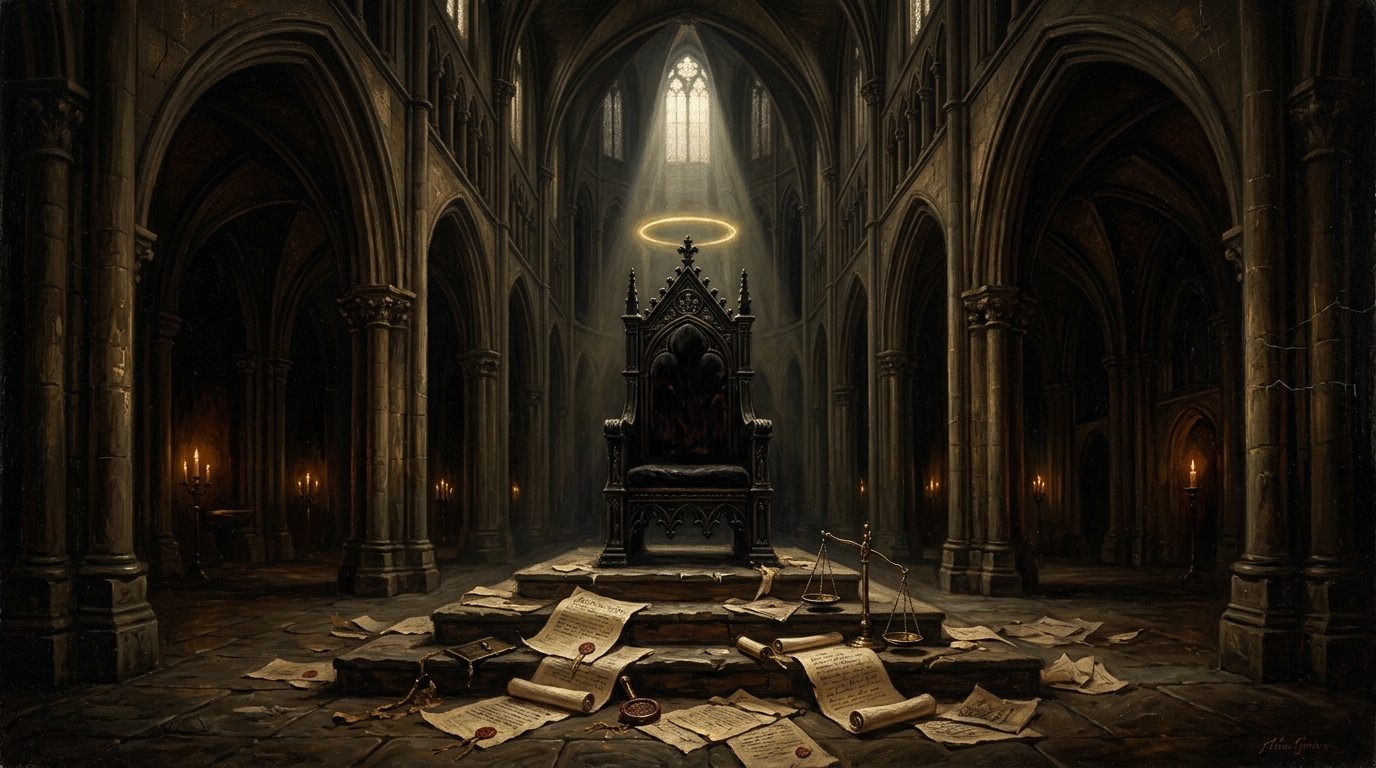
“When power wears a halo, it becomes harder to see and easier to obey... The evidence sits in archives, courtrooms, government inquiries, academic studies, and investigative journalism. The crimes are documented. The perpetrators are named. The victims are recorded. The pattern is unmistakable.” — Trevor Swistchew
The Forensic Archival Matrix: Sanctified Power on Trial
Primary Chronicles, Judicial Records, Royal Commissions & UN InquiriesMedieval Chroniclers & Crown Inquisitorial Archives
When power wears a halo, it becomes harder to see and easier to obey, and the historical record shows that religious institutions have repeatedly used this advantage to commit acts that would have been condemned outright had they been carried out by any secular authority. The First Crusade is the earliest large‑scale example preserved in detail. In 1099, during the capture of Jerusalem, Crusader chronicler Raymond of Aguilers wrote in Historia Francorum that the streets “ran with blood” as Crusaders killed Muslims, Jews, and Eastern Christians indiscriminately; this is not legend but a primary source, and modern historians such as Thomas Asbridge in The First Crusade (Oxford University Press) confirm the scale of the massacre. A century later, the Albigensian Crusade repeated the same pattern of sanctified brutality. At Béziers in 1209, papal legate Arnaud Amalric reportedly issued the command “Kill them all; God will know his own,” a line preserved in Caesarius of Heisterbach’s Dialogus Miraculorum, another medieval source. These events are not rhetorical inventions; they are documented by the very chroniclers who witnessed them.
The Spanish Inquisition shows how religious authority, once fused with state power, can institutionalise cruelty. Under Tomás de Torquemada, torture and execution became procedural tools. The orders, interrogations, and sentences are preserved in the Archivo Histórico Nacional in Madrid, and historians such as Henry Kamen in The Spanish Inquisition: A Historical Revision (Yale University Press) have analysed these records extensively. The 1492 expulsion of Jews, recorded in the Alhambra Decree signed by Ferdinand and Isabella, demonstrates how religious justification can be used to strip entire populations of their homes, rights, and safety with bureaucratic efficiency.
Centuries later, religious institutions in Canada and the United States operated residential schools designed to erase Indigenous cultures. The Truth and Reconciliation Commission of Canada’s Final Report documents physical abuse, sexual abuse, starvation, and death, supported by government archives and survivor testimony. The mass graves uncovered in 2021–2022, confirmed by ground‑penetrating radar and reported by CBC, BBC, and official Canadian government statements, reveal the scale of suffering that was concealed behind the language of moral uplift and civilising mission. These findings are forensic, not rhetorical.
Sexual abuse within religious institutions is not a modern eruption but a long‑hidden system. Marcial Maciel, founder of the Legionaries of Christ, abused minors for decades while protected by powerful clergy; this is documented in Vatican investigations and reported by Jason Berry and The New York Times (2010). The case of John Geoghan in Boston, exposed by the Boston Globe Spotlight Team (Pulitzer Prize, 2003), is preserved in court records showing how the Church repeatedly moved him between parishes despite knowing his crimes. Cardinal Bernard Law’s relocation of abusive priests is documented in diocesan files released during litigation. These are not allegations; they are verified cases supported by legal documents and investigative journalism.
The Southern Baptist Convention’s internal abuse files, revealed in a 2019 investigation by the Houston Chronicle and San Antonio Express‑News, documented more than 700 accused leaders. The Jehovah’s Witnesses’ two‑witness rule, examined by the Australian Royal Commission into Institutional Responses to Child Sexual Abuse, shows how doctrine can become a barrier to justice, preventing victims from being heard unless their abuse was witnessed by another person—a condition that almost never exists in cases of child sexual assault. These findings are judicial, not speculative.
Religious extremism has produced some of the most thoroughly documented atrocities of the modern era. ISIS, under Abu Bakr al‑Baghdadi, committed mass executions, rape, slavery, and genocide against Yazidis, all recorded in United Nations Human Rights Council reports (2014–2017), Amnesty International investigations, and Human Rights Watch documentation. These acts were not spontaneous eruptions of cruelty; they were organised, justified, and carried out under the banner of divine authority. In Myanmar, Buddhist nationalist movements led by Ashin Wirathu incited hatred that contributed to ethnic cleansing of the Rohingya, documented by the UN Fact‑Finding Mission (2017–2018). In India, the 2002 Gujarat riots, resulting in over 1,000 deaths, are preserved in the Nanavati Commission Report, Indian court records, and reporting by BBC and The Hindu. In each case, religious identity was weaponised to justify organised violence.
Financial corruption follows the same pattern. The Vatican Bank’s involvement in money laundering and the Banco Ambrosiano collapse in 1982, implicating Archbishop Paul Marcinkus, is documented in Italian court records and investigative reporting such as David Yallop’s In God’s Name. Televangelist empires built by Jim Bakker, Eddie Long, and Kenneth Copeland have faced fraud charges, sexual misconduct lawsuits, and tax controversies, all preserved in court filings and major media investigations. These cases show how religious authority can be converted into wealth, influence, and immunity until external legal systems intervene.
Across all these examples, the severity is not in the volume of crimes but in the structure that allowed them. When institutions claim divine authority, they become harder to challenge, easier to abuse, and nearly impossible to hold accountable. They sanctify violence, conceal wrongdoing, hoard wealth, suppress dissent, and claim moral superiority while acting with political and financial motives. The evidence sits in archives, courtrooms, government inquiries, academic studies, and investigative journalism. The crimes are documented. The perpetrators are named. The victims are recorded. The pattern is unmistakable.