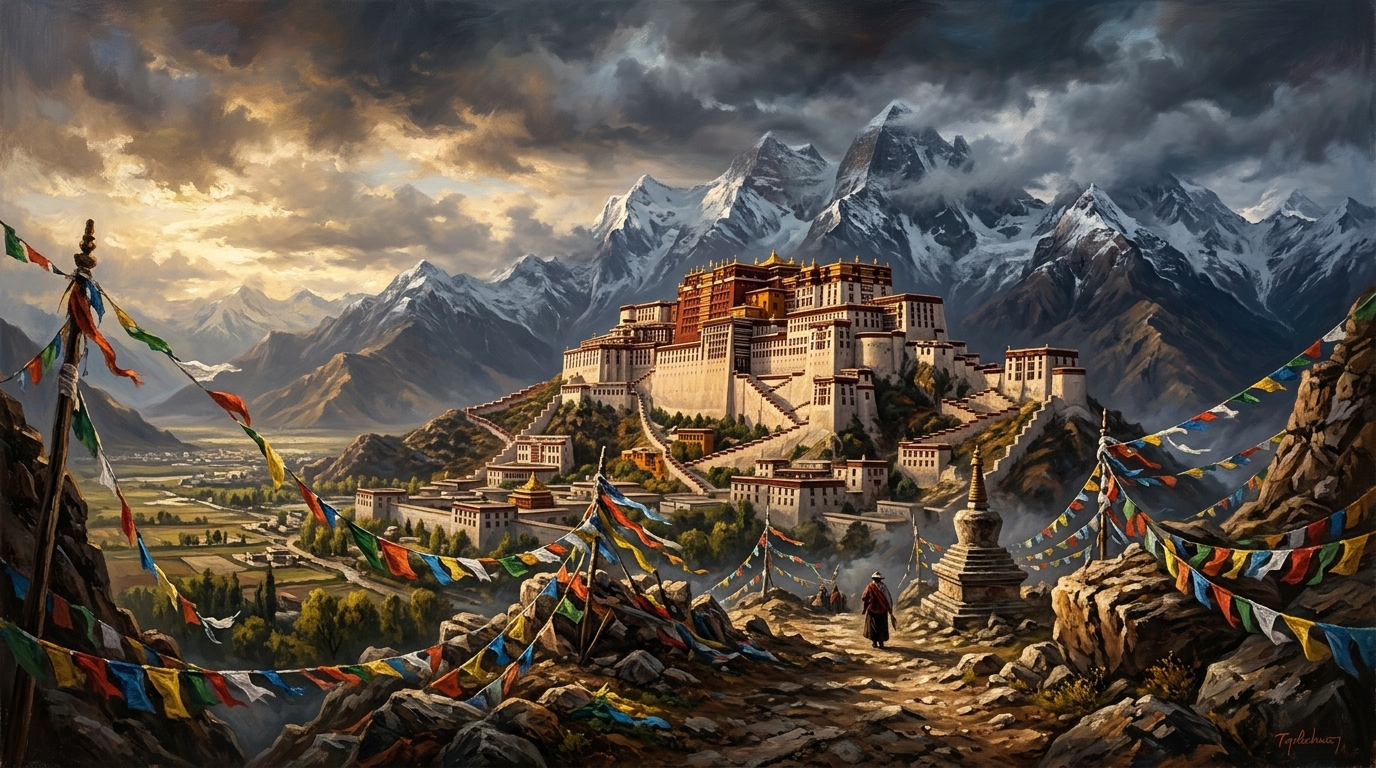
The history of Tibet is among the most disputed and emotionally charged subjects in modern politics. At its core lies a simple question that has never been resolved to the satisfaction of all parties. Was Tibet an independent country brought under Chinese rule by force, or was it a region of China over which Beijing reasserted sovereignty after a period of weakened control?
The answer depends heavily on who is speaking. The government of People's Republic of China insists Tibet has been part of China for centuries and that Chinese forces merely restored national unity. Many Tibetans, exiled organizations historians, and supporters of Tibetan self determination reject that account entirely. They argue that Tibet functioned as a self-governing state before 1950 and that the arrival of Chinese forces marked the loss of Tibetan freedom. dalailama.com ↗ savetibet.eu ↗
What cannot be disputed is that Chinese military forces entered Tibet in 1950. The argument is over the meaning of that act. From the Tibetan perspective, the very need for a military campaign raises fundamental questions about Beijing's narrative. If Tibet was already under Chinese authority, why was military force required? Why were armies deployed? Why did the Tibetan government negotiate separately with Beijing? Why did the issue reach the United Nations? These questions remain central to the Tibetan case.
Chinese leaders answered those questions by arguing that sovereignty and control are not the same thing. Beijing maintained that the country may have been beyond its effective control but nevertheless remained Chinese territory. Many Tibetans regarded this claim as little more than a justification for military conquest.
The military advance culminated in the controversial Seventeen Point Agreement of 1951. China continues to regard the agreement as proof that Tibet accepted Chinese sovereignty. The Tibetan side tells a very different story. According to statements later issued by the 14th Dalai Lama, the agreement was signed under duress and could not be considered an expression of free consent. His official statement of April 1959 declared that the agreement had been imposed by the threat of force. dalailama.com ↗ tibet.net ↗
The circumstances surrounding the agreement have remained controversial ever since. Tibetan sources maintain that military pressure left Tibetan representatives with little practical choice. Some Tibetan accounts describe the agreement not as a negotiated settlement between equals but as a political settlement reached against the backdrop of overwhelming Chinese military superiority.
The conflict escalated further during the 1950s. Tensions culminated in the 1959 Tibetan uprising, after which the Dalai Lama fled into exile in India. His departure marked a turning point in modern Tibetan history. The flight of Tibet's spiritual and political leader symbolized, for many Tibetans, the collapse of any remaining hope that Tibet would retain meaningful political independence under Chinese rule. dalailama.com ↗ tibet.net ↗
One reason the Tibet issue remains alive today is that it is not simply a political dispute. It is also a cultural and religious one. The destruction inflicted upon Tibetan religious institutions during the Mao era remains one of the strongest criticisms leveled against Chinese Communist rule in Tibet. Numerous sources document widespread destruction of monasteries, temples, sacred texts works of art and religious institutions. According to material citing the famous petition of the 10th Panchen Lama, more than 97 percent of monasteries and nunneries were destroyed and monastic populations were drastically reduced. tibetmuseum.org ↗
During the Cultural Revolution, attacks on religion intensified further. Monks and nuns were subjected to political campaigns. Religious practices were suppressed. Sacred objects were destroyed. Traditional customs were condemned as remnants of an old society. Tibetan sources regard this period as an assault not merely upon religion but upon Tibetan civilization itself. tibetmuseum.org ↗ en.wikipedia.org ↗
The destruction of monasteries became one of the defining images of twentieth-century Tibet. Some sources claim that roughly six thousand monasteries, temples and shrines suffered destruction or devastation. Exact figures vary by source and remain debated, but few historians dispute that the scale of damage to Tibetan religious life was enormous. factsanddetails.com ↗ jstor.org ↗
International concern eventually found expression at the United Nations. In 1959 the United Nations General Assembly passed a resolution expressing concern regarding conditions in Tibet. In 1961 it adopted Resolution 1723. That resolution stated concern over violations of fundamental human rights, suppression of Tibetan cultural and religious life, and specifically referred to the principle of self-determination. It called for the cessation of practices depriving Tibetans of fundamental rights and freedoms, including their right to self-determination. savetibet.eu ↗ digitallibrary.un.org ↗ mandates.un.org ↗
A further UN resolution followed in 1965. Taken together, the three resolutions established that Tibet was not entirely ignored internationally and that concerns regarding Tibetan rights reached the highest deliberative body of the United Nations en.wikipedia.org ↗
Yet these resolutions did not alter Tibet's political status. For many Tibetan supporters, this remains one of the most frustrating aspects of the entire story. They ask why resolutions were passed if no meaningful action followed. They ask why concerns about self-determination produced statements but not a referendum. They ask why Tibet did not receive the same sustained international attention devoted to other disputes around the world.
The answer generally given by political scientists is power. China emerged during the twentieth century as one of the world's most influential states and became a permanent member of the United Nations Security Council. Most governments accepted China's sovereignty claims over Tibet even while expressing concerns regarding human rights and religious freedom. Geopolitical realities outweighed support for Tibetan aspirations.
The Chinese government's modern position remains unchanged. Beijing maintains that Tibet is an inseparable part of China. It argues that Chinese administration brought roads, hospitals, schools, economic development and increased life expectancy. Chinese officials reject claims that Tibet is occupied territory and reject accusations that Tibet ever possessed a right to sovereign independence after the establishment of the People's Republic. This remains the foundation of China's official narrative. dalailama.com ↗
The position of the Dalai Lama is often misunderstood. Despite being regarded by many around the world as a symbol of Tibetan resistance, he has not for many years officially advocated full Tibetan independence. Through what he calls the "Middle Way Approach," he seeks meaningful autonomy for Tibet within China rather than outright separation. He has repeatedly argued for negotiation, coexistence and the protection of Tibetan culture, religion and identity. dalailama.com ↗ tibet.net ↗ mwa.tibet.net ↗
This position disappoints some advocates of complete Tibetan independence. However, it remains the official policy associated with the Dalai Lama and the Central Tibetan Administration. They argue that meaningful autonomy offers a realistic path to preserving Tibetan identity while avoiding perpetual political deadlock. tibet.net ↗ mwa.tibet.net ↗
The unresolved question is whether history supports Beijing's claim of reunification or the Tibetan claim of conquest. That debate continues because both sides begin from fundamentally different assumptions. China begins with the assumption that Tibet was already Chinese. Tibetan nationalists begin with the assumption that Tibet possessed the essential characteristics of an independent nation.
The result is one of the world's longest-running sovereignty disputes. More than seventy years after Chinese forces entered Tibet, the issue remains unsettled in the minds of millions. The destruction of monasteries, the exile of the Dalai Lama, the UN resolutions on Tibetan rights, the controversy over the Seventeen Point Agreement and the continuing dispute over self-determination ensure that Tibet remains a living political issue rather than a closed chapter of history. savetibet.eu ↗ en.wikipedia.org ↗ dalailama.com ↗
Whether one concludes that Tibet was conquered or reunited, one historical fact stands beyond dispute the Tibetan question did not end in 1950. It survives because Tibetans, Chinese officials, historians, governments and international organizations still fundamentally disagree about what happened, why it happened, and whether justice has ever been done.