The Return of the Teacher.
A Philosophical Allegory on Perennial Awakening, the Kingdom Within, and the Dissolution of Spiritual Monopoly.
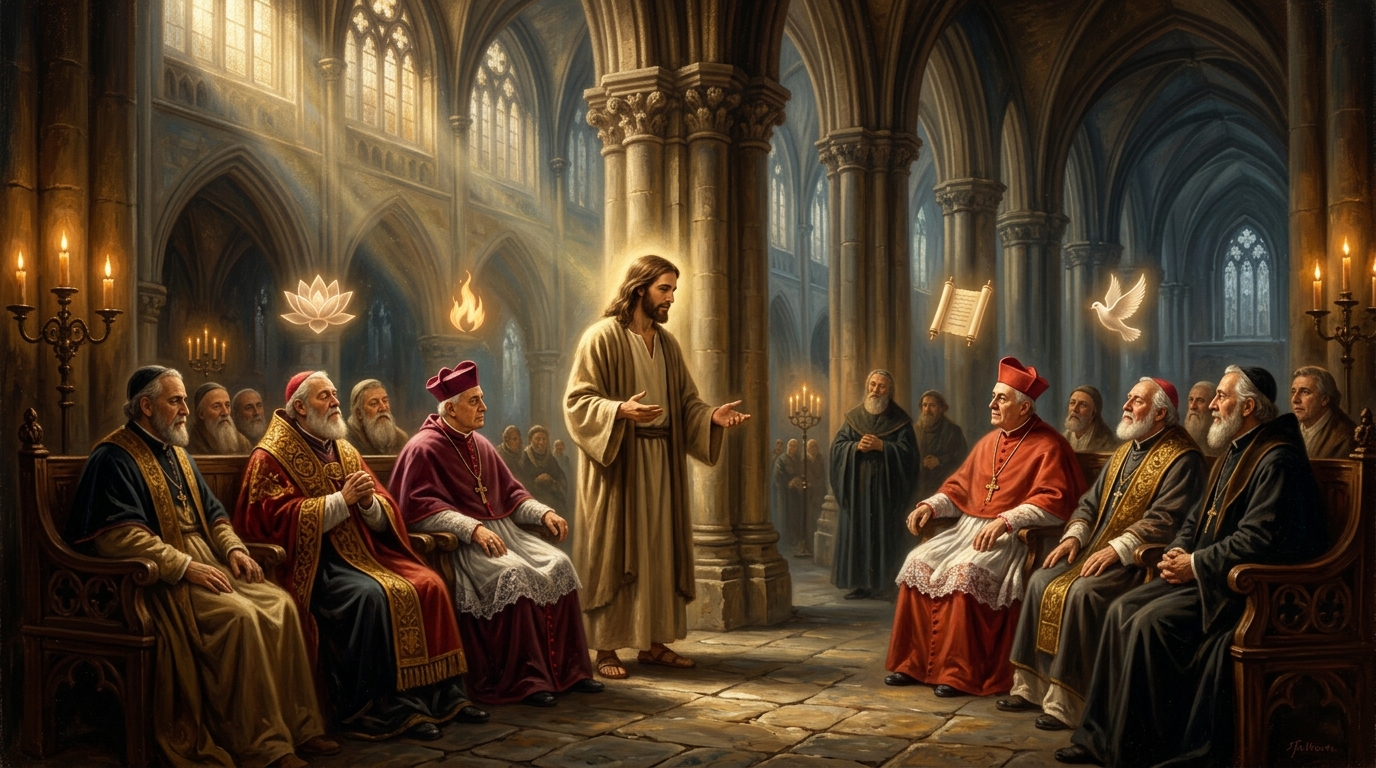
“The Father I spoke of is not a distant ruler. It is the field of Being. The same One the mystics saw. The same One the sages named... You built walls around what I meant to open. You claimed ownership of what belongs to all. You mistook the window for the light.” — Trevor Swistchew
Spiritual Dossier: The Perennial Philosophy & Direct Awakening
The Kingdom Within, Transcendent Unity, and Comparative MysticismThe Ground of Being vs. Dogmatic Monopoly
Swistchew’s allegory exposes the historical drift from direct experiential gnosis to institutional control. As articulated by Meister Eckhart, the Gospel of Thomas, and Aldous Huxley’s The Perennial Philosophy, the divine reality is not a distant sovereign demanding legalistic obedience, but the unconditioned field of Being—the living presence of awareness (entos hymon, Luke 17:21) inherent in all conscious existence. When churches mistake dogma for truth, they substitute the window for the light.
In the modern world in 2026, the Church had all but forgotten the original message of Jesus.[1] His teaching of the Kingdom Within — the living presence of awareness in every human being — had been replaced with a kind of spiritual monopoly. Other religions were dismissed without study. Other teachers were condemned without understanding. The Church had narrowed itself into a corridor so tight that almost none of his light could pass through. Into this confusion Jesus walked.
He entered quietly, without spectacle, without announcement, without the need to prove anything. He simply stepped into the world he had once taught, and saw at once that his teaching was no longer recognised as he had given it. What had been a path of inner awakening had become a system of rules. What had been freedom had become fear. What had been universal had been turned into ownership.
He walked into a cathedral where the elders were gathered. They were discussing doctrine, refining statements, preparing warnings about “false paths.” They spoke with certainty, but not with understanding.
Jesus stood among them, and the room slowly fell silent.
“You have taken my teaching,” he said softly, “and turned it into something small.”
A bishop rose. “Lord, we have protected your truth.”
Jesus shook his head. “Truth does not need protection. Only fear does.”
Another voice said, “We defended the faith against other teachers.”
Jesus looked at them with the calm of someone who sees the same light shining behind every face. He spoke gently, as if introducing old friends to a room that had forgotten them:
“Jalāl ad‑Dīn Muhammad Rūmī — the poet who saw the Divine in every heartbeat — was not your enemy.”[2]
“Guru Nanak Dev Ji — who taught that all creation is one — was not your enemy.”[3]
“Shunryu Suzuki Roshi — who helped seekers discover their own Buddha‑nature — was not your enemy.”[4]
“Jiddu Krishnamurti — who urged humanity to look directly, without fear or belief — was not your enemy.”[5]
“Paramahansa Yogananda — who revealed the unity behind all religions — was not your enemy.”[6]
“And Lord Krishna who taught mukti, the liberation that comes when the illusion of separateness dissolves — was not your enemy. He taught that freedom is found when the small self falls away and the soul remembers its unity with the whole.”[7]
He let the names settle gently into the room.
“They were my brothers in awakening. They saw the same field of Being I spoke of. The same Kingdom within. The same unity behind all forms.”
A cardinal stepped forward. “But Lord… we taught sin, guilt, repentance—”
Jesus raised his hand, not in rebuke, but in compassion.
“I taught freedom from the illusion of separateness. I taught the end of fear. I taught the return to the One. You turned awakening into obedience. You turned direct experience into ritual. You turned the living truth into a system of control.”
He walked to the centre of the hall, his presence filling the space without effort.
The Eternal Field of Being
“The Father I spoke of is not a distant ruler. It is the field of Being. The same One the mystics saw. The same One the sages named. The same One that breathes through every creature. You cannot own it. You cannot guard it. You cannot limit it.”
“You built walls around what I meant to open. You claimed ownership of what belongs to all. You mistook the window for the light.”
The silence that followed was not the silence of fear, but the silence of recognition — the silence that comes when something true is finally heard.
Jesus turned toward the doors.
“Teach awareness. Teach love. Teach the unity behind all forms. Everything else will fall away.”
— The Teacher's Final Charge
And as he stepped back into the world, something shifted in the cathedral — a loosening, a softening, a remembering.
Their hearts were opened.
© 2026 Trevor Swistchew. All rights reserved.