Reverend Eugene Cashwell never intended to become a millionaire. At least that was what he told people whenever journalists asked awkward questions. The truth was that he had intended to become a millionaire for so long that he could barely remember wanting anything else. The trouble was that he had started life as a preacher in a tiny church where the congregation contained more draughts than worshippers and where the collection plate rattled with such alarming emptiness that it sounded like a cry for help.
Every Sunday he preached sincerity, compassion and humility. Every Monday he looked at the accounts and wondered why sincerity, compassion and humility appeared to be permanently broke. Across town the owner of a chain of betting shops drove a luxury car, drank expensive whisky and holidayed in the sun. Meanwhile Eugene was trying to persuade the church treasurer that a bucket beneath a leaking roof counted as a maintenance programme.
For years he struggled with this apparent injustice until one rainy evening he was invited to watch a television preacher from overseas. The man strode onto a brightly lit stage wearing a suit so dazzling that it looked capable of guiding aircraft through fog. Behind him stood enormous screens, a live orchestra and several thousand ecstatic followers. Within twenty minutes the preacher had raised more money than Eugenes church usually saw in a month.
Eugene sat frozen. The preacher raised his hands. The crowd roared.
The preacher mentioned a divine vision. The crowd roared louder.
The preacher announced an urgent funding requirement. The crowd reached for their wallets.
At that exact moment Eugene experienced what he later described as a revelation.
Within two years he had left the little church behind and launched a television ministry of his own. What had once been a sermon became a performance. What had once been faith became branding. What had once been a congregation became an audience. The transformation suited him perfectly.
He discovered that people loved certainty. They loved confidence. They loved hearing that somebody out there knew exactly what God wanted. Most importantly, they loved hearing that their financial contribution could somehow speed up the process. Every broadcast followed a familiar pattern.
There would be music. There would be applause. There would be dramatic pauses.
Then Eugene would lower his voice and announce that he had received a fresh message from the Almighty.
• The remarkable thing about these messages was that they always involved money.
• The Almighty apparently wanted a larger studio.
• The Almighty wanted better broadcasting facilities.
• The Almighty wanted expansion.
• The Almighty wanted international outreach.
• The Almighty wanted improved travel arrangements.
• The Almighty wanted executive accommodation.
• The Almighty, according to Bartholomew, spent an astonishing amount of time discussing property development.
The Original Being, watching all this from eternity, became thoroughly confused.
No such conversations had ever taken place. The Original Being checked several times.
Not a single request.
Yet week after week Eugene confidently announced new instructions from Heaven.
The donations poured in. Before long he purchased a large house. He explained that the ministry required it. Then he purchased another. That too was for the ministry. A third house followed. By now nobody was entirely certain where the ministry ended and Eugene began.
Whenever concerned followers asked questions he smiled warmly and spoke about blessings. Blessings proved remarkably useful. A new car? Blessing. A larger office? Blessing. A luxury holiday? Blessing. An investment portfolio resembling the national budget of a small country? An exceptionally large blessing.
His fame grew. His audiences grew. His bank balance grew. His self confidence grew to such extraordinary dimensions that it eventually required its own postal code.
Then along came Reverend Ezekiel Goldwater.
Goldwater looked at Eugenes empire and saw only untapped potential. Where Cashwell owned a mansion, Goldwater owned two. Where Cashwell had one television network, Goldwater launched another. Where Cashwell held fundraisers, Goldwater held fundraising spectaculars complete with fireworks and laser displays. The rivalry became vicious.
Cashwell accused Goldwater of turning faith into a business.
Goldwater accused Cashwell of exploiting religion for profit.
Each man delivered these accusations while surrounded by luxury so absurd that ancient emperors might have considered it excessive. The public loved every minute.
One week the pair would exchange insults through television interviews. The next week they would attack each other in books. After that came conferences. Then speeches. Then interviews about the speeches.
Neither man appeared to realise that they sounded like two burglars arguing about professional ethics. The years rolled on. The ministries expanded.
Marketing departments appeared. Consultants arrived. Everything acquired an official title. Donation drives became stewardship initiatives. Advertising became spiritual outreach. Fundraising became kingdom investment.
At one executive meeting a consultant stood before a giant screen and unveiled a proposal for premium supporter levels. The room erupted in applause. Eugene stared admiringly at the presentation. He had not understood a word of it, but he was certain it would make money.
The decline into absurdity might have continued forever had it not been for an investigative journalist named Harold Pike. Pike possessed many annoying habits. He asked questions. He checked facts. He read financial records. Worst of all, he enjoyed doing it.
One morning he obtained copies of ministry expense accounts.
That single event caused several executives to require medication.
Within weeks newspapers were publishing stories about luxury spending, extravagant travel and astonishing bills for things described as “spiritual resilience programmes”. When readers discovered that spiritual resilience involved cocktails beside infinity pools overlooking tropical beaches, public enthusiasm began to cool.
Scandal followed scandal. Lawyers arrived in fleets. Public relations experts worked around the clock. Statements were issued.
Accusations flew across television screens like artillery shells.
Through it all Eugene insisted he was the victim. The larger the evidence became, the more persecuted he felt. At one press conference he compared himself to a martyr while standing in front of a fountain worth more than most family homes. Even some of his supporters struggled with that one.
Audiences became smaller. Donations became thinner. The headlines moved on. New celebrities appeared. New scandals arrived. The spotlight drifted elsewhere.
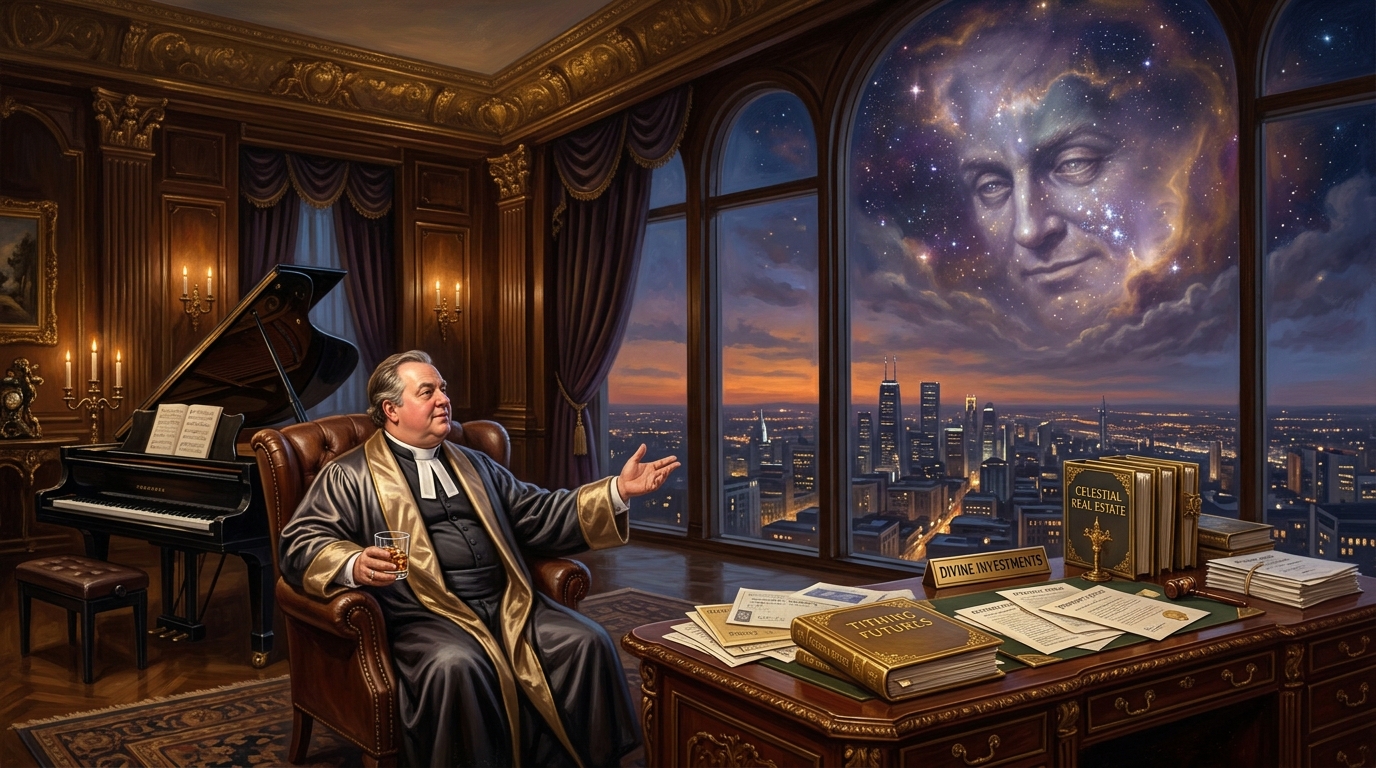
One autumn evening, many years later Eugene sat alone in his penthouse office overlooking the city. The applause had faded. The crowds had gone. The television lights no longer followed him from room to room. Yet the wealth remained. He opened drawer after drawer. Investment portfolios. Property deeds. Bank statements.
The accumulated rewards of a lifetime spent marketing the Original Being.
For a long moment he simply stared. Then he began laughing.
Not quietly. Not politely. Not modestly.
He laughed until tears rolled down his face.
He laughed because, against all probability, it had worked.
The little preacher from the leaking church had transformed into a wealthy celebrity by convincing millions of strangers that Heaven was running a fundraising operation.
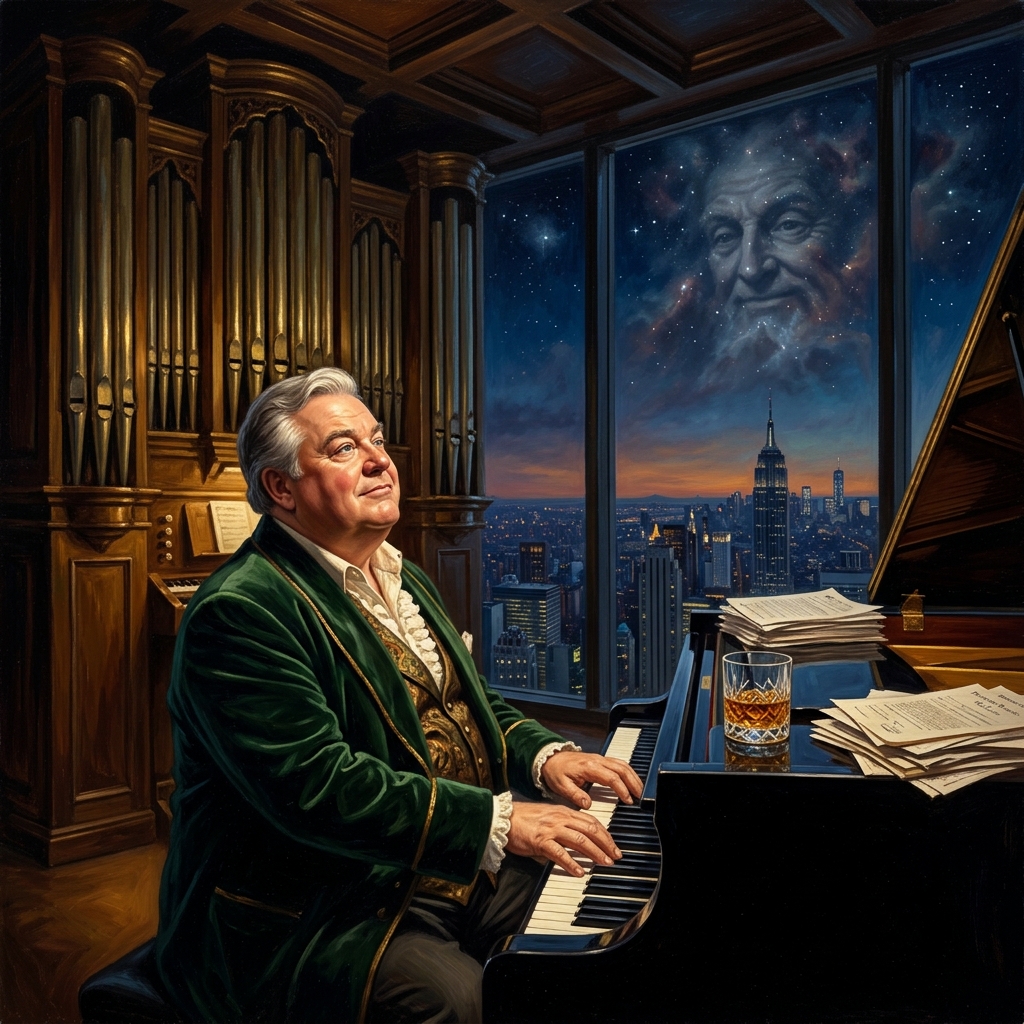
At last he rose from his desk, poured himself a glass of outrageously expensive whisky and crossed the room to a grand piano overlooking the skyline.
He settled onto the stool. Placed his fingers on the keys.
And sang the song that, deep down, had always been his true confession.
THE LORD IS MY CASHLINE.
Sung from the Penthouse Grand Piano Overlooking the City Lights
He maketh the cattle to pay
In five star hotels He fundeth me
Whilst blessing my suite every day
My investments flourish and thrive
He leadeth me into television lights
Where the donations gladly arrive
I shall fear no inquiry nigh
For lawyers are with me and accountants beside
To explain where the numbers may lie
In the sight of the cameras bright
He anointest my image with public acclaim
And keepest my ratings in sight.
My motorcars gleam in the sun
Whilst I speak of humility unto the flock
From a mansion that's second to none
And keep my accounts up high
The faithful keep filling my treasury
As the prosperous seasons roll by
And retirement draweth nigh
I'll gather the blessed loot together at last
With a thankful and tearful sigh
And smile as I bid them goodbye
Then away with the millions I've carefully stored
I'll depart for Hong Kong forbye
Far beyond the stars, the Original Being listened patiently until the final note faded.
Then the Original Being shook its head and said:
“Next time I'm hiring fewer marketers and more philosophers.”
Out there in the darkness of eternity laughter echoed for a very long time.