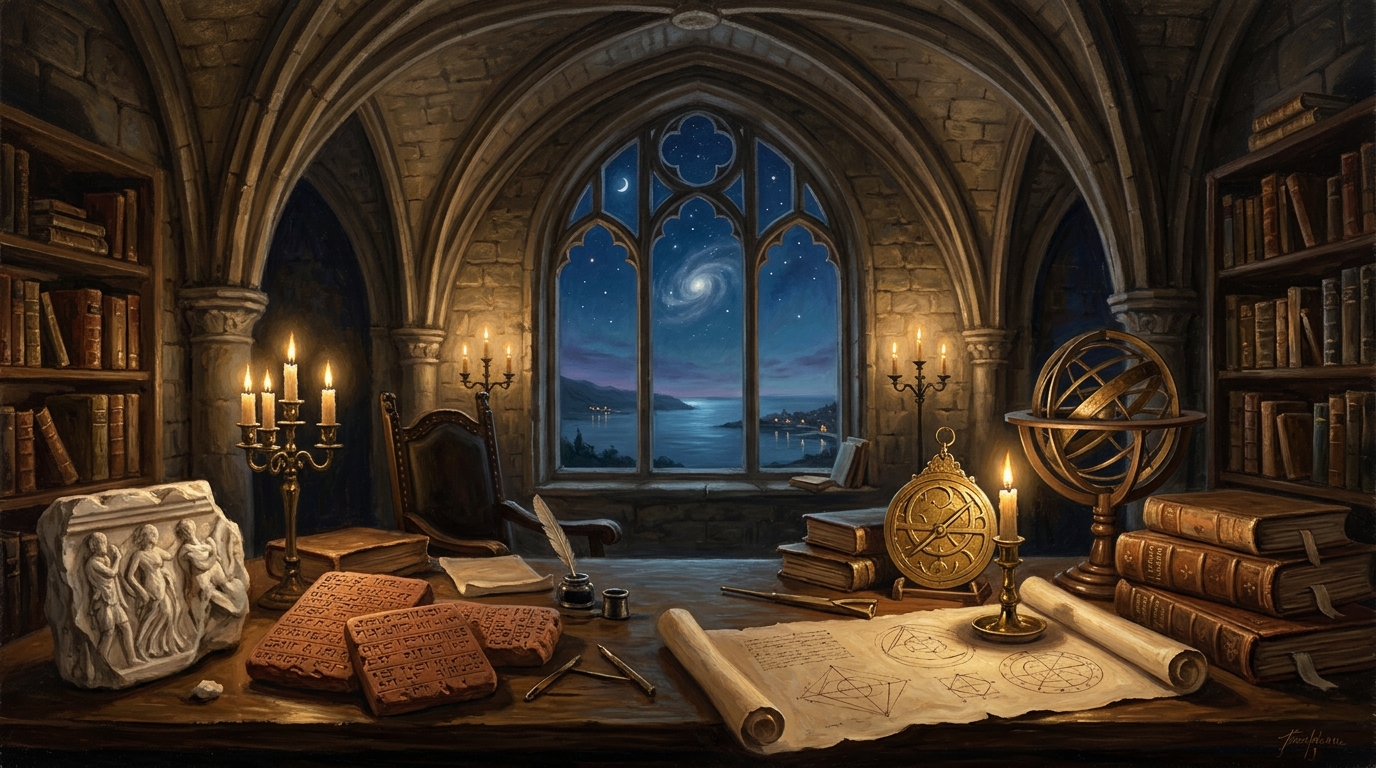
Thomas Logicus III had been born into a world of polished privilege. His family’s wealth came from antiques—real antiques, not decorative replicas. Their estate was a museum of human thought: carved idols from forgotten empires, scrolls inked by hands long turned to dust, fragments of belief systems that once commanded armies and shaped continents. People travelled across the world to buy these relics, hoping to touch something ancient, something meaningful.
Thomas, however, had never been satisfied with inherited meaning.
From the moment he could read, he had been consumed by a single, relentless question: Why anything?
Not “why us,” not “why now,” not “why this world instead of another.” He wanted to know why anything existed at all. Why there was something rather than nothing. Why the universe had bothered to begin.
His parents encouraged his curiosity, though they didn’t understand it. They assumed he would eventually settle into the family business, selling fragments of the past to people desperate for certainty. But Thomas wasn’t interested in certainty. He was interested in truth.
He devoured every origin story he could find. Creation myths from the ancient Near East. Cosmic cycles from India. Primordial chaos from Greece. The universe emerging from nothingness in modern physics. The universe always existing in certain philosophical traditions.
Different cultures, different symbols, different languages—yet each claimed to know how everything began. And where these stories collided, conflict followed. Religious one‑upmanship. Cultural rivalry. Wars justified by incompatible explanations of the same mystery.
Thomas saw the pattern early:
Humanity fought over stories it could not prove. And it failed again and again to learn from the damage.
He stripped the question back to its simplest form.
In the beginning, nothing. Then nothing became something. That something became everything—the universe.
But the spark behind that shift? Still unknown. Still unanswered. Still buried beneath belief, theory, and noise.
Thomas didn’t write to soothe himself. He wrote to find answers.
He wrote because the question demanded it. He wrote because thinking was the only honest path forward.
He wrote because silence wasn’t enough.
His first attempts were rough but sincere. He filled notebooks with observations, diagrams, and reflections. He wrote about the collision of origin stories, the wars that followed, and humanity’s long history of failing to learn from itself. He wrote about the universe as a process, not a product. He wrote about the possibility that the beginning was not a moment but a transition.
Eventually, he began sharing his thoughts online—not for attention, but to reach anyone who felt the same hunger for clarity.
At first, the world barely noticed. Some mocked him. Some dismissed him. But a few paused.
Those few mattered.
They weren’t followers. They weren’t believers. They were thinkers: people who didn’t fear questions, people who didn’t cling to inherited answers, people who recognised the difference between searching and surrendering.
Thomas kept writing.
He wrote about the human tendency to react rather than reflect. He wrote about how belief became dangerous only when it was weaponised. He wrote about how certainty, when unearned, became a cage.
But he didn’t attack belief itself. He attacked reactivity—the impulse to defend, to fight, to divide.
He realised something crucial:
Logic alone wasn’t enough. Calmness alone wasn’t enough. But together, they could change everything.
He fused them into a single idea:
Logic without arrogance. Calmness without passivity. A mind sharp enough to cut through noise, steady enough not to turn the blade on others.
He wrote:
“The Logicalm Future isn’t a world without belief. It’s a world where belief isn’t weaponised.”
His audience grew. Quietly. Steadily. People shared his words because they felt the clarity. The stillness. The refusal to inflame. The refusal to divide.
Thomas wrote again about the beginning:
“Nothing. Then something. Then everything. And everything is still changing.”
He explained that the universe wasn’t fixed. Humanity wasn’t fixed. Ideas weren’t fixed. Everything was in constant flux—and that was the point.
Certainty was the illusion. Movement was the truth.
His writing spread further. Not viral. Not explosive. Just consistent—like a quiet pulse moving through the world.
People began forming Logicalm circles. Not groups. Not sects. Just conversations. Spaces where people could think without fear, question without hostility, and disagree without violence.
Thomas watched it unfold with a calm he had never felt before.
He had spent his life searching for answers. Now he understood something deeper:
The value wasn’t in the answer. It was in the clarity of the search.
His final chapter wrote itself.
He described the universe as a constant unfolding—a process, not a product. He described humanity as capable of learning, even if it had failed for millennia. He described belief as something that could coexist with logic, as long as calmness held the centre.
He ended with the truth he had earned through thought, not faith:
“Nothing stays still. Not the universe. Not humanity. Not truth. Everything is flux and that is our freedom.”
When he published THE LOGICALM FUTURE, he didn’t expect much. But the world surprised him.
People connected. People understood. People felt seen, not judged. They didn’t need to agree with him to appreciate the clarity he offered.
For the first time in his life, Thomas Logicus III felt at peace. Not because he had solved the beginning. Not because he had ended conflict. But because he had found the audience he had been searching for since childhood: people who valued thought over noise, calm over chaos, logic over fear.
And in that connection, he found his own beginning.