The Rt Hon John E. Sprokitt was a man of immense vision. Unfortunately, every vision involved somebody else's money finding its way into his pocket. He regarded wealth as a form of public transport. If it was moving he wished to climb aboard. If it was stationary, he wished to own the station.
Sprokitt lived in a mansion so excessive that even the wallpaper had a financial adviser. His champagne cellar possessed more bubbles than his economic theories. He breakfasted upon truffles, caviar and lawsuits. Most men read newspapers with their morning coffee. Sprokitt read writs.
His legal doctrine was elegantly simple. Whenever he adjusted a silk cravat worth more than a family hatchback he would declare, “If a man blocks my path, he owes me compensation. If he breathes in my vicinity, he owes me inconvenience damages. If he disagrees with me, he has clearly inflicted emotional turbulence.”
Thus began the Great Litigation Season.
The first defendant was a taxi driver who failed to recognise him. “I demand ten million pounds!”
“For what, sir?” asked the bewildered driver. “For denting my prestige.”
The driver replied that he had never heard of him. This merely increased the damages.
Soon Sprokitt was suing neighbours, waiters, pigeons, a garden gnome manufacturer and, on one memorable occasion, an entire brass band whose rendition of Rule Britannia he described as “an assault upon commercial confidence.”
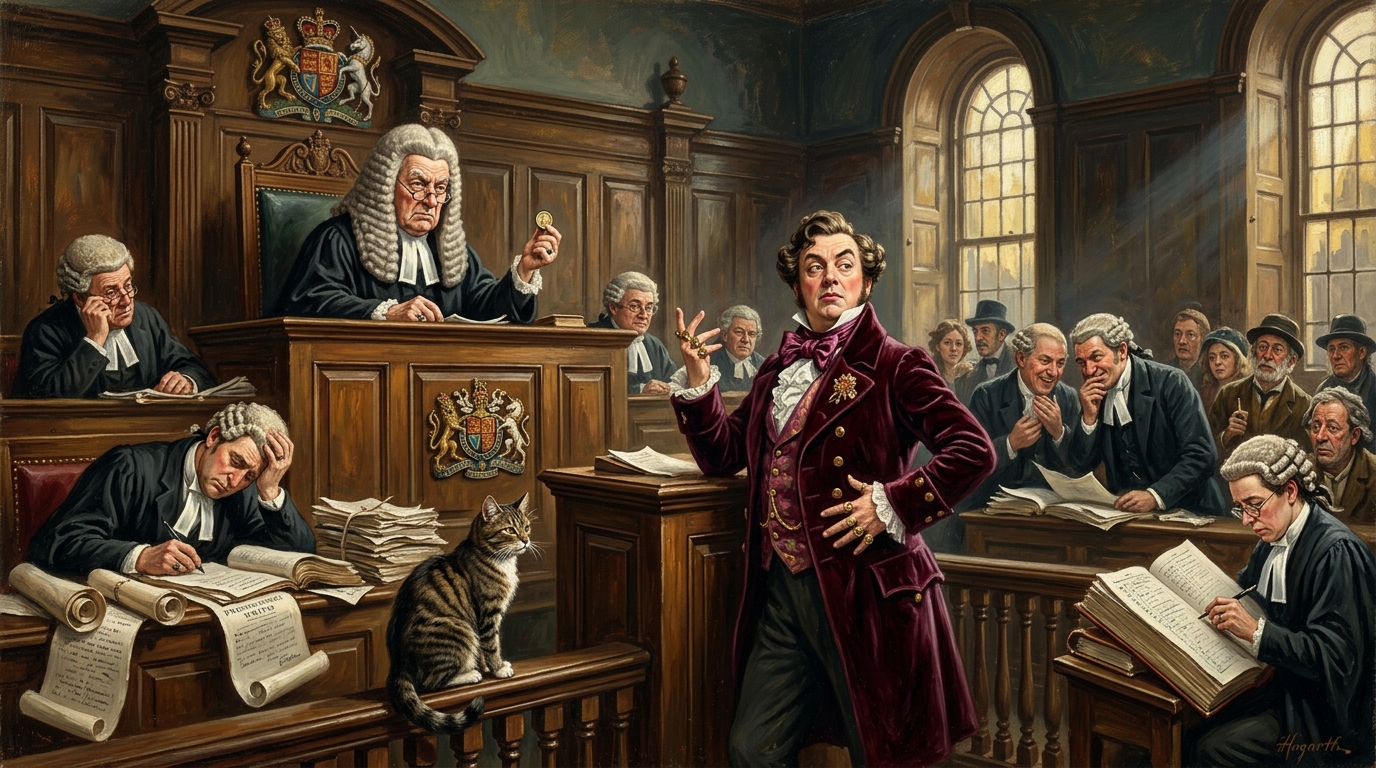
The matter eventually reached the august courtroom of Judge Ponsonby-Snoot, a gentleman whose face suggested he had not laughed voluntarily since 1973.
The courtroom glittered with barristers. Some gleamed with intellect. Others merely gleamed.
Judge Ponsonby-Snoot surveyed the chamber with profound despair.
“Mr Sprokitt,” he sighed, “am I correct in understanding that you are currently pursuing claims against seventy-two individuals?” “Only seventy-two today, my lord.”
“Today?” “I have another twelve pencilled in for Thursday.”
A murmur swept through the public gallery like a nervous tax return.
The opposition barristers rose one after another and delivered swashbuckling speeches of magnificent confidence and highly questionable honesty. One witness claimed Sprokitt had demanded ownership of the moon.
“I never said that,” declared Sprokitt indignantly. “I merely requested mineral rights.”
Another witness insisted he had attempted to trademark rainfall. “A vicious distortion.”
“Did you not apply for exclusive rights to precipitation?” “It was merely a pilot project.”
The gallery collapsed into laughter. Judge Ponsonby-Snoot struck his gavel repeatedly.
“Order!” The spectators ignored him. “ORDER!”
Still they ignored him. “Free sandwiches outside!” Instant silence.
Sprokitt then rose for his defence, which was his favourite hobby. He adjusted his cuffs and adopted the expression of a philosopher explaining gravity to turnips.
“My lord, civilisation itself depends upon my success.” The judge blinked slowly. “It does?”
“Certainly. Without vast compensation how shall I maintain standards?”
“What standards?” “I am glad you asked.”
Sprokitt immediately launched into a lecture. He spoke of marble staircases, gold-plated bath taps and imported peacocks hired exclusively to admire one another. He described a proposed fleet of yachts so large they required postal codes. He spoke for four hours.
Three jurors retired from exhaustion.
One was discovered attempting to tunnel through a wall with a spoon.
Yet Sprokitt continued uninterrupted.
“My pursuit of luxury is not selfishness. It is economic stimulus. Every bottle of champagne I consume creates employment. Every velvet smoking jacket strengthens commerce. Every diamond-encrusted slipper supports industry.”
The judge rubbed his temples.
“Mr Sprokitt, are you honestly arguing that your private indulgence is a public service?”
“Indeed, my lord. I am practically infrastructure.” The opposition barrister rose again.
“Isn't it true that you once expensed a solid silver umbrella?” “It rained.” “Indoors.”
“It looked threatening.”
Another witness appeared and claimed Sprokitt had once invoiced a mirror for reflecting him inadequately.
This was true.
The mirror had settled out of court.
Day after day the proceedings continued. Witnesses lied. Experts exaggerated. Consultants consulted other consultants. A man claiming to be a professional aristocrat charged ten thousand pounds an hour to nod thoughtfully. Nobody could quite remember what the original dispute had been.
Even the court clerk's notes eventually degenerated into the phrase:
“Good heavens, not again.”
At last Judge Ponsonby-Snoot delivered judgement. The courtroom fell silent.
Even the pigeons outside seemed legally interested.
The judge peered over his spectacles.
“Mr Sprokitt, your arguments are inventive.”
Sprokitt beamed. “They are.”
“They are also ridiculous.” The smile faded slightly.
“You have attempted to monetise inconvenience, confusion, disagreement, weather patterns and basic reality.” “An entrepreneurial spirit, my lord.”
“A predatory spirit.” Sprokitt wilted. The judge continued.
“You are awarded precisely one pound.”
A gasp echoed across the room. “One pound?” cried Sprokitt.
“Yes.” “One?” “One.” “But what of my opulent future?”
Judge Ponsonby-Snoot smiled for the first time in living memory.
It was a deeply unsettling sight.
“Mr Sprokitt, if you desire a life of luxury, I suggest earning it rather than litigating the nation into bankruptcy.”
The public gallery erupted.
Sprokitt staggered backwards.
His dream of limitless compensation had collapsed like a budget soufflé.
Outside the court, reporters rushed forward.
“Any comment, Mr Sprokitt?”
He straightened his tie. His dignity had fled, but habit remained.
“This judgement is merely a temporary setback.”
“What will you do now?”
Sprokitt drew himself up.
“I shall sue disappointment.”
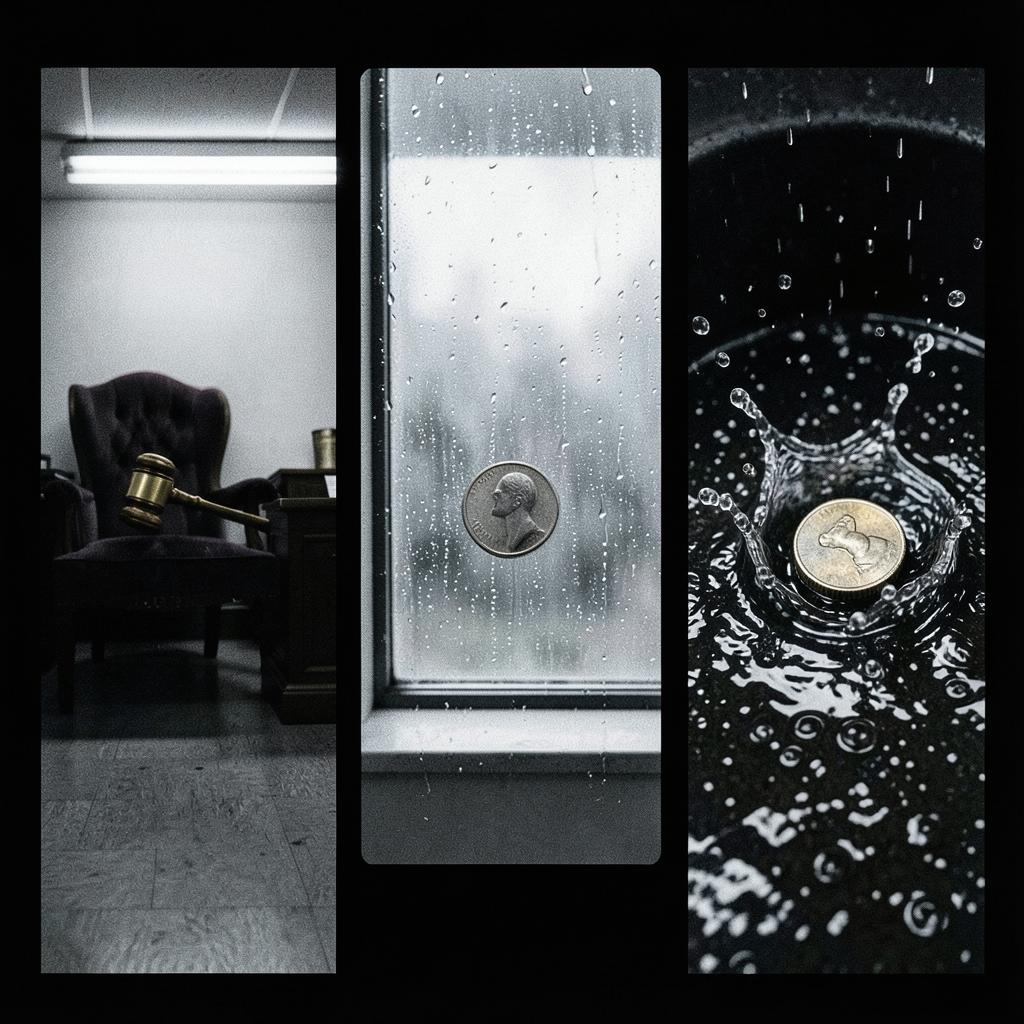
With that he swept away into the evening mist, clutching his solitary pound and already calculating how to leverage it into an international legal empire. The pound, however, escaped through a hole in his pocket and vanished down a storm drain before he had reached the end of the street.
It was the first thing he had lost in years.
The second was the case.
The third was the remaining public sympathy.
By midnight he was drafting fresh proceedings against fate, misfortune, gravity, defective tailoring and a particularly judgmental cat that had observed the entire affair from a nearby statue with unmistakable disapproval.
In the chambers, Judge Ponsonby-Snoot poured himself a restorative sherry and reviewed the closing papers.
“Another man,” he reflected, “who mistook greed for genius and nuisance for legal principle.”
He signed the final page with a flourish.
Outside, rain began to fall.
Somewhere in the darkness, Sprokitt raised a furious fist at the heavens and announced his intention to sue the weather for emotional damages and loss of prestige.
The weather declined to comment.
Thus ended the greatest legal adventure of John E. Sprokitt: a man who set out in pursuit of millions, demanded billions argued for trillions and, after exhausting half the legal profession and all reasonable patience, succeeded in losing a pound he never truly possessed.
In the end, John E. Sprokitt proved there are some things money cannot buy. Common sense was one of them.