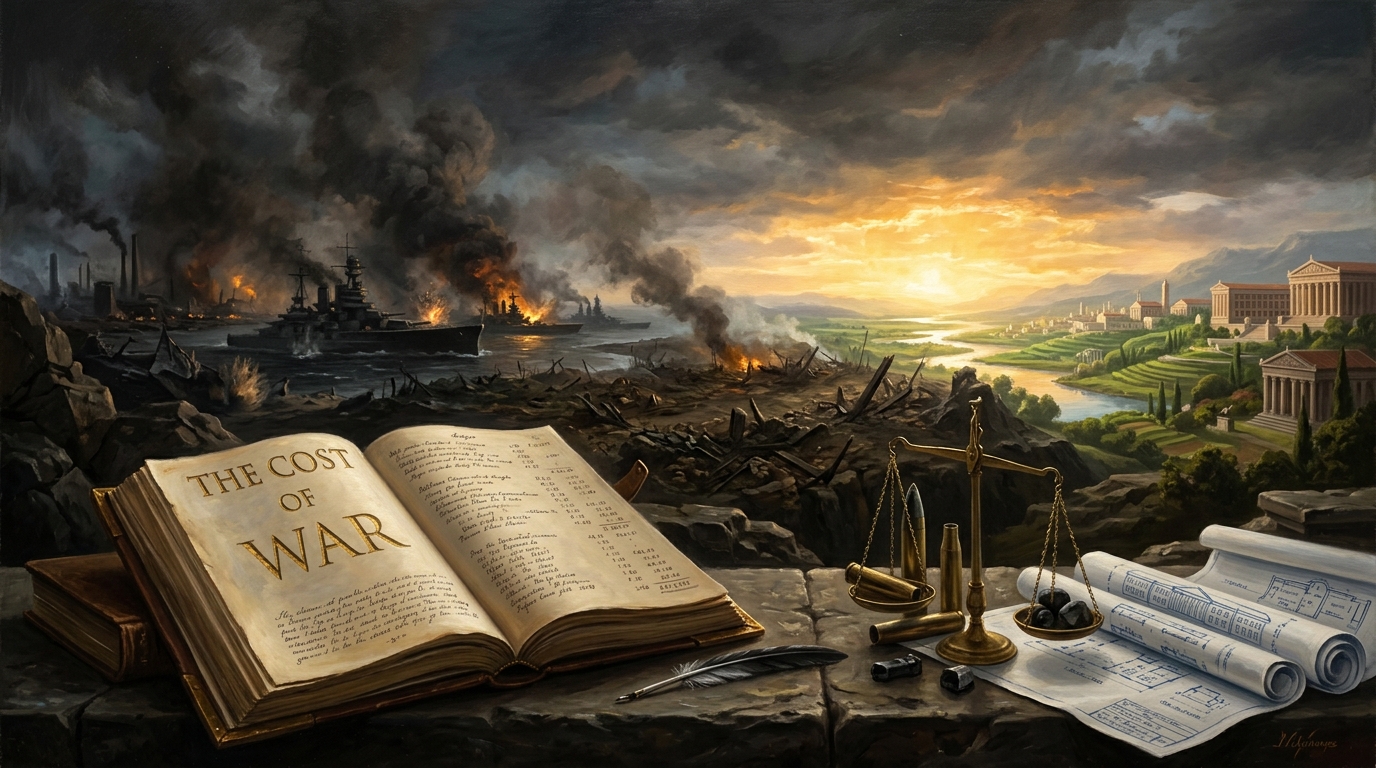
War is the most successful confidence trick ever played upon humanity.
For thousands of years ordinary men and women have done the work, paid the taxes, buried the dead and rebuilt the ruins while generations of rulers, governments, generals, ideologues and political movements have demanded still more blood and still more money. The names change. The flags change. The uniforms change. The slogans change. The invoice remains.
Humanity has been conditioned to discuss war in terms of heroism, honour, duty, patriotism, security, national interest and glorious sacrifice. Very few people are ever invited to examine the final bill. Very few people are asked to calculate what centuries of organised violence have actually cost in money. Very few people are encouraged to ask the most dangerous question of all: what could civilisation have become if that wealth had been spent building instead of destroying?
The answer is staggering.
According to Trends in World Military Expenditure 2025, global military spending reached approximately US$2.887 trillion in 2025 alone. One year. One year of weapons, armies, missiles, warships, aircraft and military infrastructure. One year in which humanity somehow found nearly three trillion dollars for the machinery of conflict while billions of people continued to struggle with poverty, inadequate housing, poor healthcare and economic insecurity. [sipri.org], [sipri.org]
Now multiply that mentality across more than a century.
From the Boer War to the present day, humanity has not merely fought wars. Humanity has poured a mountain of wealth into war so vast that it is difficult to visualise. Hundreds of trillions of pounds have been consumed directly or indirectly through military expenditure, destruction, reconstruction, debt and lost opportunity. The result is not merely a trail of graves stretching across history. It is an economic catastrophe spanning generations.
War does not merely kill people.
War devours futures.
It devours houses that were never built. It devours hospitals that were never funded. It devours schools that never opened. It devours scientific breakthroughs that never happened. It devours opportunities that vanished before they were ever born.
Every bomb dropped destroys something twice. First it destroys its target. Then it destroys everything society could have achieved with the money used to build it.
That is the hidden ledger of human conflict.
That is the story politicians rarely tell.
That is the cost of war.
THE COST OF WAR. Part 2
1900–2026 • Including Military Spending, Civilian Losses and Reconstruction
Direct military expenditure
The strongest evidence from the SIPRI Military Expenditure Database, which records military spending by country. SIPRI reports that world military expenditure reached US$2.887 trillion in 2025, the highest level ever recorded, and amounted to 2.5% of global GDP. [sipri.org], [sipri.org]
Civilian destruction and reconstruction.
- Destroyed cities and housing
- Roads, railways, bridges, ports
- Agricultural losses
- Refugee movements
- Medical costs
- Lost economic production
- Post-war rebuilding
- Long-term debt servicing
No global institution has calculated a complete worldwide total for 1900–2026. Estimate must be reconstructed from major wars and economic studies.