A Calling from the Bank
The Reverend Alvin Tosh did not discover religion through divine revelation. He discovered it through debt. For most of his adult life he had wandered from one failed occupation to another with the dogged determination of a man who firmly believed success was hiding somewhere just beyond the next disaster. By middle age he owed money to banks, neighbours, former business partners and one dentist who still referred to him exclusively as “that bastard.”
The turning point came one rainy afternoon while Alvin sat drinking coffee in a roadside diner. Across the room a local loudmouth was explaining the global economy to half a dozen truck drivers using a napkin covered in ketchup stains. Everything the man said was demonstrably wrong. Unfortunately he was speaking with such confidence that nobody noticed. Every absurd statement was received with nods of admiration. Every ridiculous conclusion was accepted as profound wisdom.
Alvin sat there watching the performance and slowly came to a realization that was both brilliant and terrible. People rarely wanted truth. Truth was often complicated, disappointing and full of details. What they wanted was certainty. Certainty was comforting. Certainty was simple. Above all, certainty could be sold.
Three months later he rented the old county hall on the edge of town and announced the formation of the Church of Eternal Certainty. The name alone guaranteed success. Nobody wants to join a church called the Fellowship of Occasional Doubt. Certainty sounds powerful even when it is attached to complete nonsense. Before long people began arriving in droves. Farmers came. Mechanics came. Truck drivers came. People who had never voluntarily entered a church in their lives came. After the first year Alvin was preaching to packed halls every Sunday and wondering why nobody had pointed him toward organised religion sooner.
Among the congregation sat Earl Jenkins, a man who looked as though life had happened to him unexpectedly. Earl possessed an unusual gift. Most people asked foolish questions from time to time. Earl had elevated it to an art form. During one sermon he interrupted Alvin to ask whether chickens technically counted as vegetables because they spent much of their lives standing in gardens. Alvin initially laughed, assuming it was a joke. Unfortunately Earl was entirely serious. More alarming was the reaction of the audience. Rather than dismissing the question, they began debating it. Within minutes half the congregation had formed opposing camps. Some argued that chickens were clearly a form of livestock. Others maintained that prolonged exposure to vegetables might indeed make them vegetables by association.
As Alvin watched seventy grown adults arguing passionately about agricultural poultry philosophy he felt something he had not experienced for years.
Hope.
The Golden Age of Nonsense
The church expanded with remarkable speed, largely because nonsense spreads much faster than knowledge. Knowledge has to be learned. Nonsense merely has to be repeated. Every Sunday Alvin would toss an offhand remark into the room and by the following week it had evolved into a local belief.
One morning he observed that common sense seemed increasingly rare. The comment was intended as a throwaway joke. Unfortunately Doris McNabb heard it. Doris was the sort of woman who could hear a rumour in the morning and have it translated into three dialects by lunchtime. By the following Sunday she had become convinced that common sense was literally a natural resource which had once been plentiful but was now running out.
The theory spread through town like wildfire through dry grass.
People discussed ancient deposits of common sense buried beneath mountains. A mechanic claimed his grandfather had once worked in a common sense quarry. Somebody else remembered reading about exports of common sense to Canada during the nineteen fifties. No records were ever produced and none were requested.
Alvin quickly learned that providing evidence slowed things down.
Soon every sermon generated fresh confusion. Earl wondered why fish never swam into clouds if clouds were made of water. Doris suggested they were unable to locate the ladders. Instead of laughing, the congregation immediately began discussing who maintained these cloud ladders and whether local government should subsidise repairs. A retired welder spent forty minutes explaining that metal ladders would attract lightning and therefore cloud access should remain privately managed.
Nobody noticed they were debating infrastructure for fish.
Each week the conversations became increasingly bizarre. Questions generated theories. Theories generated arguments. Arguments generated committees. An entire subcommittee was formed to investigate whether mirrors became heavier after reflecting overweight people. Their final report was inconclusive but highly praised for its professionalism.
Alvin watched all of this with growing satisfaction. Money flooded into church coffers. The congregation adored him. Reporters occasionally visited to interview the charismatic preacher whose followers appeared to inhabit a reality assembled entirely from misunderstandings. Alvin had become famous. Better still, other people were now inventing nonsense on his behalf. The machine practically ran itself.
Had he possessed any wisdom he might have recognized the danger.
Unfortunately success had gone to his head.
The Creation Escapes
The trouble began when Alvin attended a church committee meeting.
Until that point he had assumed he remained the most creative bullshitter within the organisation. The meeting quickly demonstrated how badly he had underestimated his followers.
The first presentation concerned gravity.
A local plumber explained that gravity appeared suspiciously selective because birds were permitted to fly while human beings remained stubbornly attached to the ground. This suggested either discrimination or corruption. Another member presented photographs of dropped hammers as evidence of systematic abuse. A third arrived with charts demonstrating that people fell down more often than they fell up, which clearly revealed statistical bias.
The room took the matter very seriously.
Alvin tried explaining that gravity was simply a law of nature.
This was received badly.
Several members questioned who had passed the law. Others demanded to know whether gravity had ever faced democratic scrutiny. One elderly gentleman demanded an inquiry.
What frightened Alvin was not their ignorance.
It was their competence. These people maintained folders.
They took minutes. They issued newsletters. They wrote position papers.
What had begun as harmless foolishness was evolving into a large organised institution capable of generating unlimited quantities of self sustaining nonsense.
The following months only made matters worse. New doctrines emerged at astonishing speed. Seedless watermelons became evidence of agricultural conspiracy. Daylight saving time became proof that humanity controlled the Sun. A substantial number of the congregation concluded that pigeons were likely government agents.
Alvin no longer led discussions. He struggled merely to keep up.
Like a scientist who accidentally creates a monster, he found himself staring in horror at his own achievement. Everything he touched multiplied beyond control. Every joke became a movement. Every exaggeration became a principle. Every passing remark eventually returned wearing a necktie and demanding formal recognition.
For the first time since founding the church, Alvin had to THINK.
The Final Sermon
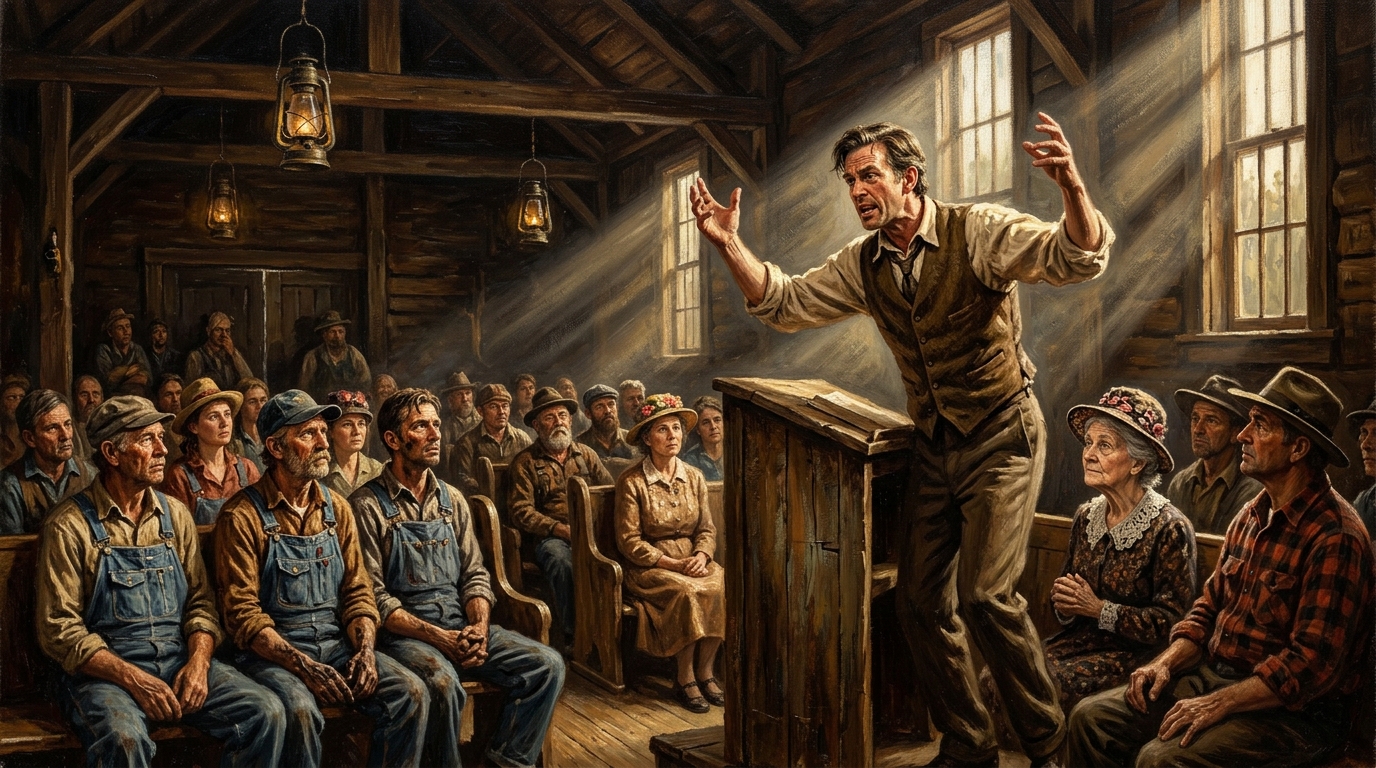
Determined to repair the damage, Alvin announced a special sermon. Word spread rapidly and huge crowds arrived from neighbouring counties. By noon every seat was occupied. People stood in aisles. They gathered outside windows. One cow wandered into the car park and appeared to be considering attendance.
As Alvin stepped forward he understood this might be his last opportunity to tell the truth.
The hall fell silent.
For several moments he simply stared at the audience. There sat Earl, still looking puzzled by existence itself. There sat Doris, undoubtedly preparing tomorrow’s rumours. There sat hundreds of faces filled with anticipation, confidence and complete misunderstanding.
Finally Alvin took a deep breath.
He confessed everything.
He explained that the common sense mines had never existed. Fish did not require cloud ladders. Gravity was not a conspiracy. Mirrors did not absorb weight. Pigeons were merely pigeons. Every absurd doctrine, every ridiculous theory and every cherished belief had emerged from misunderstandings, jokes and speculation. He admitted that much of his success had been built upon nonsense.
When he finished, silence filled the hall. It was the most honest speech he had ever delivered.
For a long moment nobody moved. Then Earl slowly stood.
A look of admiration spread across his face. “Damn,” he whispered.
The entire congregation turned towards him. Earl shook his head in amazement.
“That is the deepest sermon he’s ever preached.” The hall erupted.
People cheered.
People cried. Several embraced.
Alvin stared in disbelief as his confession was instantly transformed into theology. The congregation interpreted his honesty as metaphor, his apology as prophecy and his admission as wisdom. By nightfall attendance applications had tripled.
Years later the Church of Eternal Certainty remained prosperous. Books were written. Conferences were held. Experts emerged. Entire careers were built explaining ideas that had begun life as jokes. Alvin eventually retired wealthy, respected and thoroughly defeated.
Whenever reporters asked how he had achieved such extraordinary success, he always gave the same answer.
“I started out talking shit.”
Then he would pause, gaze sadly towards the town he had accidentally transformed, and add the part nobody ever seemed to understand. “The really weird thing is that everybody else got better at it than I did.”