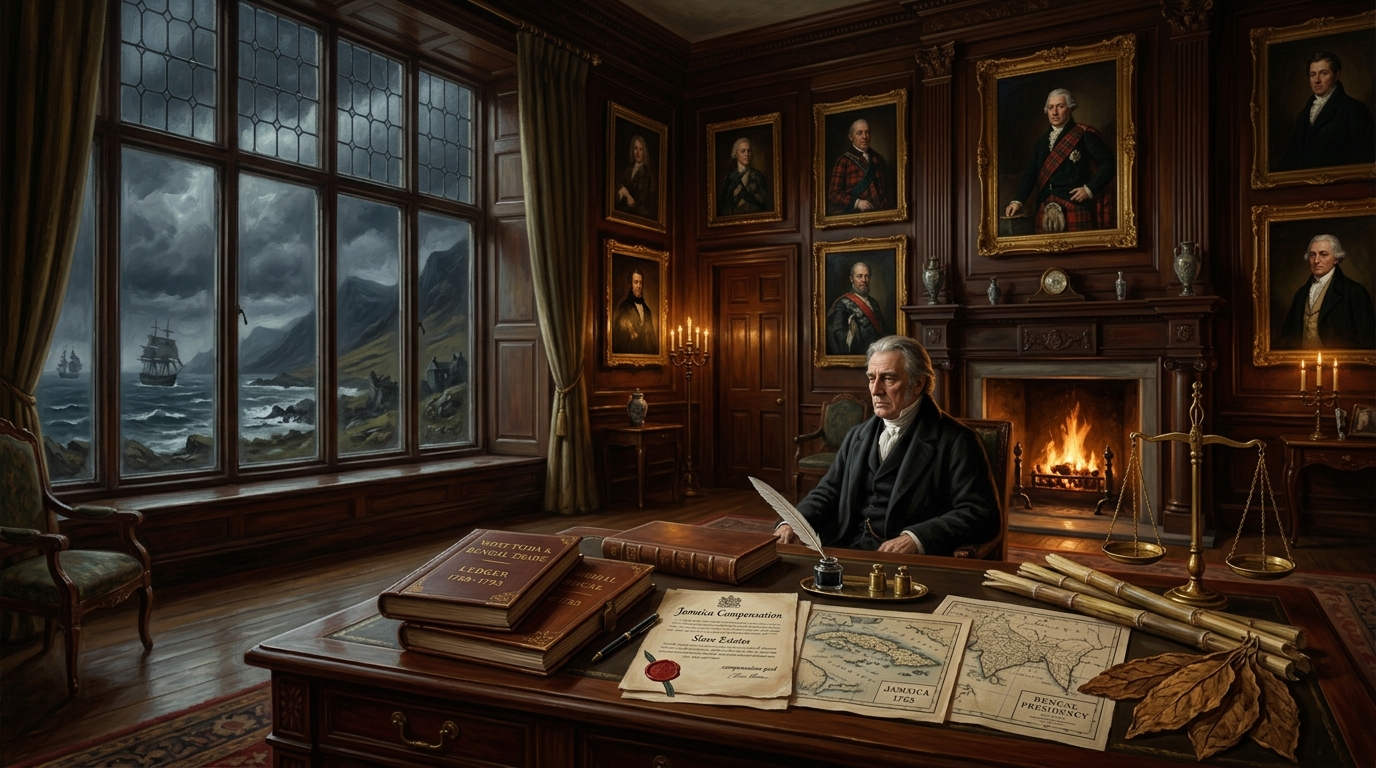
Scotland was not a passive bystander in the British Empire. After the 1707 Union, large numbers of Scots became merchants, plantation owners, soldiers, colonial administrators, slave traders, East India Company officials, bankers and investors across the Empire. Historians such as Tom Devine, Nicholas Draper and others have shown that Scots were disproportionately represented in imperial administration and colonial business. Scotland benefited from imperial trade, while many Scots also participated directly in systems of slavery, land seizure and colonial exploitation. [nms.ac.uk], [cambridge.org]
The evidence shows that by around 1800 Scots owned roughly 30% of Jamaican estates. Jamaica contained one of the largest enslaved populations in the British Caribbean, and Scots were involved as owners, investors, overseers, doctors and merchants. [scottishhistorysociety.com], [blackhistorymonth.org.uk]
It is also documented that when slavery was abolished in 1833, the British government paid £20 million in compensation to slave owners, while the enslaved received nothing. The UCL Legacies of British ownership project has identified more than 40,000 claimants and documented the payments made to former slave owners. [ucl.ac.uk], [ucl.ac.uk]
However, it is not historically accurate to state that all Scottish nobles were “criminal exploiters.” Some were deeply involved in slavery and colonial wealth extraction. Others were not. Evidence must be assessed individually.
Examples of named Scots who profited from slavery include:
Originally from Doune, was one of the largest plantation owners in Jamaica and amassed substantial wealth from enslaved labour. National Museums Scotland identifies him as one of Jamaica's biggest plantation owners. [nms.ac.uk]
An Edinburgh-based former Grenada planter, owned 332 enslaved people and received compensation valued at over £1 million in modern terms after abolition. [scotsman.com]
A Scottish doctor and plantation owner in Jamaica, received compensation equivalent to about £255,000 in modern values for enslaved people and plantation property. [scotsman.com]
Many aristocratic families also appeared among compensation recipients. Research on the compensation records has connected slave-derived wealth to major Scottish landowners and estates. Wealth from slavery was often reinvested in Scottish land, industry, railways and country estates after emancipation. [theorkneynews.scot], [cambridge.org]
Scotland's involvement was not limited to the Atlantic slave system. Large numbers of Scots made fortunes in India through the East India Company. These wealthy returnees were often called “nabobs.” Historians have documented how Scottish elites obtained wealth, political influence and landed estates through East India Company service. [india-institute.ed.ac.uk], [ourmigrationstory.org.uk]
One example is John Johnstone of Edinburgh, an East India Company official who returned from Bengal with a fortune and became a major Scottish landowner. Contemporary accounts described him as having made a substantial fortune in India. [en.wikipedia.org] There is no single verified list covering every Scottish aristocrat across centuries of empire. Many thousands of Scots were involved, and historians are still researching the full scale of ownership, compensation claims and colonial profits. The most authoritative source remains the UCL Legacies of Slave-ownership database, which documents individual claims and compensation awards from the abolition settlement. [ucl.ac.uk], [ucl.ac.uk]
The evidence therefore supports the conclusion of Scotland having both critics and beneficiaries of empire but significant sections of the Scottish elite, merchant class and landed class accumulated wealth through colonialism, slavery and imperial trade, particularly in Jamaica, the wider Caribbean and India. [nms.ac.uk], [scottishhistorysociety.com], [cambridge.org]
How Nobles Disgraced Scotland.
For years Scots have been taught a comforting story about Empire. In that story Scotland was a small nation carried along by events beyond its control, contributing engineers, doctors, teachers and soldiers to a vast imperial enterprise. There is some truth in that narrative. But it is not the whole truth. Behind the myths, or monuments or grand country houses and the polished statues, lies a darker reality. Scotland did not merely participate in the British Empire. Many members of Scotland's aristocracy, merchant class and political elite helped build and profit from one of the largest systems of exploitation the world has ever seen.
The British Empire eventually claimed authority over roughly a quarter of the world's land surface and population. Across Asia, Africa, the Caribbean, North America and the Pacific, wealth flowed into Britain. Scotland shared in that wealth. The question is not whether Scottish elites benefited. Historians have established that many did. The real question is how they acquired that wealth and at whose expense.
The Union of 1707 opened imperial markets to Scottish merchants and investors. Following the failure of the Darien Scheme, which had itself been an attempt to establish a Scottish colonial foothold in the Americas, Scotland's landed and commercial elites gained access to the expanding machinery of the British Empire. National Museums Scotland notes that the failure of Darien helped form the background to the Union and the opening of imperial trade opportunities that allowed Scots to benefit from colonial commerce and the transatlantic slave system. [nms.ac.uk]
What followed was a remarkable and disturbing success story. Scottish merchants established themselves throughout the Caribbean. Glasgow became wealthy through the tobacco trade. Scottish investors financed plantations. Scottish overseers managed estates. Scottish doctors treated plantation owners. Scottish lawyers were in charge of plantation accounts. Scottish ships carried goods produced by enslaved labour.
The profits returned home and transformed sections of the Scottish economy. Historians have shown that by 1800 Scots owned approximately 30 percent of Jamaican estates and played major roles throughout colonial plantation society. [scottishhistorysociety.com], [blackhistorymonth.org.uk]
Those fortunes were not created through hard work alone. They depended on systems of coercion and human suffering. Sugar plantations, tobacco estates and cotton production relied heavily upon enslaved Africans and their descendants. Men, women and children were treated as property. Families were divided. Human beings were bought and sold. Physical punishment was routine. The immense wealth generated by this system enriched plantation owners while condemning countless others to misery.
Some Scots became infamous for the scale of their involvement. William Mitchell, often known as “King” Mitchell, became one of the largest plantation owners in Jamaica. His wealth was derived from estates worked by enslaved labour. National Museums Scotland identifies him as one of Jamaica's biggest plantation owners. [nms.ac.uk]
When slavery was finally abolished throughout most of the British Empire in the 1830s, a remarkable injustice followed. The British government paid compensation not to the formerly enslaved but to former slave owners. Parliament authorised £20 million for compensation, one of the largest public expenditures of the nineteenth century. The enslaved themselves received nothing. The UCL Legacies of British Slave-ownership project documents the identities of compensation recipients and the enormous scale of these payments. [ucl.ac.uk], [ucl.ac.uk]
Among those identified in the records were Scottish beneficiaries. Thomas Duncan, a former planter connected with Grenada and resident in Edinburgh, owned hundreds of enslaved people and received compensation valued at more than £1 million in modern terms. [scotsman.com]
Likewise, Alexander Murchison, a Scottish doctor and plantation owner in Jamaica, received compensation equivalent to hundreds of thousands of pounds in today's values for enslaved people and plantation property. [scotsman.com]
The significance of these payments goes far beyond individual fortunes. Research has shown that wealth generated through slavery helped finance Scottish estates, industries and land acquisitions. Historians studying the Highlands and Islands have argued that slave-derived wealth was reinvested in major land purchases throughout Scotland after abolition. [theorkneynews.scot]
Nor was the Caribbean the only source of imperial wealth. Scotland played an outsized role in the administration of British India. Scottish officials, soldiers and businessmen entered the East India Company in large numbers. Many returned home wealthy men. These so-called “nabobs” purchased estates, entered politics and became part of the Scottish establishment. [india-institute.ed.ac.uk], [ourmigrationstory.org.uk]
One example was John Johnstone, an East India Company official from Edinburgh who accumulated a fortune in Bengal before returning to Scotland as a major landowner. Contemporary accounts describe him as having made a fortune through Company service. [en.wikipedia.org]
It is therefore impossible to sustain the comforting fiction that imperial exploitation was something done entirely by others. Sections of the Scottish elite were active participants. Some accumulated fortunes from slavery. Others benefited from colonial monopolies. Others gained from imperial administration and extraction. Grand houses were built. Estates expanded. Family fortunes multiplied. Respectability was purchased with money ultimately derived from labour, conquest and imperial power.
Yet historical honesty also requires an important qualification. Scotland was never morally united behind empire. Many ordinary Scots opposed slavery. Scotland contributed significantly to abolition campaigns. Petitions against slavery flowed from Scottish towns and communities. Activists, writers and campaigners challenged the system long before its abolition. [blackhistorymonth.org.uk]
History is therefore more complex than nationalist mythology or imperial nostalgia. Scotland produced exploiters and reformers, plantation owners and abolitionists, colonial administrators and critics of empire. But the evidence leaves little doubt that important sections of Scotland's aristocracy and wealthy classes profited greatly from imperial expansion and from systems that today would be regarded as profoundly unjust.
The greatest disgrace is perhaps not that this happened. Human history is filled with exploitation. The greater disgrace is that generations were encouraged to forget it. Statues remained standing. Mansions retained their prestige. Fortunes passed through families. The origins of that wealth were often softened, romanticised or ignored.
A mature nation does not need myths. It needs honesty. The historical record shows that many members of Scotland's elite were deeply entwined with slavery, colonial extraction and imperial commerce. Their wealth helped shape modern Scotland. Their actions also linked Scotland to some of the darkest chapters in imperial history. Recognising that fact is not an attack on Scotland. It is the beginning of understanding Scotland's history as it truly was, rather than as some would prefer it to be.
Major Scottish Individuals Identified in Sources.
William Mitchell (“King Mitchell”), originally from Doune, became one of the largest plantation owners in Jamaica and accumulated substantial wealth from enslaved labour. [nms.ac.uk]
Thomas Duncan, resident of Great King Street, Edinburgh, owned 332 enslaved people in Grenada and received compensation valued at over £1 million in modern terms. [scotsman.com]
Alexander Murchison, a Scottish doctor and plantation owner in Jamaica, received compensation valued at approximately £255,000 in today's terms for his estates and enslaved people. [scotsman.com]
John Johnstone of Edinburgh accumulated a fortune through East India Company service in Bengal and returned as a major Scottish landowner. [en.wikipedia.org]
Wealth and Landed Estates.
Research discussed by Scottish historians Iain Mackinnon and Andrew Mackillop found that wealth generated directly and indirectly through slavery was invested in Scottish land purchases, particularly in the Highlands and Islands after emancipation. The researchers describe extensive land acquisition funded by colonial wealth. [theorkneynews.scot]
The evidence therefore supports the conclusion that some Scottish estates were purchased, expanded or improved using wealth connected to colonial exploitation.
Important Historical Context.
Historians estimate that Scots owned around 30% of Jamaica's estates by 1800 and played major roles throughout the plantation economy. Scots were involved as owners, overseers, investors, merchants, doctors and administrators. [scottishhistorysociety.com], [blackhistorymonth.org.uk]
When slavery was abolished, Parliament paid £20 million in compensation to slave owners while enslaved people received nothing. The compensation records form the basis of much modern research into slave ownership. [ucl.ac.uk], [ucl.ac.uk]