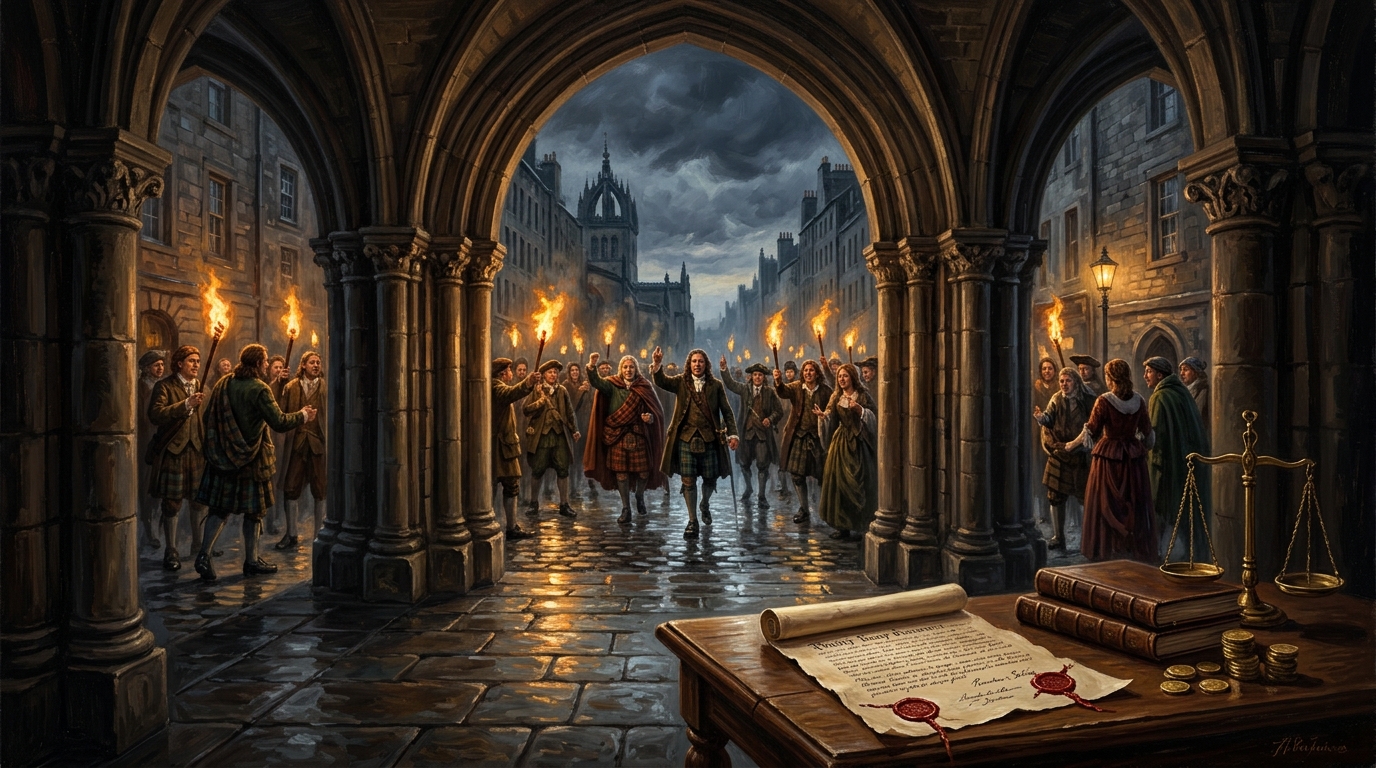
The official story of the Union of 1707 is that two sovereign nations voluntarily came together to form a new state called Great Britain. That interpretation remains the orthodox view taught in many schools and universities. Yet when the events surrounding the Union are examined closely, a different picture emerges. It becomes difficult to escape the conclusion that the Union was not the democratic choice of the Scottish people. Instead, it was an agreement negotiated by political elites during a period of economic weakness, diplomatic pressure and public opposition.
The first fact that must be faced is simple. The people of Scotland were never asked whether they wanted the Union. There was no referendum. There was no national vote. The decision was made entirely through the Scottish and English Parliaments. At the beginning of the eighteenth century, ordinary Scots had no meaningful democratic mechanism through which to approve or reject a constitutional transformation of such enormous importance.
The timing of the Union was closely connected to Scotland's economic difficulties. The disastrous Darien Scheme of the 1690s had ruined many members of the Scottish political and financial elite. Huge sums of capital had been lost. A significant proportion of the Scottish ruling class had invested heavily in the failed colonial venture. Following the collapse of Darien, many influential figures found themselves financially damaged and politically vulnerable.
Against this background, the English government entered negotiations from a position of considerable strength. England possessed the larger population, the stronger economy, the larger military establishment and greater international influence. Scottish negotiators were dealing not with an equal partner in practical terms but with a far more powerful neighbour.
The issue of succession also increased English pressure. The English political establishment was determined to secure the Protestant succession after the death of Queen Anne. There was widespread concern in England that an independent Scotland might choose a different monarch, potentially creating a strategic and military threat north of the border. English policymakers therefore had powerful geopolitical reasons for seeking closer constitutional control over Scotland.
Economic pressure was also applied. The Alien Act of 1705 demonstrated England's willingness to use its superior economic position to influence Scottish decision-making. The Act threatened severe restrictions upon trade and other measures unless Scotland accepted English demands regarding succession and negotiations. To many critics this amounted to a clear form of political coercion.
Public opinion within Scotland presents an even more difficult problem for defenders of the Union. Petitions opposing the measure arrived from numerous burghs, parishes, and local interests. Serious disturbances occurred in several places. Demonstrations and protests took place in Edinburgh and elsewhere. Contemporary observers reported widespread hostility among ordinary people. While historians continue to debate the exact scale of opposition, very few maintain that the Union emerged from an enthusiastic mass movement among the Scottish population.
The conduct of the parliamentary negotiations has remained controversial for more than three centuries. Payments were made through what became known as “The Equivalent”, a substantial financial settlement intended partly to compensate Scottish investors affected by Darien and to address financial issues arising from Union. Critics at the time alleged corruption, bribery, and the purchasing of political support. Robert Burns later immortalised this accusation in his famous description of Scotland being “bought and sold for English gold.” Whether every accusation can be proven is a separate matter. What cannot be denied is that allegations of financial inducements became central to the popular memory of the Union almost immediately.
When the Scottish Parliament finally voted for Union, it acted constitutionally according to the legal framework that existed at the time. This point is important. The Union was not imposed through military conquest. There were no English armies marching through Edinburgh forcing members to vote at gunpoint. The legal process itself was parliamentary. However, legality and democratic legitimacy are not identical concepts. A parliament may possess legal authority while still acting contrary to the wishes of large sections of the population.
This distinction lies at the heart of the Scottish debate. The question is not whether the Union legislation passed through parliamentary procedures. It undeniably did. The question is whether a small political elite had the moral authority to extinguish an ancient independent kingdom without consulting its people directly.
For many Scots, the answer remains no.
The consequences of the Union still shape politics today. Scotland retained important national institutions including its legal system, church, and educational structures. Yet sovereignty was transferred to the new Parliament of Great Britain sitting at Westminster. From that moment onward, the centre of political power moved south. Decisions affecting Scotland increasingly emerged from institutions in which Scottish representatives formed a minority.
Supporters of the Union argue that the arrangement opened access to markets, facilitated economic development enhanced security, and contributed to later prosperity. Opponents argue that these potential benefits do not erase the central democratic issue. They contend that the people themselves never granted direct consent.
More than three centuries later, the debate endures because it concerns a question larger than economics, trade, or military strategy. It concerns legitimacy. Was the Union primarily a voluntary partnership freely embraced by a nation, or was it the product of pressure exerted by a more powerful neighbour upon a weaker state whose governing elite could be persuaded, influenced, or rewarded to comply?
The historical evidence cannot support the claim that the Scottish people democratically approved the Union in the modern sense. No popular vote occurred. Significant opposition existed. Economic pressure was applied by England. Powerful financial interests had much to gain from agreement. These facts are not seriously disputed.
For that reason, many Scots continue to view the Union not as an act of popular national self-determination but as a political settlement negotiated above the heads of the people. Whether one supports or opposes the Union today, that uncomfortable reality remains central to understanding how the Union came into existence in 1707.