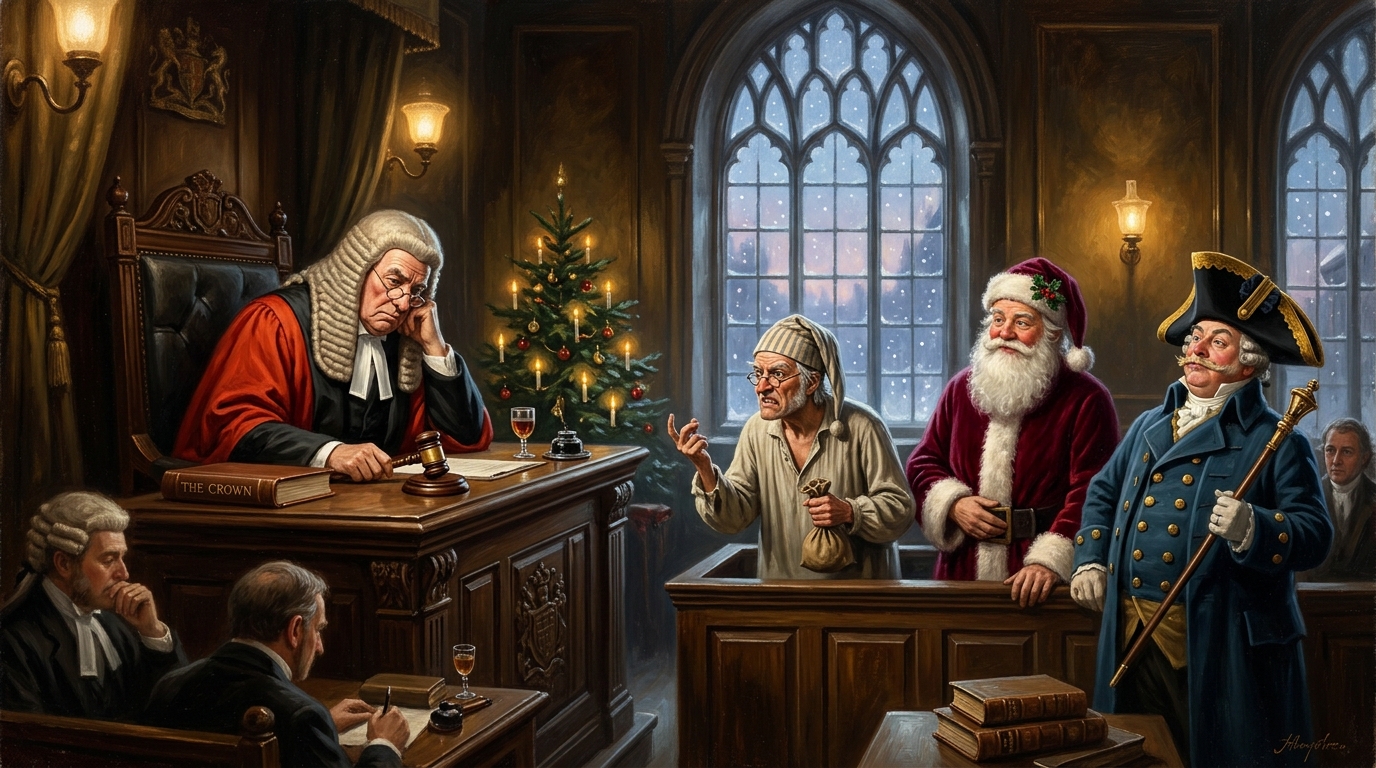
First Degree Humbuggery: The Crown v. Ebenezer Scrooge
Judge Ponsonby-Snoot had presided over murder trials, fraud trials, tax trials and in one famous occasion, a trial involving a Morris dancer and an inflatable sheep.
Yet nothing had prepared him for Christmas 2026, when a committee somewhere deep inside Government finally decided that festive literature required "re-evaluation."
The first casualty was Ebenezer Scrooge.
The old gentleman shuffled into court looking exactly as a man named Ebenezer Scrooge should look.
The prosecutor rose.
"Mr Scrooge, is it true that on Christmas Eve you approached a group of children?"
"Unfortunately."
"And spoke to them?"
"Regrettably."
"And wished them to go away?"
"Passionately."
The prosecutor smiled. "So you specifically sought to separate yourself from children."
"Only those that were singing."
"Ah." Scrooge blinked.
The prosecutor turned to the jury. "You hear that? Only those that were singing." The jury looked impressed, as though some dark secret had been revealed.
A small carol singer took the stand. "What happened?"
"We sang."
"Then?"
"He came outside."
The prosecutor leaned forward dramatically. "Then?"
"He told us to stop."
Gasps echoed around the courtroom. One woman fainted straight into a tray of mince pies. Scrooge threw up his hands.
"For Heaven's sake, they were murdering Good King Wenceslas."
Judge Ponsonby-Snoot frowned. "That does not give you the right to criticise artistic expression, Mr Scrooge."
"It certainly should."
After a week of evidence the jury concluded that Scrooge was not a menace to children but was unquestionably guilty of First Degree Humbuggery.
His punishment involved attending twenty school nativity plays. The sentence was later described by human rights lawyers as "possibly cruel and unusual."
The Midnight Intruder: The Crown v. Father Christmas
The second trial attracted global attention.
Father Christmas himself sat in the witness box. The prosecutor adjusted his tie.
"Now then, Mr Claus. You maintain a list of children?"
"Yes."
"You monitor their behaviour?"
"Yes."
"You know when they're sleeping."
"Technically."
"You know when they're awake."
"Also technically."
The prosecutor turned to the jury. "I shall let those facts speak for themselves."
Santa sighed. "They've been speaking for themselves for two hundred years."
The questioning continued.
"You enter houses after midnight?"
"Yes."
"Without ringing the bell?"
"Usually."
"You proceed directly toward children's rooms?"
"To leave presents."
"Nudge, nudge."
"Not nudge, nudge," Santa replied. "Presents."
"You carry a large sack?"
"Of toys."
"A likely story."
At this point Mrs Claus shouted from the public gallery. "He's been married to me for ninety years, you idiot."
A ripple of laughter travelled around the court. The prosecutor pressed on.
"Is it also true that children leave refreshments for you?"
"Yes."
"So they actively encourage you to come?"
"That is generally how invitations work."
Several jurors reluctantly agreed. One elderly juror stood up. "If you jail Santa, who brings my whisky-filled chocolates?"
The court recorded this as a procedural interruption.
After two weeks the case collapsed completely because every supposed victim turned out to be delighted.
Judge Ponsonby-Snoot finally declared, "The court finds that while Mr Claus displays behaviour which would appear highly unusual in almost any other context, the evidence suggests he is in fact Santa Claus."
The gallery erupted in applause. The judge added hastily, "This finding should not be treated as a legal precedent."
Aggravated Pomposity: The Crown v. The Beadle
The final case involved the Beadle from Oliver Twist.
Newspapers had already convicted him a thousand times before the trial even began.
The prosecutor approached. "You spent much of your life around children."
"Correct."
"Often unsupervised."
"Sometimes."
"Making notes about them."
"Certainly."
The prosecutor paused. "Nudge, nudge."
The Beadle buried his face in his hands. "Oh, do grow up."
Oliver Twist himself appeared as a witness. The prosecutor smiled.
"Did the Beadle ever make you feel uncomfortable?"
"Constantly."
A buzz swept through the courtroom.
"In what way?"
Oliver shrugged. "He never stopped talking about himself."
The buzz evaporated.
Another witness recalled the Beadle spending twenty minutes describing the importance of his hat. A third claimed he once referred to himself as "a public servant of rare magnificence."
Judge Ponsonby-Snoot raised an eyebrow. "Did anybody agree?"
"No, my lord."
The jury started laughing.
At the end of the proceedings it became apparent that the Beadle's greatest vice was not wickedness but vanity. He possessed all the menace of an overcooked Christmas pudding.
The verdict was swift. Not guilty of all sinister allegations. Guilty of Aggravated Pomposity.
The Beadle looked relieved until sentencing. Judge Ponsonby-Snoot cleared his throat.
"For the next twelve months you are forbidden from announcing your title, polishing decorative buttons, admiring your reflection in shop windows or beginning any sentence with the words 'Do you know who I am?'"
The poor man nearly collapsed.
The Requisite Sherry: The Crown v. The Tooth Fairy
As the court emptied and snow drifted beyond the windows, the weary judge gathered his papers.
"A peculiar week," he muttered.
"Indeed, my lord," said his clerk.
The judge nodded. "We investigated a grumpy pensioner, interrogated Santa Claus and cross examined a Victorian blowhard."
"What have we learned?"
Ponsonby-Snoot glanced at the Christmas tree standing quietly in the corner. "Only that modern society can find innuendo in anything if it squints hard enough."
At that moment another file landed on his desk.
The title read:
THE CROWN versus THE TOOTH FAIRY.
The judge stared at it for several seconds.
Then he quietly reached for the sherry.