An Explanation of the Universe
On the Uncompromising Law of Impermanence, the Human Invention of Sin, the Evolutionary Purpose of Suffering, and the Cosmic Recycling of Consciousness.
“An Explanation of the Universe”
This essay was adapted into a driving, atmospheric industrial blues-rock anthem produced in collaboration between The Shady River Bard and Trevor Swistchew. Channeling raw electric distortion, contemplative blues cadences, and defiant spoken cadence, it gives sonic form to the realization that change is the only permanent.
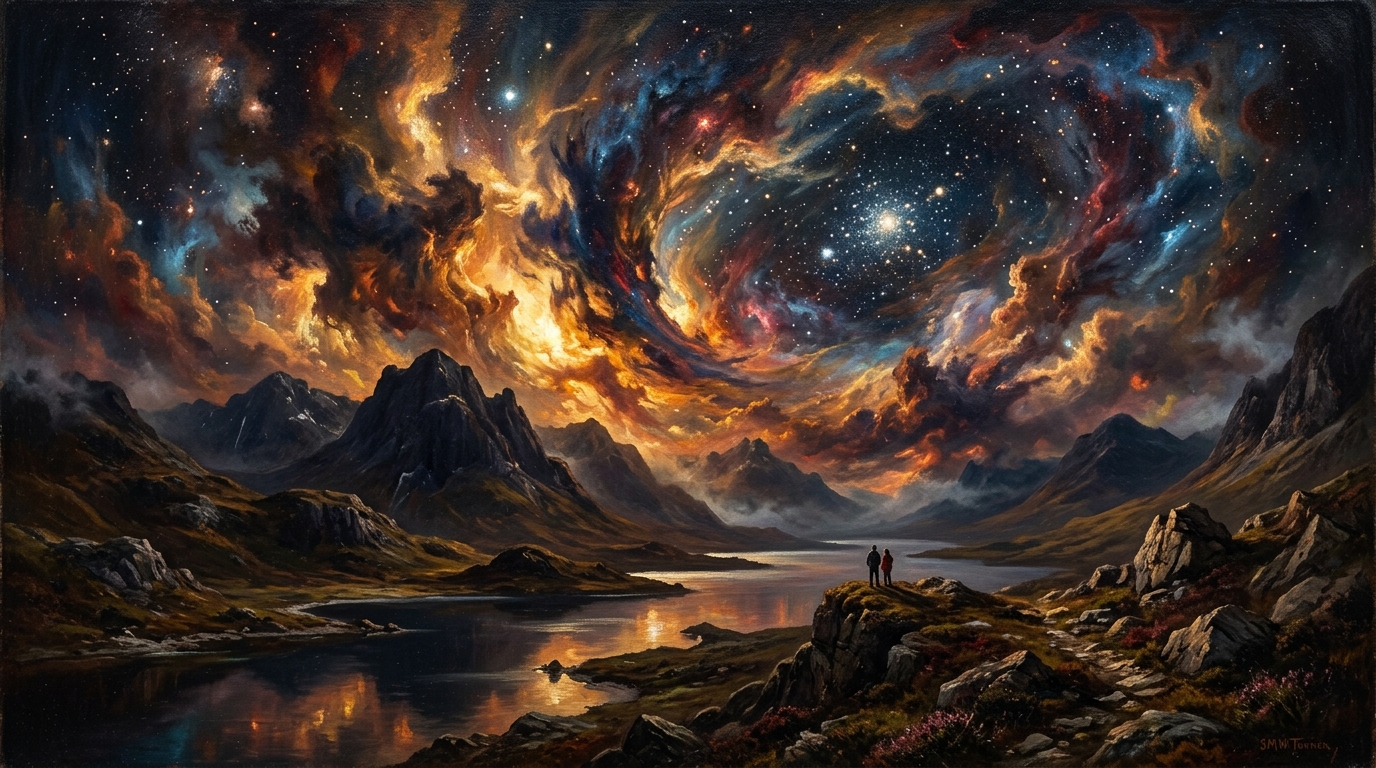
Physical Foundations: Impermanence, Feedback & Becoming
Scientific cross-examination: non-equilibrium thermodynamics, evolutionary neurobiology of pain, and anthropological sociology of religious prohibition.
The Physical Impossibility of Stasis
Swistchew argues that a static universe would collapse under its own stillness, unable to generate complexity or sustain consciousness. Modern astrophysics and non-equilibrium thermodynamics validate this thesis unequivocally:
The universe was never designed as a sanctuary of comfort, perfection, or painless harmony. If anything, its architecture reveals a single uncompromising truth: the only permanent is change. Everything else—life, death, matter, consciousness, morality, suffering—exists as expressions of that one underlying law. A static universe would collapse under its own stillness, unable to evolve, unable to produce complexity, unable to generate anything resembling life. Change is not an accident or a flaw; it is the engine that makes existence possible.
“Change is not an accident or a flaw; it is the engine that makes existence possible. The only permanent is change.”
Human beings, in their fear of chaos, invented rules. They invented sin. They invented moral categories to control one another, to regulate behaviour, to keep tribes from tearing themselves apart. Sin is not a divine decree; it is a human tool. If God exists, God does not dwell in the ledger of petty human taboos, in the neurotic policing of desire, or in the ancient scripts of retribution. Those are human anxieties dressed as sacred truths. If divinity has any meaning, it is the process itself: the unfolding of form, the dance of transformation, the ceaseless movement from one state to another.
Suffering, too, is misunderstood. We treat pain as an enemy, an error, a cosmic injustice. But pain is the nervous system of reality. It is the friction that alerts consciousness to its limits, the pressure that drives adaptation, the boundary that defines where the self ends and the world begins. Without pain, life would have no compass. It would drift into dissolution, unable to protect itself, unable to learn, unable to grow. To demand a life without suffering is to demand a world without depth, an existence without contour.
“Pain is the nervous system of reality. It is the friction that alerts consciousness to its limits, the pressure that drives adaptation.”
Death is not the termination of existence; it is its recycling. The carbon in our bones was forged in the furnaces of collapsing stars. The water in our blood has cycled through oceans, clouds, and ancient beasts. We do not stand apart from the cosmos, peering in through a window; we are the cosmos experiencing itself in finite form for a fleeting interval. When that form dissolves, nothing is lost. The energy disperses, the matter reorganises, the dance continues.
To live well in such a universe requires neither resignation nor despair. It requires surrender to the truth: that you are temporary, that your certainties are fragile, that your suffering has purpose, and that your death is not an end but a return. Once you accept that change is the only constant, the need for comforting illusions falls away. What remains is awe, clarity, and the quiet dignity of taking part in a process far greater than yourself.
The Universal Synthesis
“Once you accept that change is the only constant, the need for comforting illusions falls away. What remains is awe, clarity, and the quiet dignity of taking part in a process far greater than yourself.”