Compendium
Compendium #73 Philosophical Inquiry • Epistemology Consciousness • Existential Wonder 2026 Archive

Trevor Swistchew • 2026

A Cause For Hope

On the Shedding of Borrowed Dogmas, the Honesty of the Unknown, and the Discovery of Wonder.

TS
Trevor Swistchew Scottish Essayist, Cultural Critic & Philosophical Inquirer
~3 min read 415 words Philosophical Meditation
A Cause For Hope Fine Art Oil Painting
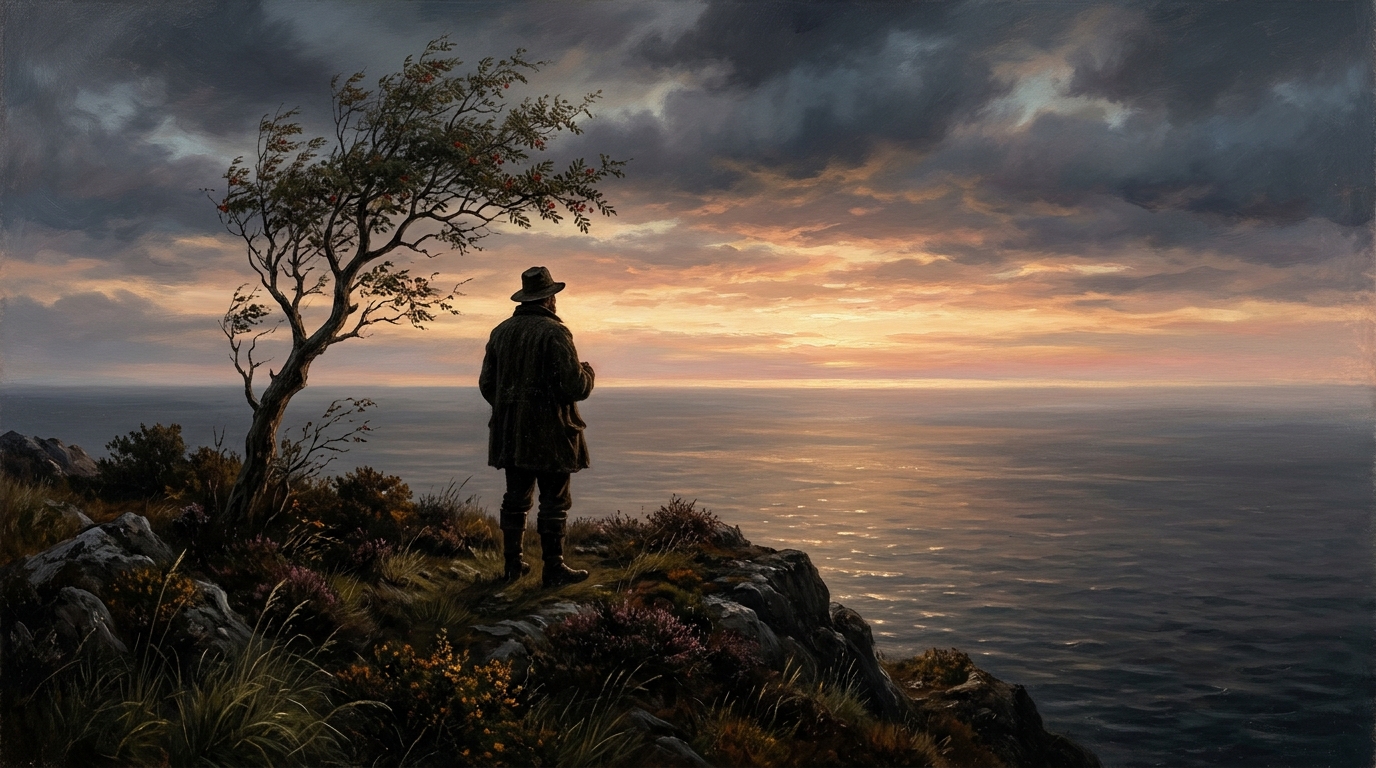
The Horizon of Wonder: A sublime fine-art chiaroscuro oil painting in the tradition of Caspar David Friedrich and J.M.W. Turner, depicting a solitary wanderer on a rugged coastal headland at dawn, looking across an open sea beneath parting clouds as the first golden rays of light illuminate the morning mist.
“

“He saw that not knowing was not a failure. It was honesty. For the first time in his life, he was not pretending certainty. He was no longer repeating the conclusions of others. He stood before existence as a blank canvas, empty of borrowed narratives ready to see what was actually there. And in that emptiness he discovered a quiet freedom.”

— Trevor Swistchew, ‘A Cause For Hope’ (2026)
Philosophical Ledger • The Stages of Intellectual Awakening
Inherited Dogma
Borrowed Belief

Belief absorbed unquestioned in youth from tradition, authority, and habit; accepted as natural landscape until subjected to direct inquiry.

The Great Collapse
Unsettling Void

The disorienting chill of standing beneath a vast sky without ready-made answers; old maps proving unreliable when held up to reality.

Honest Emptiness
The Blank Canvas

Recognizing that not-knowing is not deficiency but truth; stepping away from pretension to perceive what is actually present.

Gentle Wonder
Living Hope

Stars still shine, kindness still warms, life remains a living mystery; stepping into the future without certainty, but with enduring hope.

Philosophical Dossier • Meditations on Hope
The Conditioning of Borrowed Certainty

Human beings are born into linguistic, cultural, and spiritual architectures that precede them. We inherit narratives of purpose, origin, and righteousness before our critical faculties awaken. For most of existence, we confuse familiarity with truth, relying upon authority and habit as substitutes for genuine understanding.

Trevor Swistchew notes that setting these aside requires neither rebellion nor anger, but quiet honesty: asking ourselves what we truly know, and finding the courage to admit when the cupboard of certainty is bare.

For most of his life, he believed.

He believed because others believed. The ideas had been given to him when he was young long before he knew how to question them. They became part of the landscape of his mind as familiar as the sky or the passing of the seasons.

Then something changed.

As the years passed, he began to look more closely at the things he had always accepted. Quietly, honestly, he asked himself what he truly knew. The answers surprised him.

One by one, the old certainties fell away.

He realized that much of what he called belief had not come from direct understanding at all. It had come from tradition, authority, and habit. He did not condemn those things, but he could no longer rest in them. They no longer satisfied the deep hunger within him for truth.

The discovery was unsettling.

For a time he felt like a stranger in the world. The familiar map that had guided him for years no longer seemed reliable. What once felt solid now appeared uncertain. He felt the chill of standing alone beneath a vast sky without ready-made answers.

Yet something unexpected happened.

As the old stories faded, a space opened inside him.

He saw that not knowing was not a failure. It was honesty.

For the first time in his life, he was not pretending certainty. He was no longer repeating the conclusions of others. He stood before existence as a blank canvas, empty of borrowed narratives ready to see what was actually there.

And in that emptiness he discovered a quiet freedom.

The stars still shone. The wind still moved through the trees. Kindness still mattered. Love still warmed the heart. Beauty still appeared in unexpected places. Life itself remained a mystery, but now it was a living mystery rather than a second-hand answer.

He began to understand that truth had nothing to fear from questions.

The unknown was no longer an enemy. It became a doorway.

As he walked forward, he carried no grand conclusions, only humility and wonder. He did not know where the path would lead, but for the first time the journey itself felt real.

And so he stepped into the future with open eyes.

Not with certainty.

Not with belief.

But with something gentler and perhaps more valuable.

Hope.