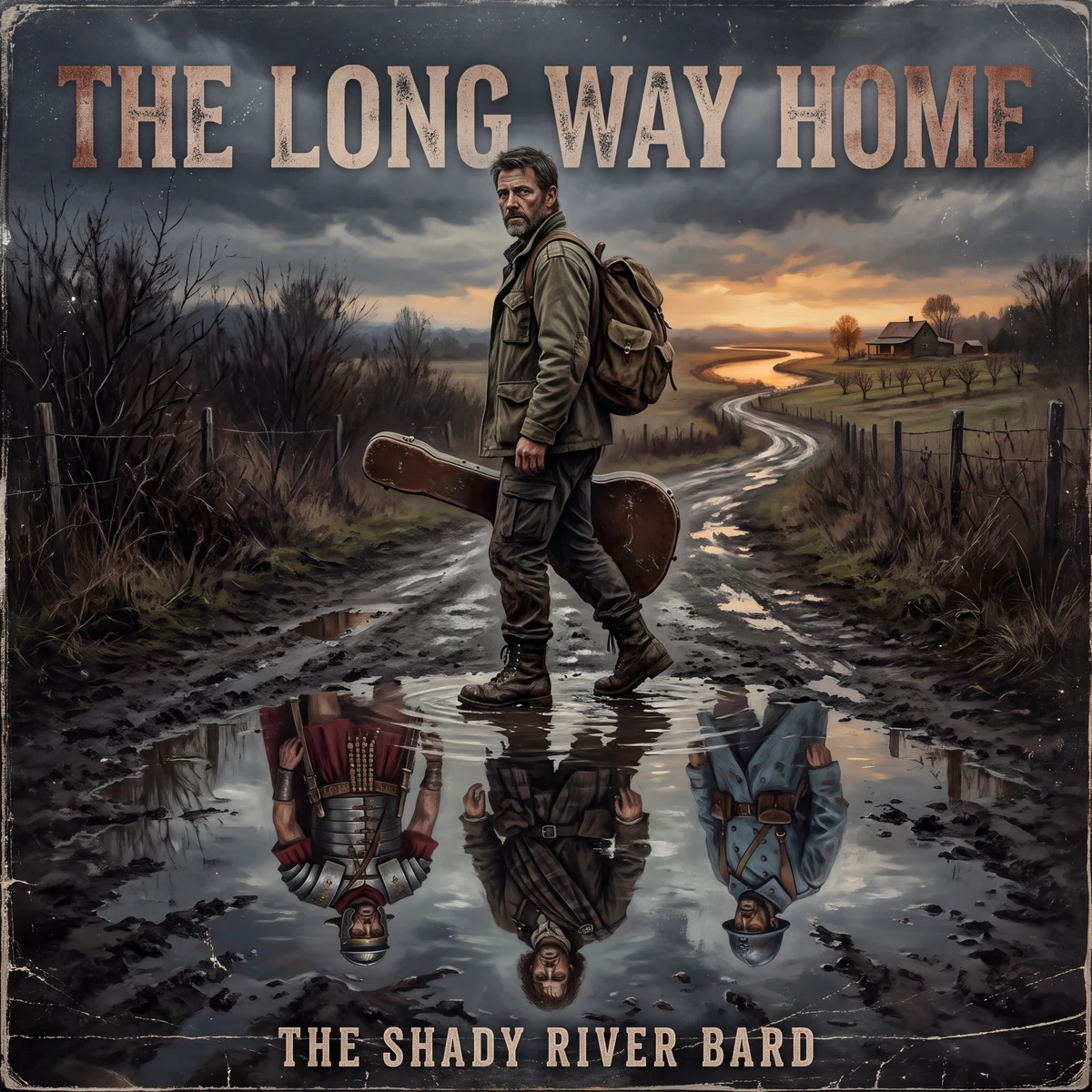
The Long Way Home cover art: A lone weary soldier walking down a muddy rural road toward a distant farmhouse at dusk
Design In Place • Pre-Production

Working Folder: XX - The Long Road Home • Cover Title: The Long Way Home

Studio Incubator Architectural Blueprint • No Songs Recorded Yet

THE LONG WAY HOME

A Thousand Marching Boots, One Quiet Road

Where The Balance Sheet of Outrage (Album 12) examined the machinery, profiteering, and industrial architecture of war, The Long Way Home turns the lens entirely onto the human aftermath: the quiet, agonizing war that begins the moment the shooting stops.

Rather than confining this story to a single modern conflict, the album follows an Archetypal Eternal Soldier—the exact same man, with the same weary eyes and calloused hands, recurring across two millennia of history and multiple nations. He is not a science-fiction time traveler; he is the perennial working-class citizen-soldier whom empires summon in moments of crisis and discard in moments of peace.

Across fourteen planned tracks, we walk beside him as a Roman legionnaire retiring from Hadrian’s Wall (122 AD), a Scottish Highlander returning to a cleared glen (1746/1815), a barefoot farm boy walking down the Appomattox Pike (1865), a French poilu emerging from Verdun into a Paris café (1919), a Scottish Black Watch veteran coming home to Clydeside ration lines and stoic silence (1946), a British jungle fighter returning from Malaya and Korea (1954), an American rifleman frozen under the fluorescent lights of a suburban big-box store after Fallujah (2008), the last flesh-and-blood infantryman walking away from an automated battlefield on Lithium Ridge, and finally, an elder trading the sword for cedar posts and heavy clay along the river’s bend.

14
Planned Tracks
4 Acts
Narrative Arc
122 AD – Future
2,000-Year Span
Spartan Folk
Sonic Palette
Section I // Clinical, Historical & Anthropological Foundation

Why the War Begins When the Shooting Stops

To understand the Eternal Soldier’s two-thousand-year journey, the album draws upon two landmark clinical and anthropological frameworks—paired with the core civic ethos of The Shady River Bard.

01 // CLINICAL PSYCHIATRY

Moral Injury vs. PTSD

Dr. Jonathan Shay • Achilles in Vietnam & Odysseus in America

While PTSD is fundamentally a fear-based physiological imprint triggered by mortal danger, Moral Injury is a wound to the soul caused by the betrayal of what’s right—either by someone in legitimate authority in a high-stakes situation, or by one’s own actions under orders.

Shay demonstrated that Homer’s Odyssey is the oldest surviving clinical map of veteran reintegration: Odysseus loses his men not at the walls of Troy, but on the ten-year voyage home—through the “Lotus-Eaters” (numbing addiction), the “Sirens” (the intoxicating pull of nostalgic war stories), and the slaughter in his own courtyard (the inability to turn off lethal hypervigilance in civilian spaces).

Anchored in Tracks 02, 04, 05, 10 & 11
02 // ANTHROPOLOGY OF BELONGING

The Loss of the Platoon Tribe

Sebastian Junger • Tribe: On Homecoming and Belonging

Humans evolved to live in small, interdependent bands of 30 to 50 people where every person’s survival depends on the person beside them. War accidentally recreates that ancient evolutionary tribe inside the platoon, fireteam, or Roman testudo shield wall.

When the soldier returns to a modern, atomized, consumerist suburb—where neighbors retreat behind automatic garage doors and life is reduced to solitary transactions under buzzing fluorescent lights—the psychological drop from supreme collective purpose to total social irrelevance is devastating. The returning veteran is the canary in the coal mine showing that consumer culture has broken the human village.

Anchored in Tracks 03, 07, 08 & 10
03 // THE SHADY RIVER BARD THESIS

Stepping Off the Imperial Highway

From the Roman Wedge to Swords into Plowshares

The division between civilian and veteran—like the broader political and economic divisions fracturing modern society—is not an accident. Empires and ruling classes have always known how to forge working people into a unified tribe when they need them to bleed, and have always fractured, isolated, and pacified them with spectacles (“bread and circuses” in Rome, shopping malls and partisan outrage today) when they come home.

Healing the Moral Injury requires stepping off the imperial highway altogether: breaking the stoic isolation at the family table, rebuilding genuine community, and turning the discipline of the sword into the stewardship of the living earth.

Resolved in Act IV (Tracks 12, 13 & 14)
Section II // Five Sociological & Psychological Pillars

Interactive Thematic Analysis (Facets A–E)

Select any thematic facet below to inspect its historical causes, manifestations across eras, dramatic outcomes, and philosophical implications.

Thematic Element Core Causes Key Historical Manifestations Dramatic Outcomes & Implications
A. The Eternal Return & Historical Moral Injury Betrayal of the warrior’s moral code by imperial/state self-interest; forced violation of conscience under orders. Roman legionnaires returning to decadent spectacle; Highlanders returning to cleared glens; WWI poilus watching profiteers celebrate. Spiritual dislocation; permanent alienation from civilian values; recognition that empires exploit working-class loyalty.
B. The Loss of the Platoon Tribe vs. Civilian Isolation Abrupt transition from evolutionary small-unit interdependence in combat to hyper-individualistic consumer society. Aching nostalgia for the brotherhood of the shield wall or fireteam; sensory paralysis in banal suburban shopping malls. Existential loneliness; inability to relate to trivial civilian concerns; withdrawal, numbing, and social exile.
C. Performative Gratitude & Bureaucratic Betrayal State desire to celebrate war cheaply in public while minimizing financial and moral accountability in private. Broken Roman praemia militiae land promises; 1932 Bonus March; modern “Thank you for your service” platitudes paired with VA delays. Silencing of authentic veteran testimony; institutional betrayal; deepening cynicism and despair.
D. The Stoic Silence & The Intergenerational Ghost Cultural demand that returning soldiers suppress trauma to preserve peacetime comfort and industrial productivity. Post-WWII Scottish/British and Cold War silence; clenched jaws, night terrors, and unspoken rules against asking about the war. Secondary trauma passed to wives and children; emotional distance at home; multi-generational haunting.
E. Swords into Plowshares (Agrarian & Craft Reintegration) Innate human need to redirect martial discipline and mission focus into tangible, life-giving creation and community stewardship. Returning to the soil, planting orchards, woodworking, and sharing honest storytelling outside state systems. Restoration of moral agency; healing of the nervous system; transformation of the warrior into the community steward.
Section III // Complete 4-Act Narrative Architecture

The 14-Track Song Roadmap

Every song is vocal-driven narrative storytelling (no pure instrumentals) featuring the exact same protagonist across two thousand years. Filter by Act or click any track to inspect its historical setting, instrumentation, vocal profile, and narrative progression.

Showing all 14 tracks in blueprint
# • Working Title & Era Facets
Section IV // Musical Genre, Sonic Palette & Vocal Design

“Spartan Folk” & Somber Americana Blueprint

Extremely disciplined, minimalist arrangements that feel “buttoned-up” on the surface while barely holding back an undercurrent of emotional chaos—gradually giving way in Act IV to the warm resonance of living wood and open vocal harmonies.

Core Instrumentation & Signature Sounds
  • The Spartan Folk Spine: Military snare drums played softly with wire brushes (a persistent, ghosted cadence echoing marching boots and a racing pulse) paired with close-mic’d fingerpicked acoustic guitars.
  • Weeping Harmonica Bugle: In place of brass bugles, melodies of mourning and recall (such as the fractured French Aux Morts in Track 05) are played on a distorted, weeping diatonic harmonica.
  • Signature Cello / Guitar Duels: Sparse, dignified interplay between a single fingerpicked acoustic guitar and a solemn, sustained cello acting as the voice of the soldier’s unspoken grief.
  • Era-Specific Accents: Detuned modal banjo (1865 Appomattox Pike), subtle Highland bagpipe/fiddle drone overtones (Scottish Clearances & Clydeside), gritty electric swells (2008 suburban supermarket), and cold industrial pulses (Lithium Ridge).
Five Vocal Profiles Across Two Millennia
1. The Weathered Historian Lead
Serious, weathered, heartfelt male baritone singing with the sad wisdom of a historian watching a tragedy repeat itself (Tracks 01, 02, 06, 12, 14).
2. The Rich Southern Baritone
Deep, resonant Southern male baritone—calm, rich, and commanding for rural American & homestead chapters (Tracks 04, 09, 13).
3. The Soaring High-Tenor
Clean, soaring high-tenor lead with immense range for moments of breaking-point anguish (Tracks 05, 10, 11).
4. The Alt-Rock Delivery
Smooth, rhythmic alt-rock male lead, earnest and crisp, for post-Malaya dockside apathy and modern suburban paralysis (Tracks 07, 08).
5. Powerhouse / Ethereal Female Duets
Giving voice to the wives, mothers, and ghosts waiting on the other side of the threshold (Tracks 03, 06, 11, 12).